
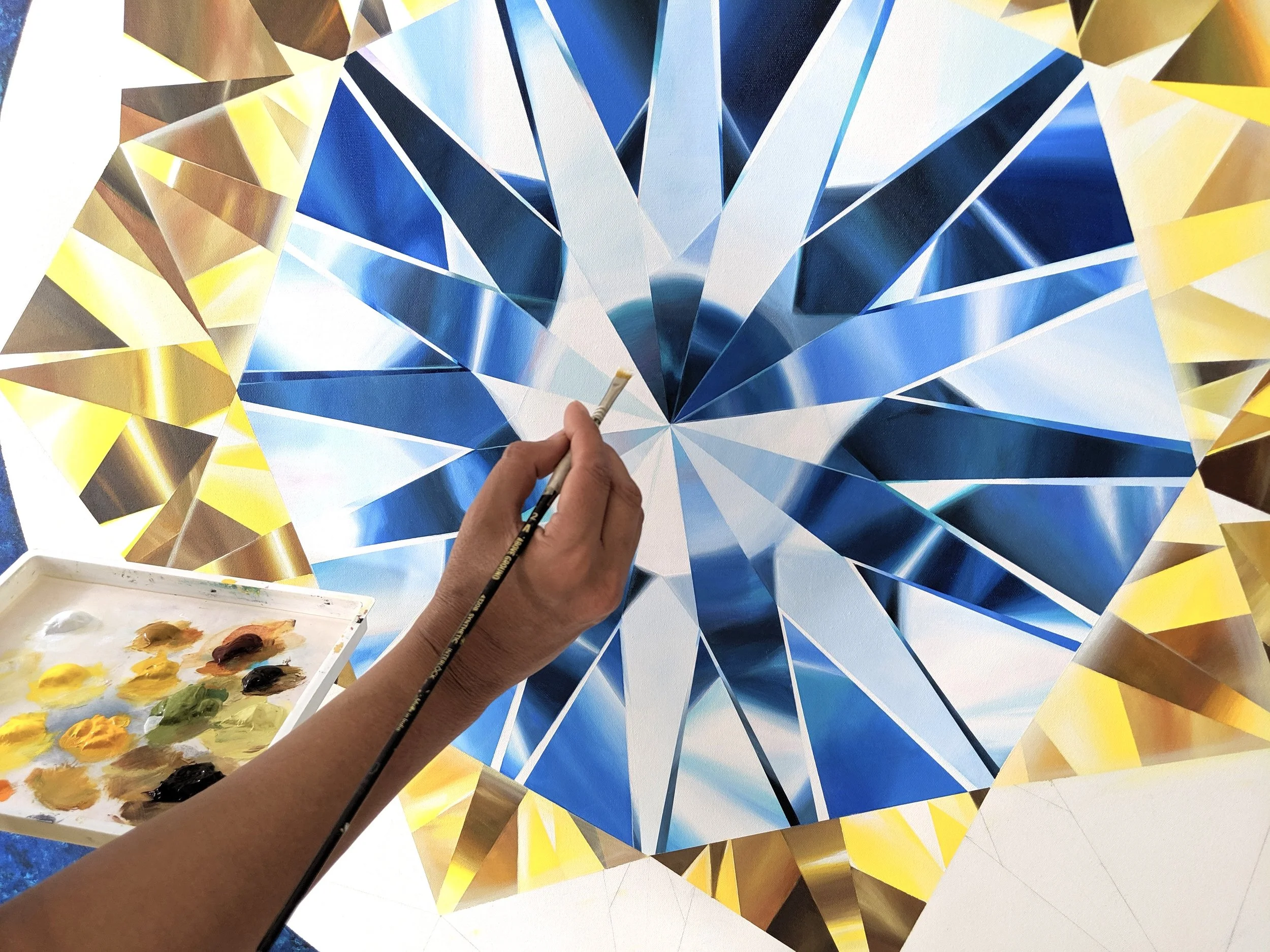
Veteran journalist Rob Bates invited visual artist Reena Ahluwalia to his Five Questions series on The Jewelry Wire to discuss her visual art practice. Moving beyond commercial conventions, the conversation examines the conceptual core of her work — the Human-Gem Arc and how she utilizes monumental painting and sculptural jewelry as mediums to explore human resilience, transformation, and identity.
Attribution: Video originally published and featured on Rob Bates' Substack: https://thejewelrywire.substack.com/p/the-latest-on-the-de-beers-sale
Interview Chapters
00:00 - Introduction by Rob Bates
01:23 - Visual Art Practice: Paintings, Writing, and Wearable Sculpture
03:10 - Monumental Fine Art Canvases and the Human-Gem Arc
04:10 - Exploring Meaning in Form and The Diamond Trails Project
05:51 - Gemstones as a Philosophical Prism for Resilience, Transformation and Identity
07:00 - Historic milestones and Legislative Mace of Ontario
08:22 - Early life to global recognition
10:23 - Commodity vs. wearable art
12:15 - Cross-Pollination: Merging Art and Moving Towards Cultural Relevance
14:46 - Beyond Studio Life
16:40 - Closing & Journalistic Rigor
Full Interview Transcript:
Rob Bates: Hey, everybody. It's Rob, founder and editor of The Jewelry Wire, and it's time for another edition of Five Questions, an innovative concept where we find somebody who's really interesting in the industry and ask them five questions. And I think you'll all agree that I have a very, very interesting person today, Reena Ahluwalia. She's a visual artist and painter based out of Canada who does work with jewelry and painting, and we'll talk a little bit about that. But first of all, how are you? You doing okay?
Reena Ahluwalia: I'm doing great, Rob, and it was great to see you at VicenzaOro at the CIBJO Congress, and it's great following you on Jewelry Wire, as everybody should.
Rob Bates: All right, great. Great start to this conversation. I like that. It's always good with a plug. Okay. So I think it's really interesting because, and I think there's, I know there's other people, but you do both painting and jewelry. And I'm just wondering, is there an overlap between them? Do you find them kind of similar skills and similar activities?
Reena Ahluwalia: Yeah, Rob, it's a very good question to lead this, our five questions. I am a visual artist. And what it means is that within my practice, within my art practice, I do paintings, I do writing, I do jewelry. So all of these sit under that roof. And you asked as to how they connect to each other. When I started off, I was painting, I was sculpting, and that's how I started my artistic journey. And then directly came into the diamond industry. But these two are mediums within my practice, and they inform each other. I'm really interested in the history of how humanity intersects with gemstones and how people wear jewelry to express themselves. What does it say to society? And all of these themes feed off each other. And they're very important to me because in jewelry, you're talking to people who want to wear it on their body. It's a very intimate form that we put on our bodies. And also in some ways it's market driven too. Sometimes you're making, although I make wearable sculpture, that's how I look at jewelry. Whereas painting is very artistic. It's away from all of that. It's my self-expression. And how do I look at diamonds, gemstones, and the human condition. So it's a larger dialogue that I'm very interested in. That's what I'm really focusing on.
Rob Bates: Okay. So you want to talk a little bit about things that you're working on right now?
Reena Ahluwalia: At the moment in my studio, and we're in my studio, one of the corners here. I'm really focusing on these monumental fine art paintings and a concept I call the Human-Gem Arc. So it's how humanity intersects with gems. Gemstones take billions of years to form. It's we as humans who have collided in that trajectory. We are in the gemstones timeline, not the other way. But I find that fascinating because gemstones in many ways, there are many parallels. I talk about human resilience and human spirit. And some of these conditions are what the Human-Gem Arc is. So I'm doing that, and continuing on that.
Rob Bates: Okay. And you have some things to show?
Reena Ahluwalia: Well, let's show you. I have a piece of jewelry here.
Rob Bates: And what's that made out of?
Reena Ahluwalia: These are gemstones and diamond ring. And the concept is very simple.
Rob Bates: I like the fact that it spins. It's kind of cool.
Reena Ahluwalia: Whichever way the world moves, you have to focus on your inner brilliance. And that's what it simply says.
Rob Bates: It's like a fidget spinner. Like a fidget spinner in a ring.
Reena Ahluwalia: Yeah. And it has a pointer too, that points to the true center. Just a small reminder to center yourself, to center and focus on things that are important to you, your family, love, nature, life, community. So this is just a little reminder. People can take it in any way, but this is what my thought process was behind that. There is one painting right here. This was from the Diamond Trails Project. And I don't know if you can see.
Rob Bates: That's beautiful.
Reena Ahluwalia: And this is a story written by Grant Mobley of The Diamond Collective. However, in 2024, when I started the Diamond Trails Project, I formed a Diamond Trails Collective. And the whole idea was to co-create and also away from any external influences. Can we tell stories that are more authentic, that are away from the marketing playbooks, and let's merge literature and art together.
Rob Bates: And are most of your paintings about jewelry? Because, I mean, I've seen a lot of your diamond paintings. I've seen a lot of your jewelry paintings.
Reena Ahluwalia: I would say my paintings are more... How I approach that is, I look at gemstone through a philosophical prism, how it reflects the human condition, how it can show human resilience. That's my main focus, along with transformation and identity. So gemstones become one of the vehicles, a prism that shows all these different facets of our lives, our journeys. And so it is not as much of showing jewelry, but it's more about how light enters and reflects back. We have seen even 9/11, what happened? People came together, they stood up. There was a human resilience, a spirit, a shining spirit. And some of those are very interesting ideas that I want to capture in my art.
Rob Bates: And you've worked for a lot of, or I should say you've done work for a lot of trade associations. I know you had something with CIBJO, and want to talk a little bit about that?
Reena Ahluwalia: Yeah, so I think for both jewelry and paintings, both of these have been running parallel within my visual art practice. In jewelry, I've worked with amazing people. I've been very fortunate to have worked with miners like De Beers, Rio Tinto, and Greenland Ruby. I had the great privilege of being invited by the Legislature of Ontario when De Beers found their first diamond from the Victor Mine to place it in the historic Mace of Ontario. Now the parliament cannot proceed without that Mace entering. And that diamond is very critical and pivotal to that. Then I had another opportunity where my sculptural jewelry was placed on a Belgian postage stamp to celebrate the world of diamonds. And so many such things. And of course, GJEPC one year back inducted me into the Hall of Fame, and I'm very grateful.
Rob Bates: Oh, cool, cool. All right. Do you want to talk a little bit about how you got into the business?
Reena Ahluwalia: Absolutely. That's a great topic.
Rob Bates: I mean, were you always into art? Were you what they call an artsy child?
Reena Ahluwalia: Yes, very much an artsy child. Always painting, always sketching, always building things. I grew up in India and there were things around. It's such a fascinating country. We didn't have so many toys and things and gadgets at that point. There were sticks outside, random stuff. And I would always be putting them together into some kind of story or form. I was interested in that. I went to India's top art and design school, and right after that I directly came into the diamond industry. That was one of the very first professionally trained designers to enter the diamond industry. The whole idea for me was very simple, at that time as a young artist, I was trying to figure out, for me jewelry is an art form. It's wearable art. And when you put it on your body, what does it say about self? What does not only a self-image, but what does it communicate to others? What is that transformation that happens in between? So that was a little bit of an idea and I entered. And right after that, there were some major turning points. I had won the De Beers Diamonds International Award and then many subsequent international awards and recognitions, and that really helped me focus on my artistic voice. I thought that jewelry for me was a little bit away from commoditized, commercial things. It was more wearable art, a marker of identity. And I guess that's the philosophy that I've carried, and it has shown me a path and journey ahead.
Rob Bates: Cool. So I know you talk to a lot of people in the market. What's hot right now? Are you starting to see a recovery as far as natural diamonds? What are you noticing and what are you hearing?
Reena Ahluwalia: What I'm hearing is, it really depends on what market segment you're looking at. But if you're looking at mass market, commercial jewelry, there's a battle of promotions and price and these kind of very tight margins. So the activity is there, but I feel there's a lack of differentiation. There's so many factors. How do you differentiate a product? But at the same time, if you look at the higher-end value cultural side of the market, the story is quite different. Collectors are looking for provenance. They're looking for concept. They're looking at jewelry more as wearable art. And it's a very resilient market. I see that. I work in that market. I know firsthand how people respond to that. And I think overall, I hear from people and I feel it myself that there's this kind of general tiredness with generic luxury. If it's expensive, if it's diamonds, why do I buy that? So the whole idea of why is it desirable to me? How does it connect to who I am today? So the market isn't disappearing. That's the good news. As long as humanity exists, jewelry will exist. It's just that we need to be more careful as to how we tell our stories, really.
Rob Bates: And do you think there's opportunity for more kind of cross-pollination between the art and jewelry world? Because I think people look at art as something that's worthy of study and things like that. And I think jewelry is starting to be perceived that way, but it has not historically been perceived that way. I'm wondering if you've noticed that change and if you are starting to see more kind of interest between the two worlds.
Reena Ahluwalia: Not from the trade, but from the public. There are these two different ways of looking at it. If we have conversations within the industry, there is a certain marketing way to go about it. I'm not saying if it's good, great, bad, any of that, but there is a certain pattern. Irrespective of how many changes happen, there is a similar pattern that you can recognize. However, if you look at—
Rob Bates: As far as the marketing or the—
Reena Ahluwalia: The marketing outreach. We say, well, we need to co-create, but who's co-creating? When I founded the Diamond Trails project, that was the first time I challenged journalists to write flash fiction, analysts to write that. That's something different, but they had to challenge me to come up with a compelling piece of art with that. But what I see is that if you look at the overall market, there are people—I'm tired of Gen Z, millennial, all that talk. Yes, we have all generations and we'll have many more generations ahead. But we have to look at the overall market. There are people who are 55 years old, 65 years old. They are buying really high-value jewelry. And people connect with cinema. They connect with music, they connect with dance, they connect with art in a very visceral way. It's very emotional. And if you combine all of those things in the way you talk about diamonds, you remove the commodity curse that comes with selling a piece of jewelry. You elevate that experience because now you connect to people from where they are at, the culture on the move.
Rob Bates: Okay, great. And then I guess the final question, question number five, what do you like to do when you're not painting or making jewelry?
Reena Ahluwalia: Wow, that's great. Definitely, as I said, I spend a lot of my time in the studio painting and creating jewelry and writing. But when I get a chance and when I'm completely away from the studio, I love nature. I like hiking. I do gardening. And a couple of years back, I found these neglected neighborhood corners. So I would go and plant pollinator gardens. And it's doing very well. Besides that, just to unwind, I watch true crime and psychological thrillers.
Rob Bates: That unwinds you? Because that doesn't make you tense or no?
Reena Ahluwalia: No, I love it. Just give me a gritty—
Rob Bates: Any true crime that's like your favorite?
Reena Ahluwalia: Well, I love Dexter.
Rob Bates: That's not true, but yeah.
Reena Ahluwalia: That's not true, but just crime dramas and things like that. I watched Shutter Island once again, Inception. But I also do these self-studies. I've been doing it for over a decade or more than that. I give myself some topics. It doesn't need to be jewelry, first of all, it doesn't need to be jewelry. And just deep dive into it, like ocean ecosystems, astrophysics topics, stellar evolution, just to explore how the stars form these minerals that make us part of the cosmos. All these are very interesting. Then I travel, I'm nomadic, and I like the sense of discovery.
Rob Bates: Okay, so can you drop a little astrophysics on us?
Reena Ahluwalia: Oh, my God. Let me leave it to the experts.
Rob Bates: Okay. All right. Well, thank you very much, Reena Ahluwalia. If people want to get a hold of you, how can they do it? Where's your website?
Reena Ahluwalia: www.reenaahluwalia.com. Or you can find me on social media, on LinkedIn or Instagram.
Rob Bates: Okay. We'll link to all that when we post this. Thank you so much. You're always lovely company.
Reena Ahluwalia: Thank you, Rob. And I have to say something. I've been reading you for, I don't even know how long, every single article. And I really want to say that I really appreciate the journalistic rigor that you bring. We need more of that. We need more people to question and also challenge people. This is the time. We need more of it. So thank you very much for that. It's much appreciated.
Rob Bates: Well, thank you very much for saying that. I'm kind of blushing a little bit. But I appreciate it. Thank you so much.
Reena Ahluwalia: Thank you, Rob. Bye.
About Rob Bates
Rob Bates is the founder of TheJewelryWire.com and has written about the jewelry industry for three decades, with the last 25 years spent at JCK and JCKonline. His work has received 12 industry and editorial awards. He is the author of three mystery novels set in the Diamond District: A Murder is Forever, Murder is Not a Girl's Best Friend, and Slay It With a Diamond, which was published in September 2023 by Camel Press.
