
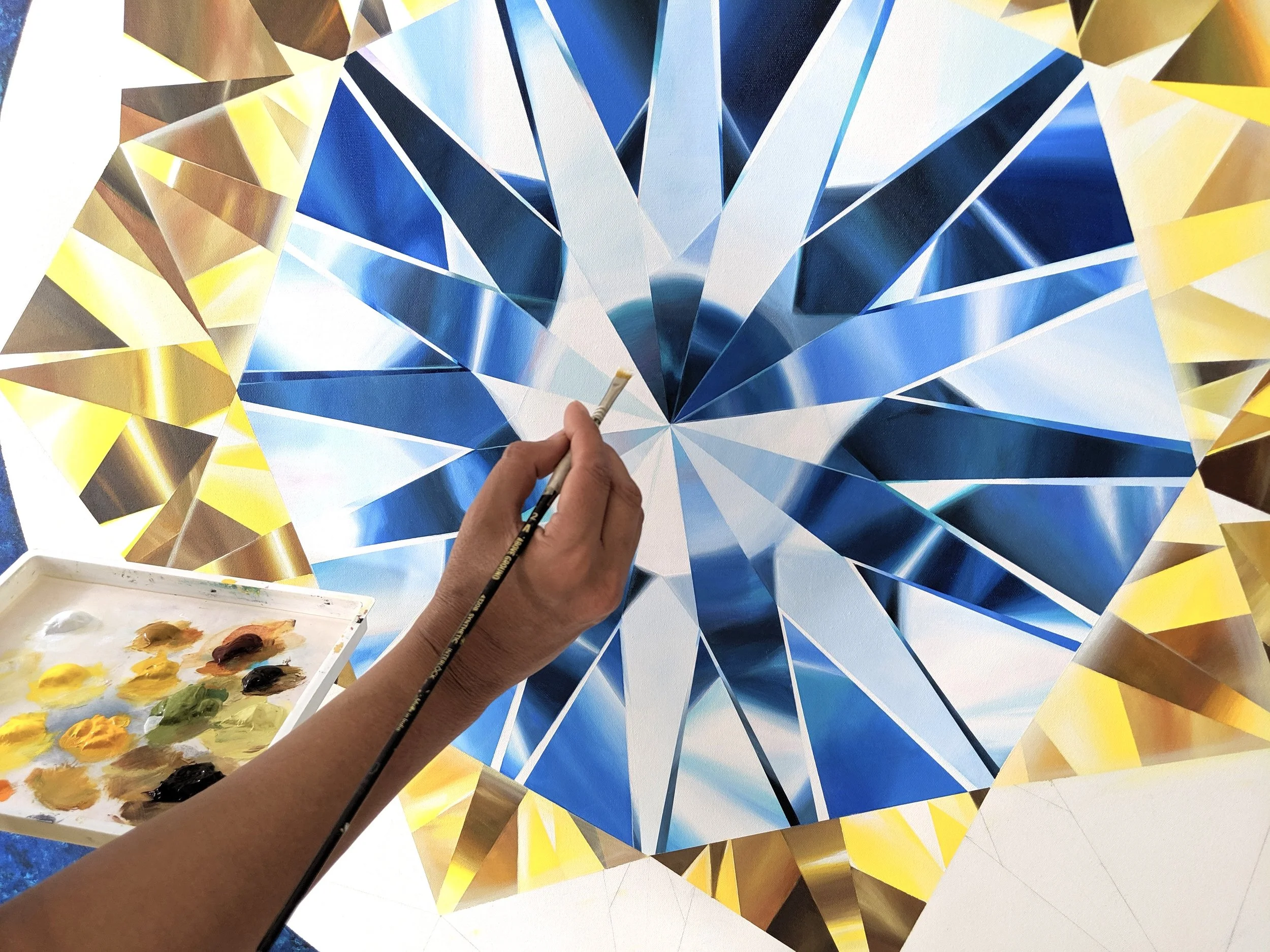
Visual Artist Reena Ahluwalia paints one of Earth’s rarest red diamonds for the permanent record at the National Museum of Natural History.
Visual Artist Reena Ahluwalia’s painting, “The Legacy of The Winston Red Diamond,” has been accessioned into the Smithsonian National Museum of Natural History. At a May 6 ceremony in the Janet Annenberg Hooker Hall of Geology, Gems, and Minerals, Dr. Gabriela Farfan, the Coralyn W. Whitney Curator of Gems and Minerals, accepted the painting. This is the first contemporary painting ever gifted to the National Gem Collection.
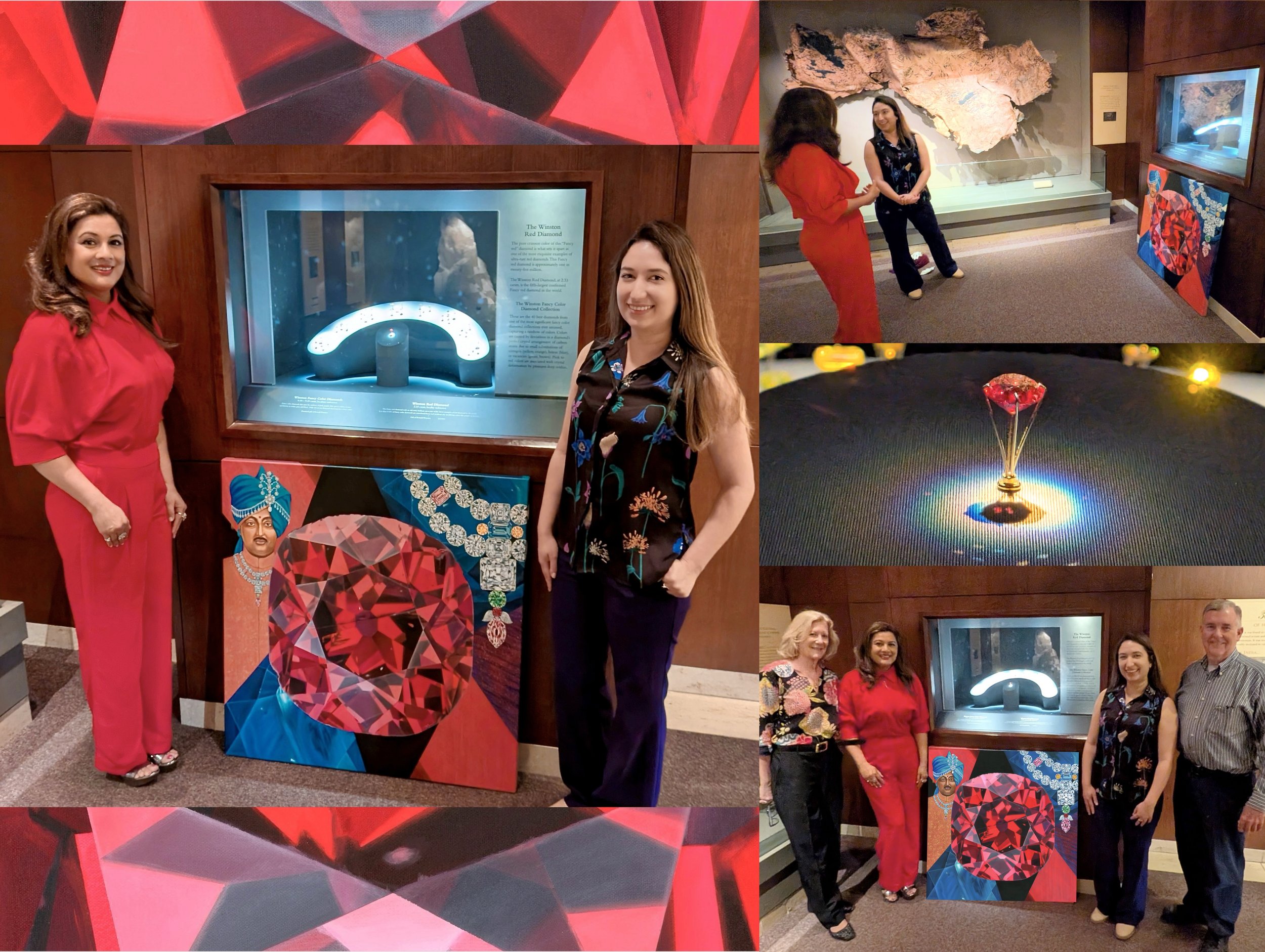
Visual Artist Reena Ahluwalia (left) with Dr. Gabriela Farfan, Coralyn W. Whitney Curator of Gems and Minerals (right), and the National Gem team at the Smithsonian National Museum of Natural History.
Ahluwalia’s artwork synthesizes the Winston Red’s scientific findings, historical significance, and cultural symbolism within a single canvas. The painting creates a visual bridge between the stone’s mineralogy and its place in human history.
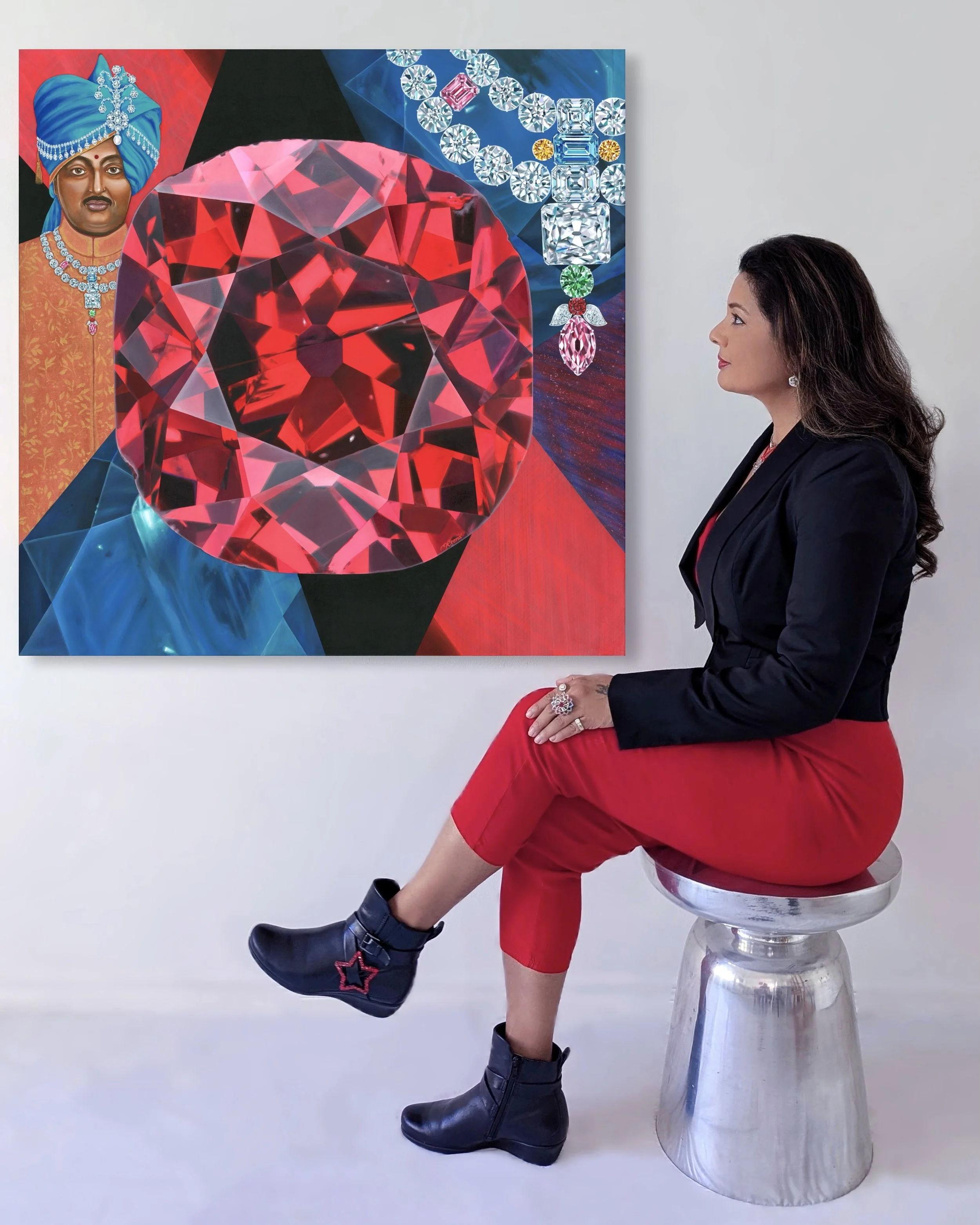
Visual Artist Reena Ahluwalia with her painting, “The Legacy of the Winston Red Diamond”. The painting invites viewers to reflect on the intersection of nature, science, and art - showing how a single diamond can become a vessel of memory, meaning, and awe. Image: Reena Ahluwalia.
The painting features the Winston Red Diamond, one of the world’s rarest diamonds. A 2.33-carat, pure Fancy red, old mine brilliant cut, it represents a one-in-25-million rarity. It is the 5th-largest of its kind known to exist and the only Fancy red diamond on public exhibit. In 2023, Ronald Winston, son of legendary jeweler Harry Winston, the “King of Diamonds”, gifted the diamond to the Smithsonian.
The composition traces the diamond’s journey from the “Raj Red” to the “Winston Red,” from its likely South American origins to Jacques Cartier’s 1938 sale to Digvijaysinhji, the Indian Maharaja of Nawanagar. Known as the “Good Maharaja,” he set the red diamond in his iconic Ceremonial Necklace of Nawanagar, a Cartier masterpiece that later inspired the “Toussaint Necklace” recreation. The stone’s donor, Ronald Winston, purchased the diamond from the Maharaja of Jamnagar in the late 1980s.
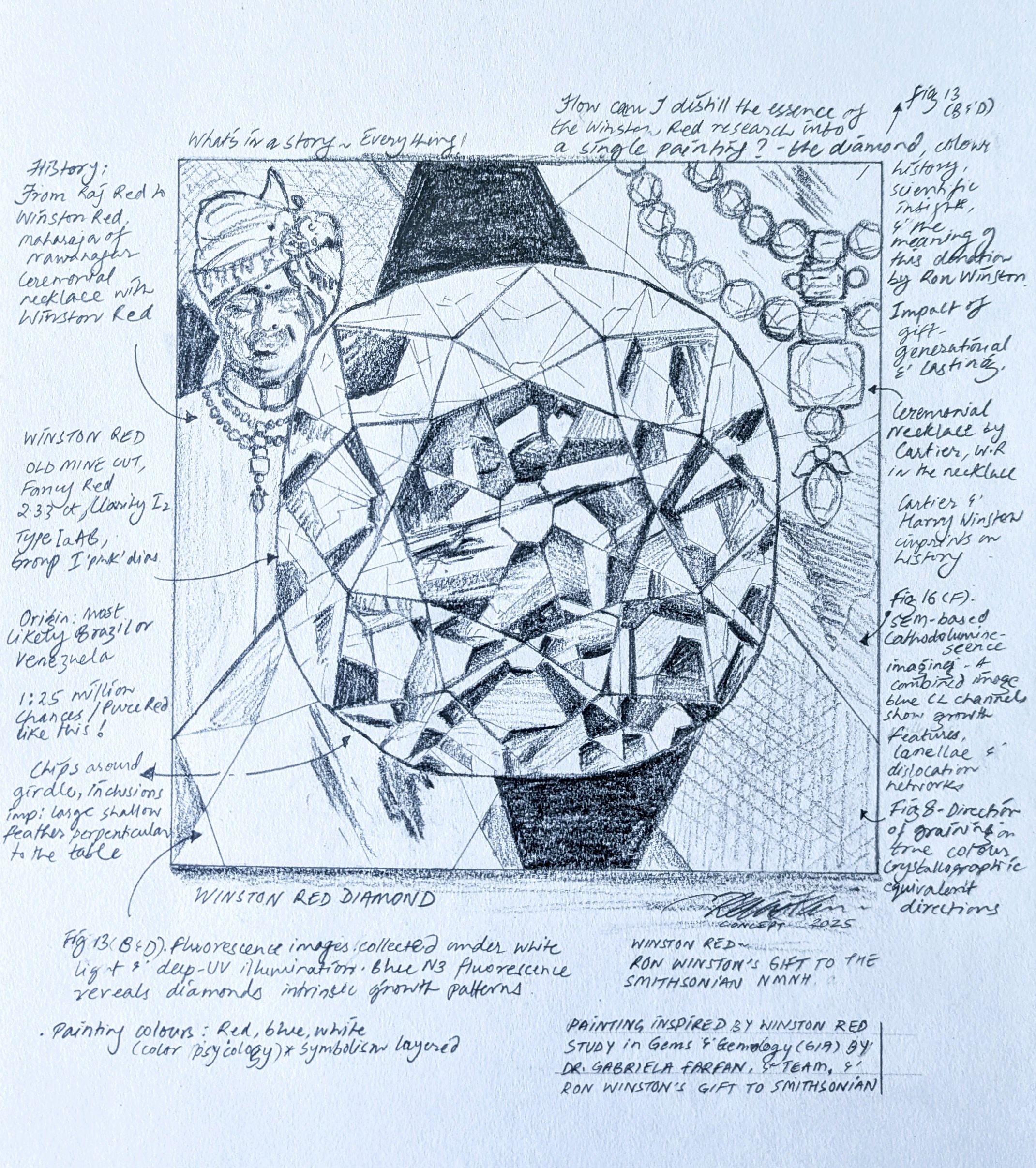
A hand-drawn STUDY from the archive of Visual Artist Reena Ahluwalia. The artist uses the diamond as a philosophical prism to distill scientific, historical, and symbolic narratives into a singular conceptual framework. Image copyright: Reena Ahluwalia.
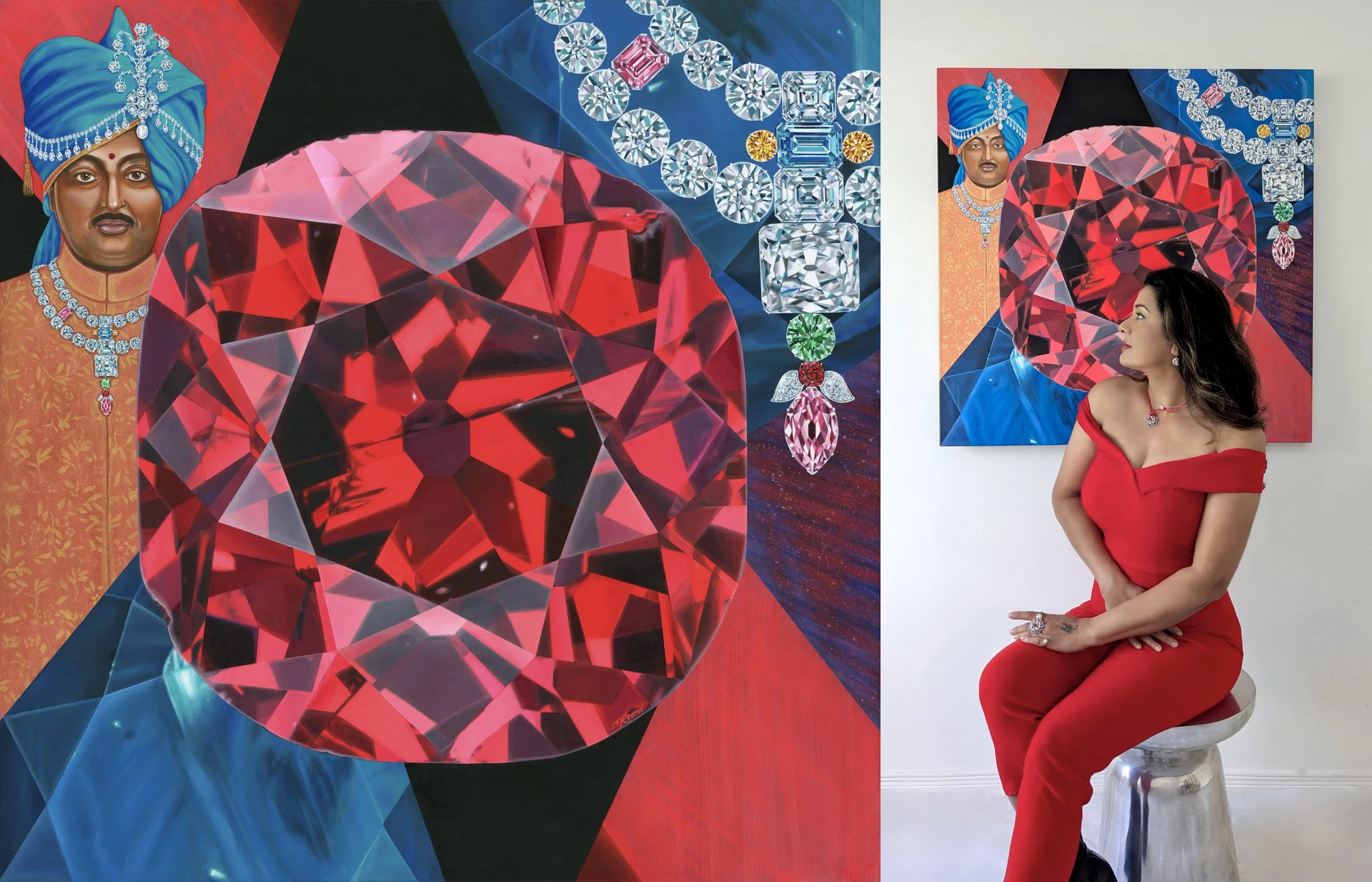
“The Legacy of the Winston Red Diamond” by visual artist Reena Ahluwalia. The artwork synthesizes Winston Red’s scientific findings, historical significance, and cultural symbolism within a single canvas. Image: Reena Ahluwalia.
The artwork is an artistic enquiry inspired by Ronald Winston’s gift and the study authored by Dr. Gabriela A. Farfan and team, published in the Gemological Institute of America (GIA) Gems & Gemology, Spring 2025. The Winston Red owes its pure crimson color to a balance of absorption features: the 550 nm band associated with plastic deformation and nitrogen-related defects. Through precise color and form, Ahluwalia translates these mineralogical markers into a unified composition.

Visual artist Reena Ahluwalia’s Winston Red Diamond painting captures three crystallographically equivalent graining directions on a facet in true colors. The work integrates DiamondView Deep-UV Fluorescence Imaging—collected under white light and deep-UV illumination—using the distribution of blue N3 fluorescence to reveal the diamond’s intrinsic growth pattern. Combined with SEM-based cathodoluminescence (CL) imaging channels, the visual mapping exposes specific growth features, lamellae, and internal dislocation networks. Image: Reena Ahluwalia.
“Art endures beyond its physical form as an idea whose meaning transcends time. I chose to paint the Winston Red because I felt a responsibility to tell its whole story through an artistic lens. Using the diamond as a philosophical prism, my practice treats minerals as analogues for human resilience — formed under pressure, shaped by circumstance, and resilient through adversity.” ~ Reena Ahluwalia
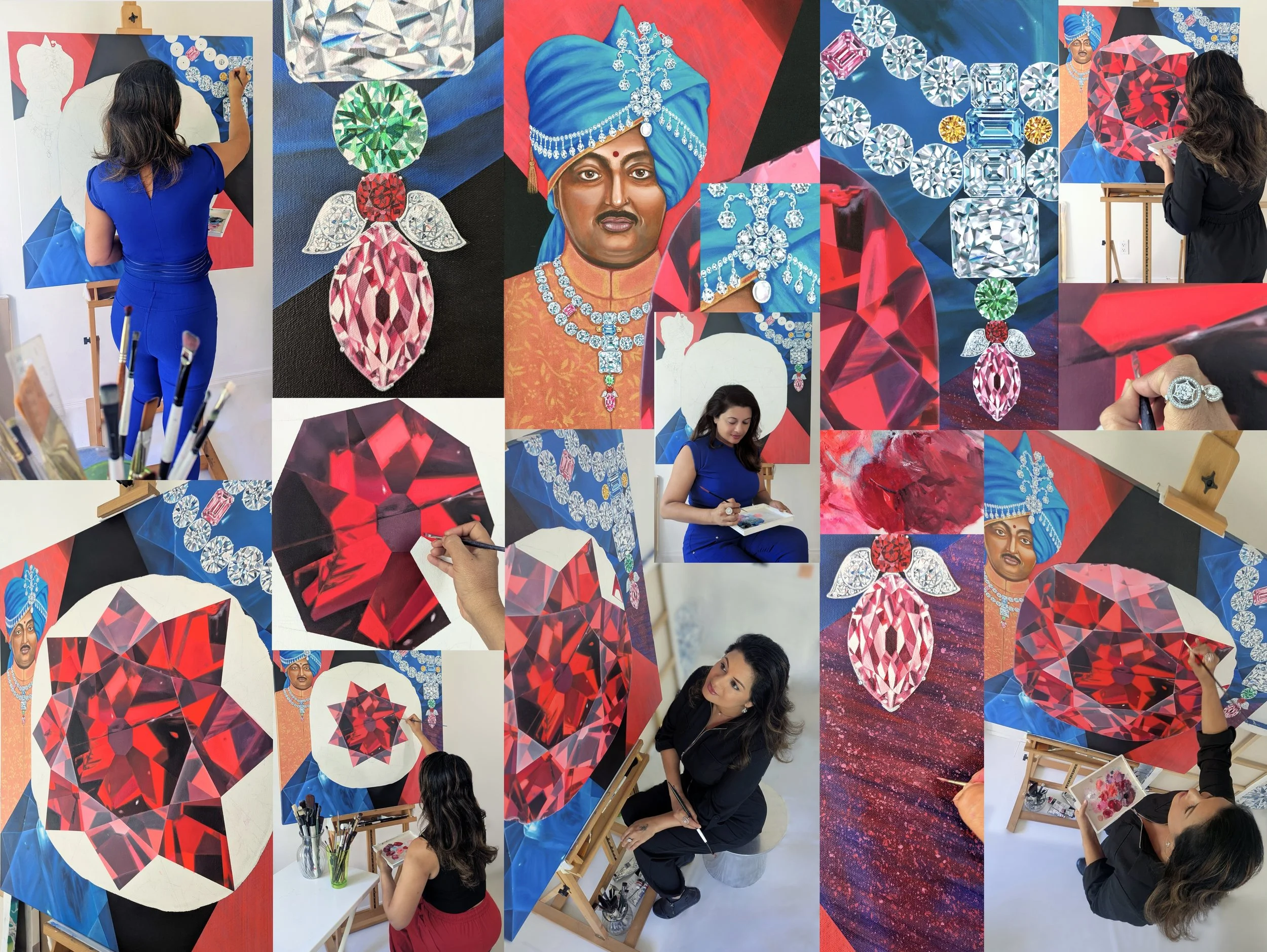
Visual Artist Reena Ahluwalia captures the science, history, and symbolism of the Winston Red Diamond. The painting chronicles the gem’s journey from "Raj Red" to "Winston Red”—framing the diamond as a parallel between geological endurance and human resilience. Image: Reena Ahluwalia
Ahluwalia maintained dialogue with both Ronald Winston and Dr. Gabriela Farfan throughout her artistic process. The resulting artwork intersects nature, science, and art, framing the diamond as a vessel of cultural and geological memory.
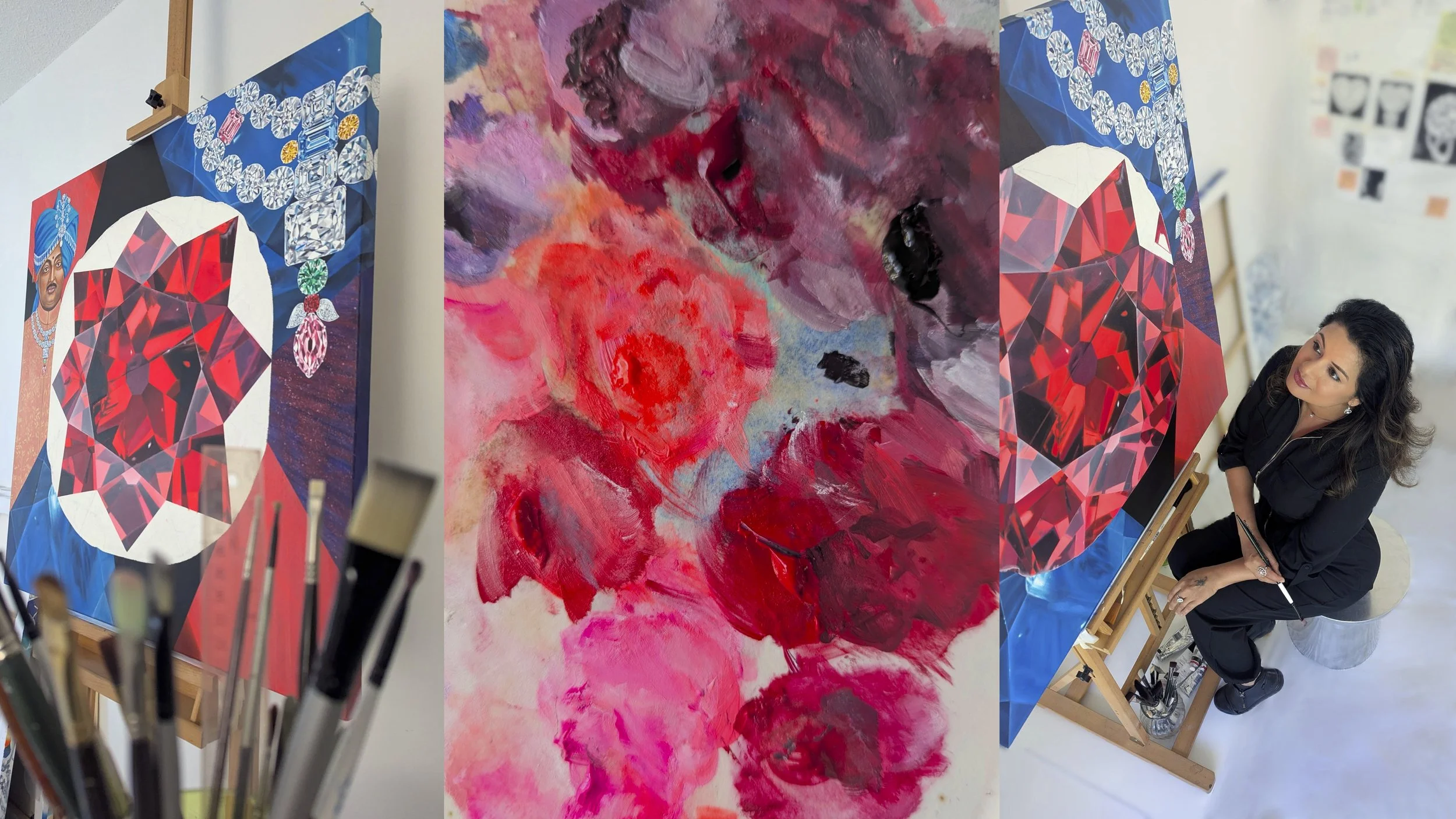
“Ultimately, this painting serves the diamond's history and legacy,” Ahluwalia concludes. “When art serves a larger purpose, its impact becomes as enduring as the diamond itself. It is my way of preserving the intangible heritage of the Winston Red Diamond for future generations. I want it to spark curiosity and inspire the next generation — from gem lovers and historians to mineralogists and Earth scientists.”
Within Ahluwalia's Human-Gem Arc, the work is a conceptual study of endurance, turning geological pressure into a visual statement of resilience.
