
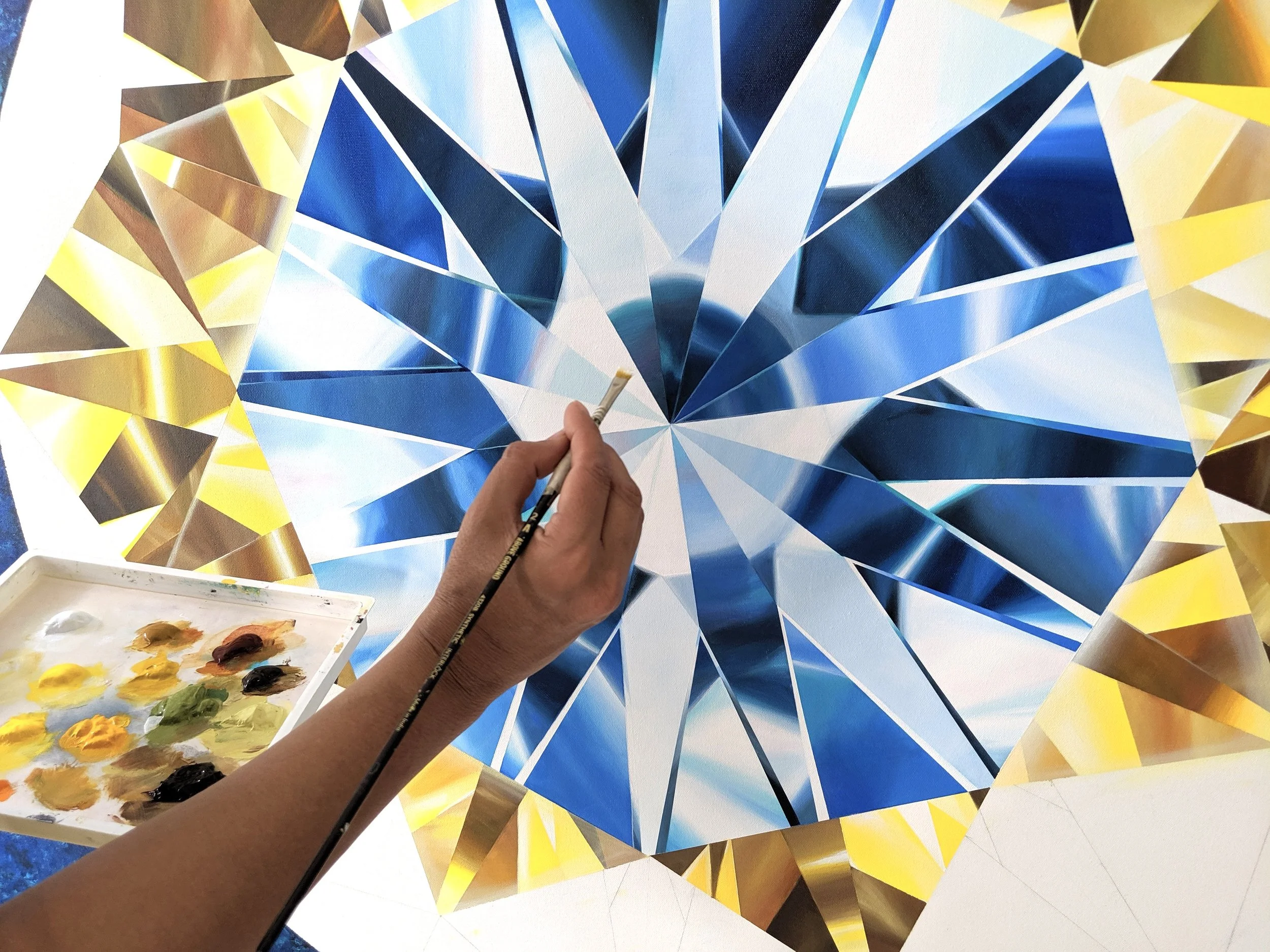

Rapaport discusses jewelry design and relevant diamond industry topics with designer Reena Ahluwalia. The profile can be seen at the news section.
Diamonds.net at http://www.diamonds.net/News/NewsItem.aspx?ArticleID=46253

Reena Ahluwalia recognized as Top 25 "Masters of Jewellery Design in Canada"

Book Cover. Masters of Jewellery Design in Canada. Vol. 2: Contemporary Artists by author Cora Golden.
"It's a great privilege to be recognized as a Master Canadian Jewellery Designer. I am delighted at this recognition of my ongoing journey of creating meaningful jewelry with narratives that promote socially-conscious values."
-- Reena Ahluwalia
November, 2013. Toronto — The first-ever books about fine jewellery in Canada highlight a talented group of designers who have won every major international award, and have earned prestigious jewellery commissions from people ranging from Pope John II to Uma Thurman. The two-volume, 50-year retrospective on jewellery in Canada was written and produced by Cora Golden, who also co-authored the award-winning book, Design in Canada. Produced in collaboration with Birks, Masters of Jewellery Design in Canada (Volume 1 and 2) include over 450 photographs of rarely seen Canadian-designed jewellery. Together, they provide a fascinating glimpse into the lives of the makers of the most beautiful objects in the world.
Volume 1: Post-War Pioneers profiles 25 early designers and ateliers.
Volume 2: Contemporary Artists features 25 current designers; many of whom were trained or influenced by the previous generation. Worldly and peripatetic, John de Jong caters to upscale clients across Europe and North America; while Reena Ahluwalia, also of Toronto, often uses Canadian diamonds in her extravagant creations.
Masters of Jewellery Design in Canada (Volume 1 and Volume 2) are now available on Apple iTunes for purchase. Don't forget to get your copy!
https://itunes.apple.com/ca/book/masters-jewellery-design-in/id727835668?mt=11
https://itunes.apple.com/ca/book/masters-jewellery-design-in/id621630295?mt=11
Author Cora Golden: http://www.goldene-books.com/

Designer Reena Ahluwalia. Excerpt from Masters of Jewellery Design in Canada. Vol. 2.
Ode to Fall

“Every leaf speaks bliss to me, fluttering from the autumn tree” - Emily Brontë
I love the splendor and crispness of Fall! Do you as well?
My ‘Autumn’ creation was inspired by the golden, graceful falling dry leaves of Fall. The leaves of this necklace can be detached. Once separated, the leaves can be worn individually as pendants, necklaces and multiple brooches.
The ‘Autumn’ necklace won the National Design Award in Jewelry - ‘Swarnanjali’ by the World Gold Council and was my first design award ever.

Ode to Fall - 'Autumn' necklace by Reena Ahluwalia. 22 K yellow gold.
Canadian Jeweller Magazine's annual 'Excellence in Design Awards 2013'
Last week I had the privilege to once again judge the Canadian Jeweller Magazine's annual 'Excellence in Design Awards 2013' along with an esteemed panel of judges. Always a big supporter of Canadian talent. It was a true pleasure!
This was the first ever round of submissions and judging for the Awards of Excellence contest, launched by Canadian Jeweller Magazine this year. Winners for both competitions will be officially announced on November 16 at The Jewellers’ Ball.

From left to right: Linda Penwarden of Penwarden Fine Jewellery, Luxury Retail Executive Andrea Hopson, Paul Mcfarlane of Chanel Canada, award winning jewellery designer Reena Ahluwalia, and jewellery designer Lisanne Skeoch.
Tangents
“Today’s tangents will become tomorrow’s arcs, and unforeseen connections will tie up your loose ends in a way that will make you want to slap your head and holler at your accidental brilliance.” -- Chris Baty
Creativity. Ah, that splendid thing! Where does it happen?
I believe it happens not in the loops of circular thinking, but rather, on those magnificent tangents. That's were the real creative stuff lurks. Go off on a tangent, suspend judgement, and disrupt known patterns of thinking.
Go on! :-)

JNA Interview - Reena Ahluwalia
Jewellery News Asia features an interview with designer Reena Ahluwalia in their July 2013 Issue 347. Interview by Marie Feliciano, Editor, JNA.
About JNA Magazine: Jewellery News Asia is a leading monthly news magazine for the world's jewellery trade; diamond, pearl, gemstone and jewellery-making equipment and supplies sectors in Asia. Every month Jewellery News Asia features original reports by experienced journalists.
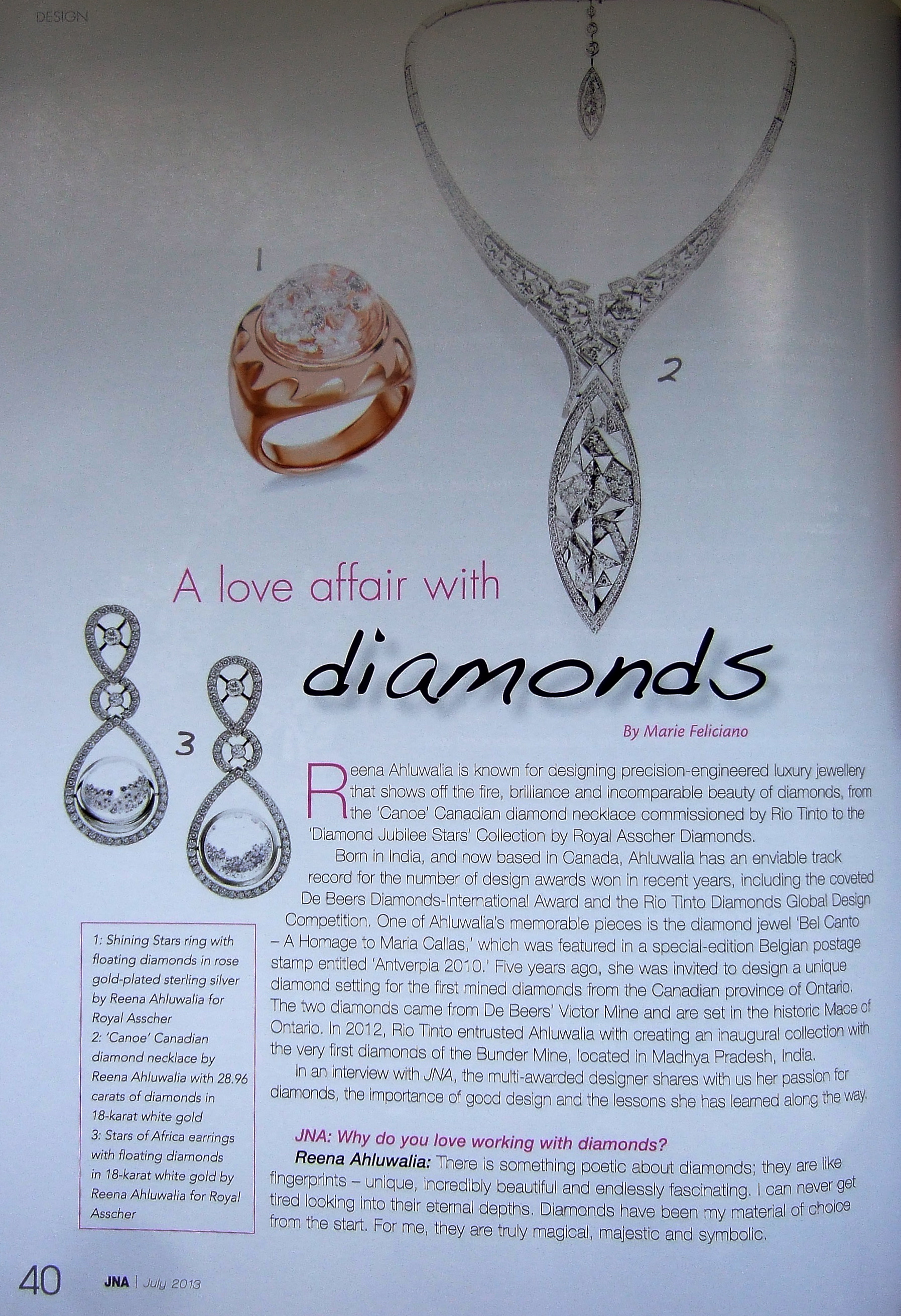
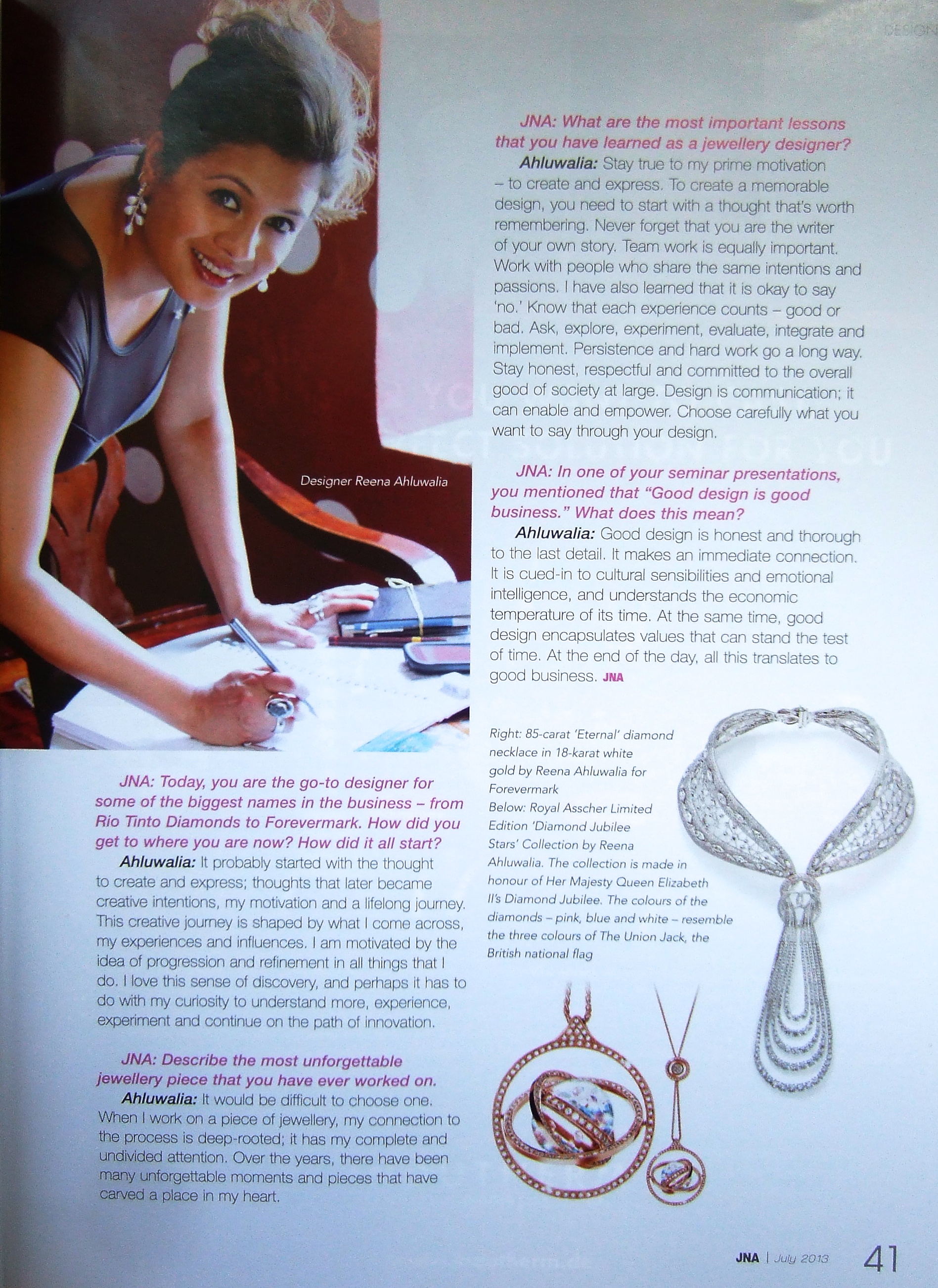
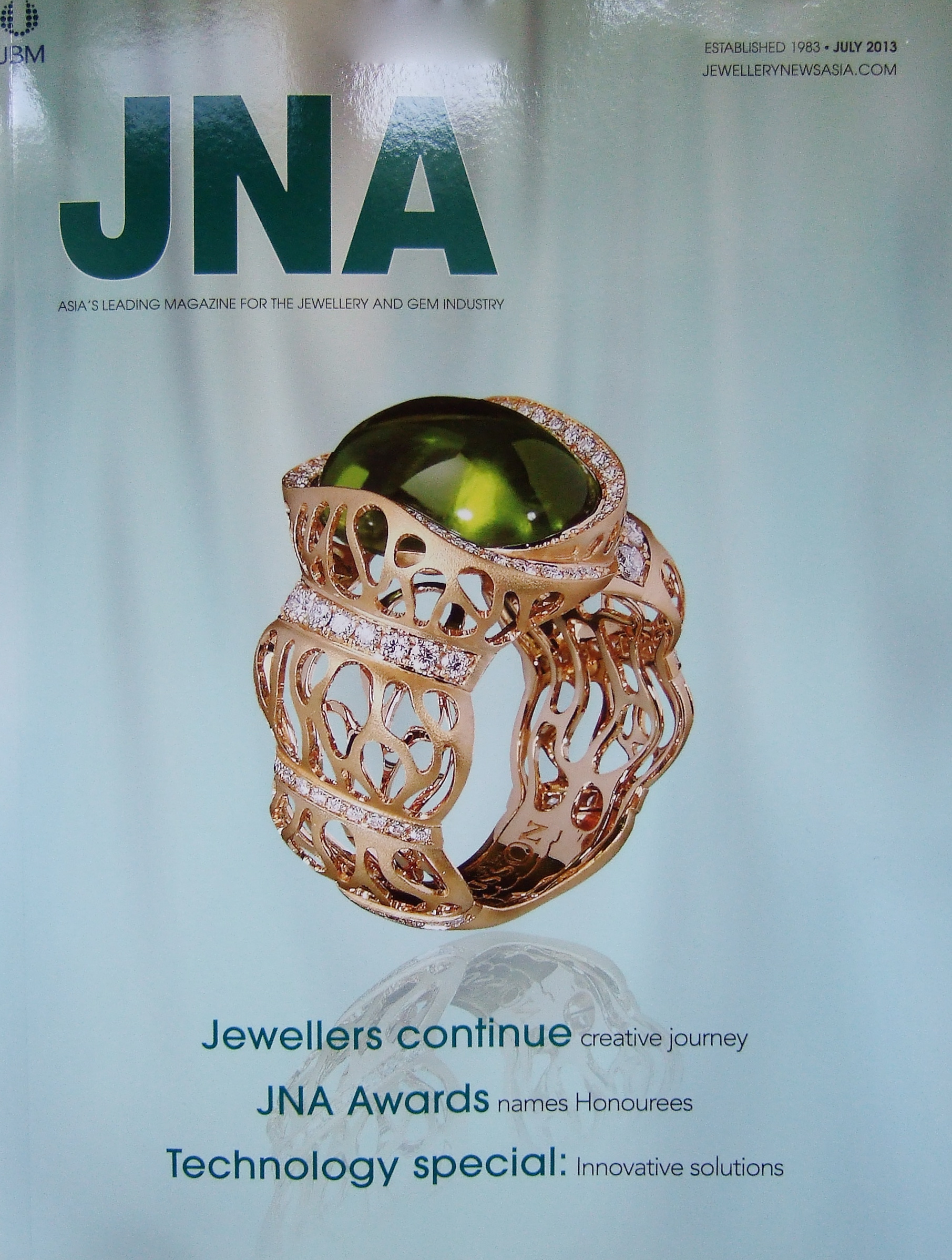
Cover - Jewellery News Asia, July 2013 Issue 347
LEGACY
Here's a special piece that I want to share with you, it's titled "Legacy".
LEGACY vintage-inspired platinum engagement ring by Reena Ahluwalia, takes it's inspiration from the fabled jewelry-vault of Royal Asscher from 1920s-1930s, conjuring the old Hollywood glamour and romanticism.
Marquise shape buds form the shank of the ring, center Royal Asscher Cut diamond represents a bloom with promise of new future and creation of lasting legacy together. Stylized and warmly organic!

Legacy engagement ring by Reena Ahluwalia for Royal Asscher Diamonds. Platinum. Royal Asscher cut, marquise cut and round diamonds.

Legacy engagement ring by Reena Ahluwalia for Royal Asscher Diamonds. Platinum. Royal Asscher cut, marquise cut and round diamonds.
Type IIa Diamonds
Type IIa diamonds are the most valued and the purest type of diamonds. They contain either very little or no nitrogen atoms in the crystal structure. White stones are exceptionally colorless and fancy colored diamonds are often found with a brown, purple, blue, or pink tone. They represent only 1% - 2% of all mined diamonds in the world.
What makes the Type IIa diamonds even more special is that they are “super-deep” diamonds. Most Type IIa diamonds originate from extreme depths in Earth’s mantle, a depth between 360 and 750 km. To put it in context, most diamonds are formed between 150 to 230 kilometers below the Earth's crust.
In the world of mined diamonds, Type IIa are so rare that they command a 5% to 15% premium, when they can be found.
One of the most well-known examples is the “Elizabeth Taylor Diamond” (formerly known as the “Krupp Diamond”), a 33.19-carat Type IIA diamond.
Purchased for $300,000 in 1968 by Richard Burton, the ring became one Elizabeth Taylor’s most cherished white diamonds; one she wore nearly every day. Of the ring, she once said, “[It] gives me the strangest feeling for beauty. With its sparks of red and white and blue and purple, and on and on, really, it sort of hums with its own beatific life.” The Asscher-cut diamond ring recently sold at auction for a whopping $8.8 million.
Other iconic historic Type IIa diamonds include the Cullinan, the Lesedi La Rona, the Koh-I-Noor, the Darya-I-Noor, the Archduke Joseph, the Regent, the Agra, The Star of the South, The Winston legacy and the Beau Sancy. Type IIa diamonds also have a famous historic connection with Golconda diamonds mined from the historic Kingdom of Golconda in India.
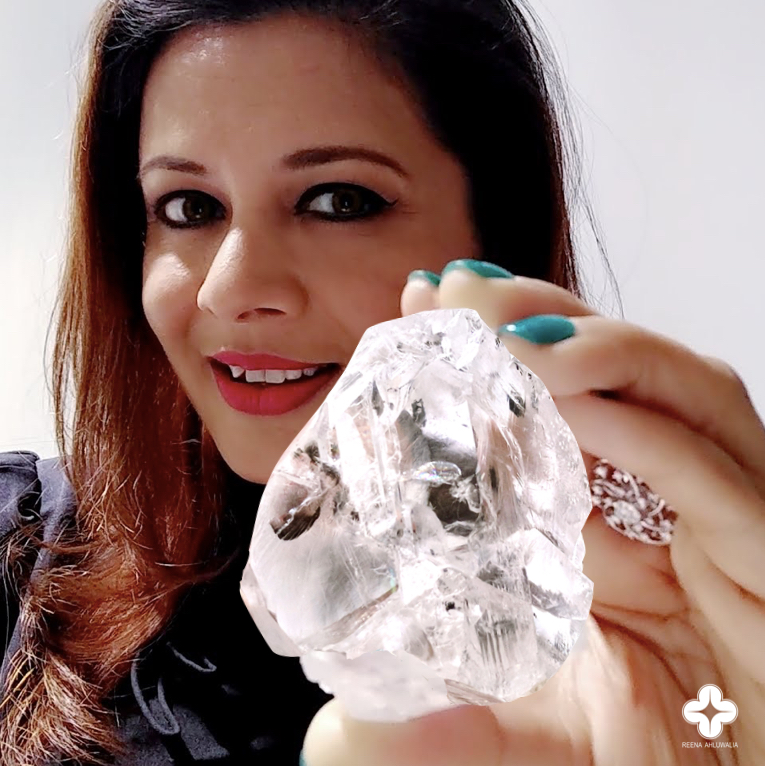
Reena Ahluwalia holds the Type II A, D-color, 910-carat ‘The Lesotho Legend’, the fifth-largest gem diamond in history. In 2018, the diamond was sold for $40 million. The diamond is from the Letseng mine in Lesotho, a country encircled by South Africa. According to Gem Diamonds, it was the largest diamond to have been recovered from the mine (untill 2018).
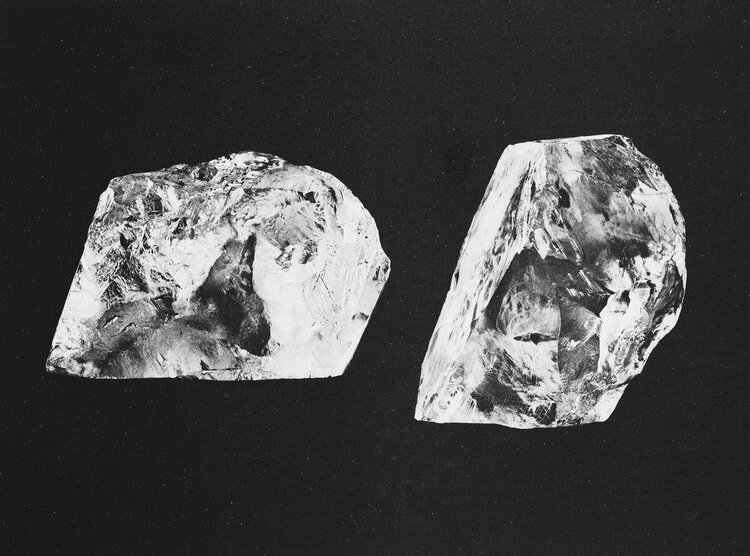
Cullinan Diamond is a Type IIa, super-deep diamond. Photograph showing two models (replicas) of the original stone. The Cullinan Diamond was discovered in South Africa in 1905 and presented to King Edward VII in 1907. Image: Royal Collection © Her Majesty Queen Elizabeth II

Famous Type IIa Diamonds.
Shown here: (1) The De Beers Millennium Star | 203.04 carat, (2) The Lesedi la Rona | 1109 carat, (3) The Koh-I-Noor | 105.60 carat, (4) The Pink Legacy | 18.96 carat, (5) The Idol's Eye | 70.21 carat, (6) The Cullinan I | 530.20 carat, (7) The Graff Venus | 118.78 carat, (8)The Agra | 28.15 carat. Images and information complied by Reena Ahluwalia.
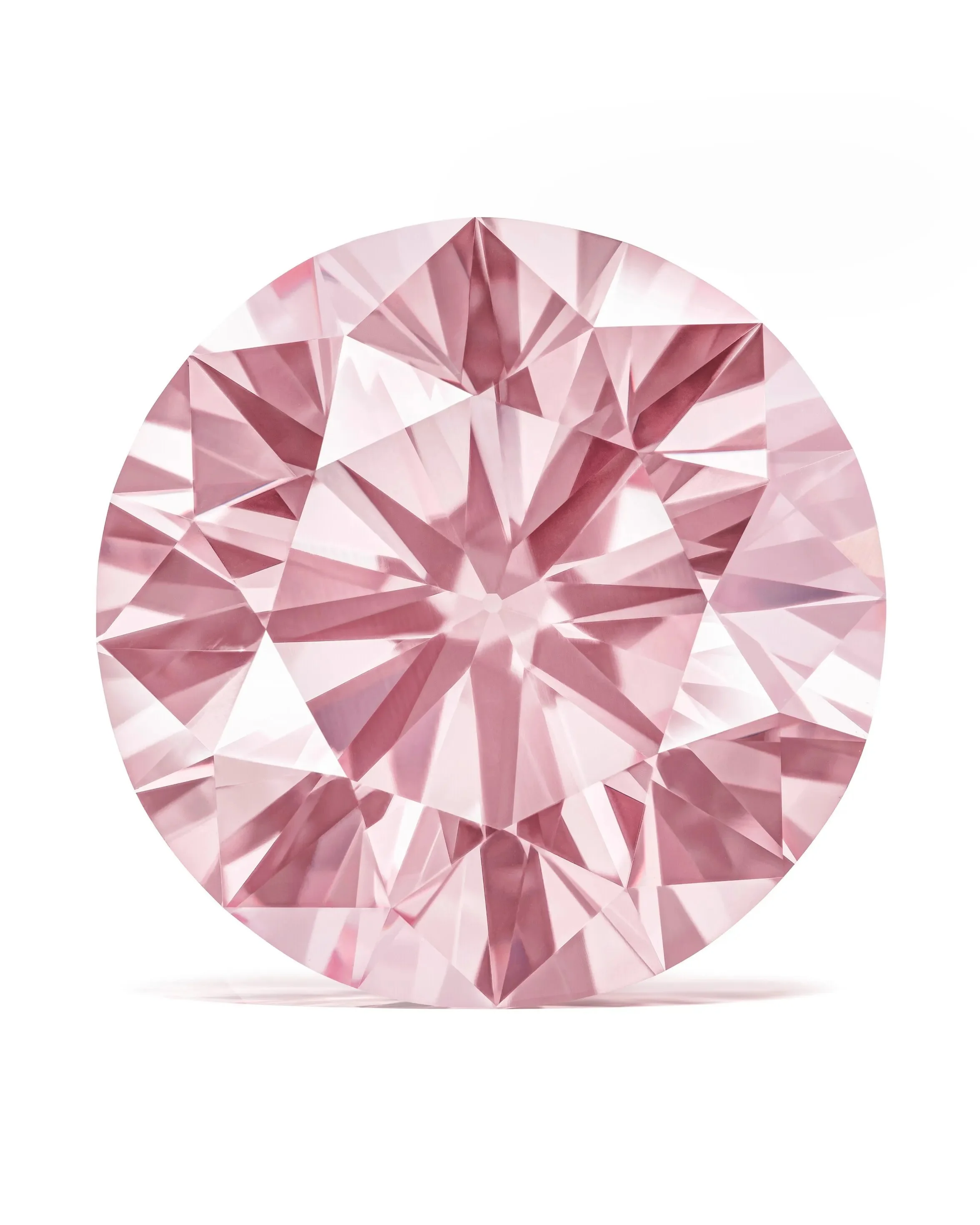
The Eden Rose, a 10.20-carat Fancy Intense Pink Diamond is a Type IIA diamond. Image: Christie’s, 2024. The stone is clear of any secondary hues like gray, blue, or purple that are common in natural pink diamonds.
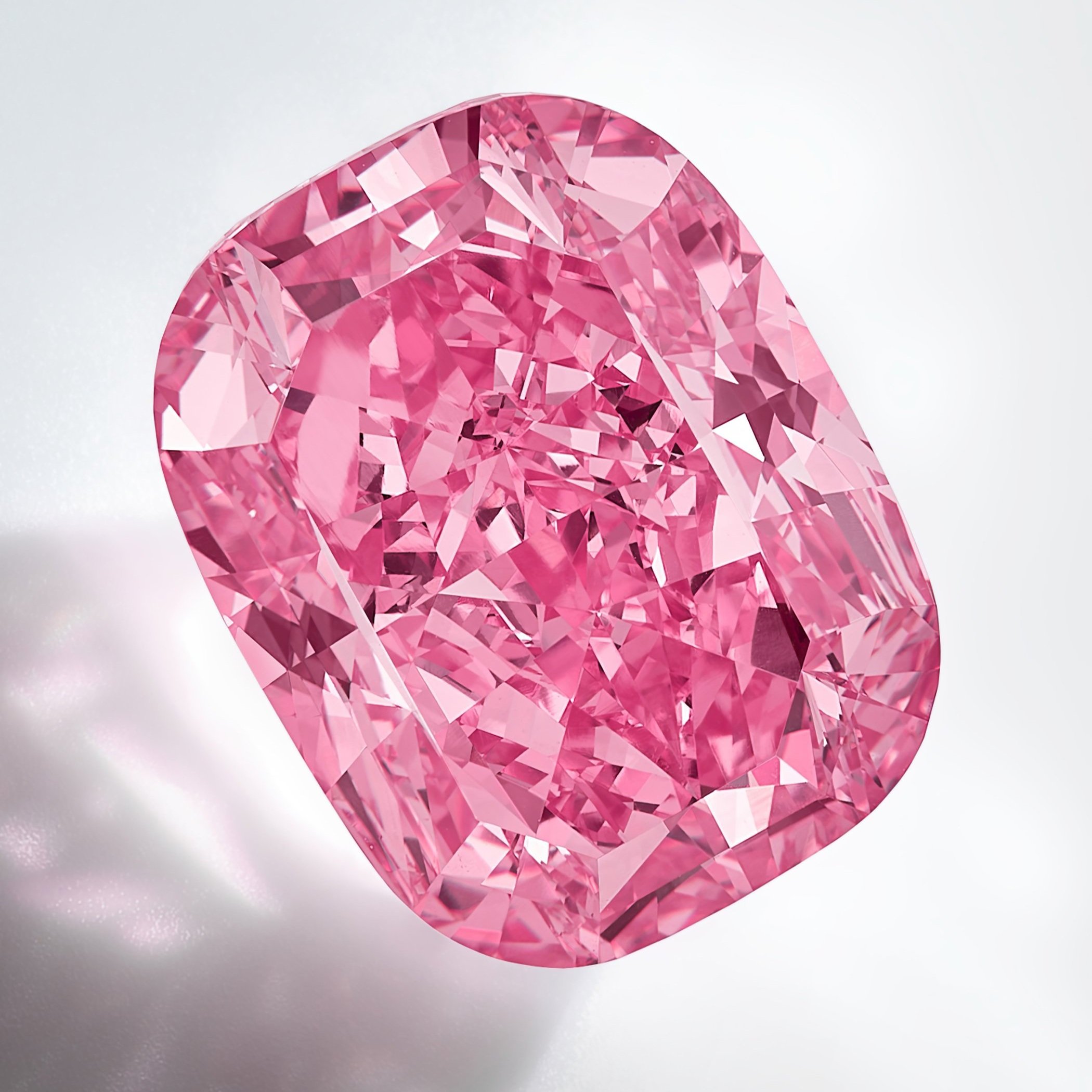
The Eternal Pink sold for $34.8 Million. The cushion mixed-cut Fancy Vivid Purplish Pink diamond weighing 10.57 carats. Of all the diamonds submitted to the GIA, less than 3% are classified as colored diamonds, and less than 5% of those are considered predominantly pink. The Eternal Pink is arguably the most important pink diamond ever to appear at auction. The diamond was discovered in 2020 at the Damtshaa mine in Botswana. The rough weighed 23.78 carats and was carefully cut in Diacore’s New York City facility over a period of six months. Image: Sotheby’s, 2023.
Other famous, historic pink diamonds are the Agra, the Regent, the Williamson Pink and the Darya-i-Noor.
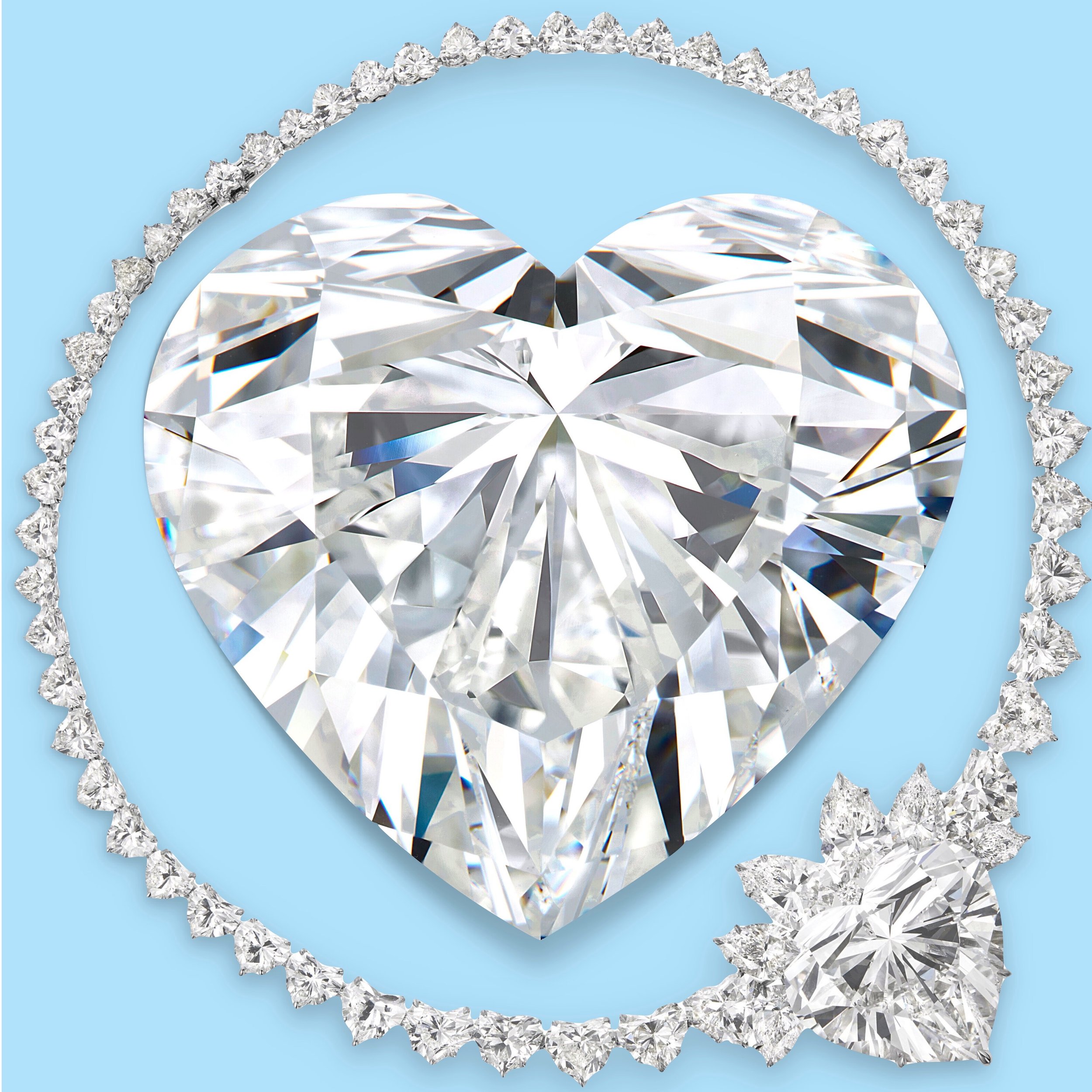
This extraordinary 76.46-carat heart-shaped diamond is a Type IIA diamond. Came up at the Christie’s New York Magnificent Jewels sale in 2022. Image: Christies.
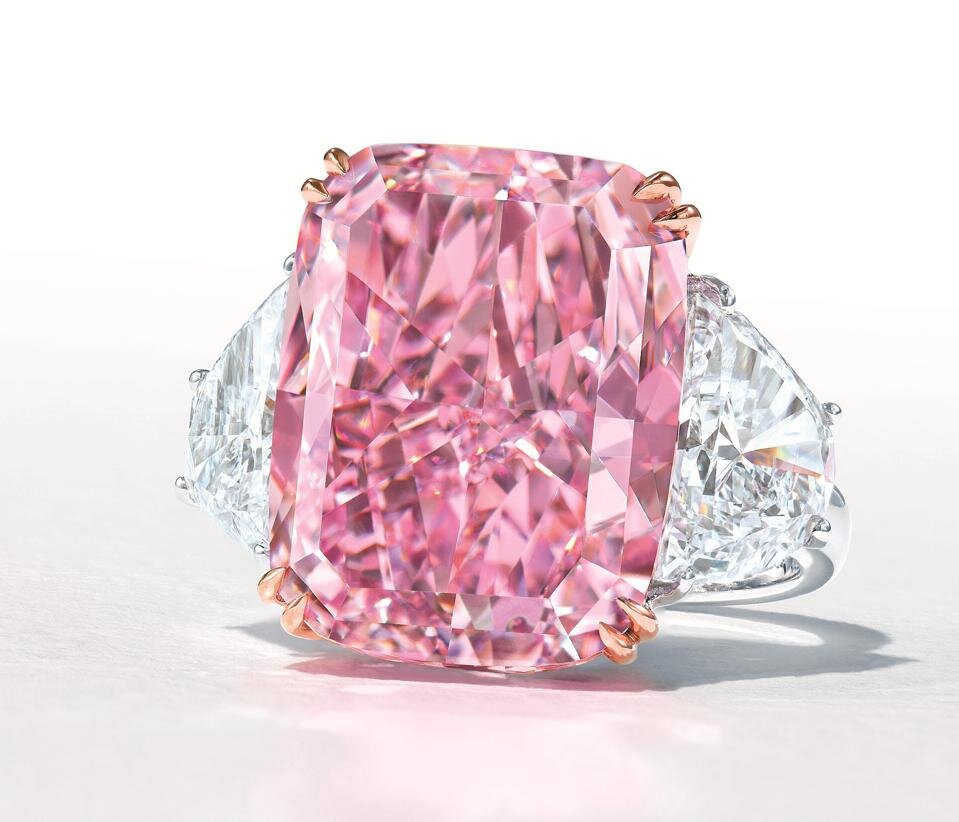
The Sakura Diamond is a 15.81 carat, largest Fancy Vivid Purple-Pink Internally Flawless Type IIa diamond to ever appear at auction. Sold at Chrisrie’s for $29.3 million in Hong Kong in May 2021 to become the most expensive purple-pink diamond ever to sell at auction. Image: Christie’s.

The 102.39 carat, Maiko Star Diamond is a Canadian, Type IIa, D Colour, Flawless Oval Diamond. Held here by Sotheby’s employee during a media preview at Sotheby's on Sept. 9, 2020 in New York City. PHOTO BY ANGELA WEISS /AFP via Getty Images.
Read my interview about this colossal TypeIIa diamond here: https://www.cbc.ca/news/business/diamond-auction-1.5723379
The diamond was sold to a Japanese private collector who names the gem ‘Maiko Star’ after his second daughter. The same collector bought the 88.22-carat ‘Manami Star’ at Sotheby’s in April 2019 for his first daughter.

The 102.39 carat, Maiko Star Diamond is a Canadian, Type IIa, D Colour, Flawless Oval Diamond. Image: Sotheby’s.

The Spirit of Rose diamond, is a 14.83 ct Fancy Vivid Purple-Pink, IF, Type IIa diamond. Only 1% of all pink diamonds are larger than 10-carats and only 4% of all pink are graded ‘Fancy Vivid’. Named ‘The Spirit of the Rose’ after Vaslav Nijinsky’s legendary ballet, Le Spectre de la rose, the diamond was mined, cut and polished in Russia. Its unparalleled qualities make it the largest Purple-Pink diamond to ever appear at auction. Credit: Sotheby’s, 2020

The rough diamond was unearthed by ALROSA from the Ebelyakh deposit in the Republic of Sakha (Yakutia) in the northeast of Russia in July 2017. The stone was cut from the largest pink crystal ever mined in Russia which is currently the world’s most important diamond producer by volume. The 27.85-carat clear pink rough diamond was itself called the “Nijinsky”, a nod to the legendary dancer and his acclaimed performance as the “Rose” in the original Ballets Russes performance. The Spirit of Rose diamond, is a 14.83 ct Fancy Vivid Purple-Pink, IF, Type IIa diamond. Credit: Sotheby’s, 2020

The 100-carat D flawless shield-shaped diamond was bought by Moussaieff for over $6 million in July 2020. Image: Moussaieff

The Pink Legacy, a Fancy Vivid Pink, Type IIA, cut-cornered rectangular-cut diamond of 18.96 carats. This incomparable pink diamond has descended from the Oppenheimer Family and was sold for $50.4 million. Image: Christie’s / 2018


Stephen Silver, gemologist and jeweler, who is known for his keen eye for gemstones sold the Pink Promise, a Type IIa, 14.93 carat Fancy Vivid Pink Diamond for $32 million at the Christies’ Hong Kong Auction, 2017.
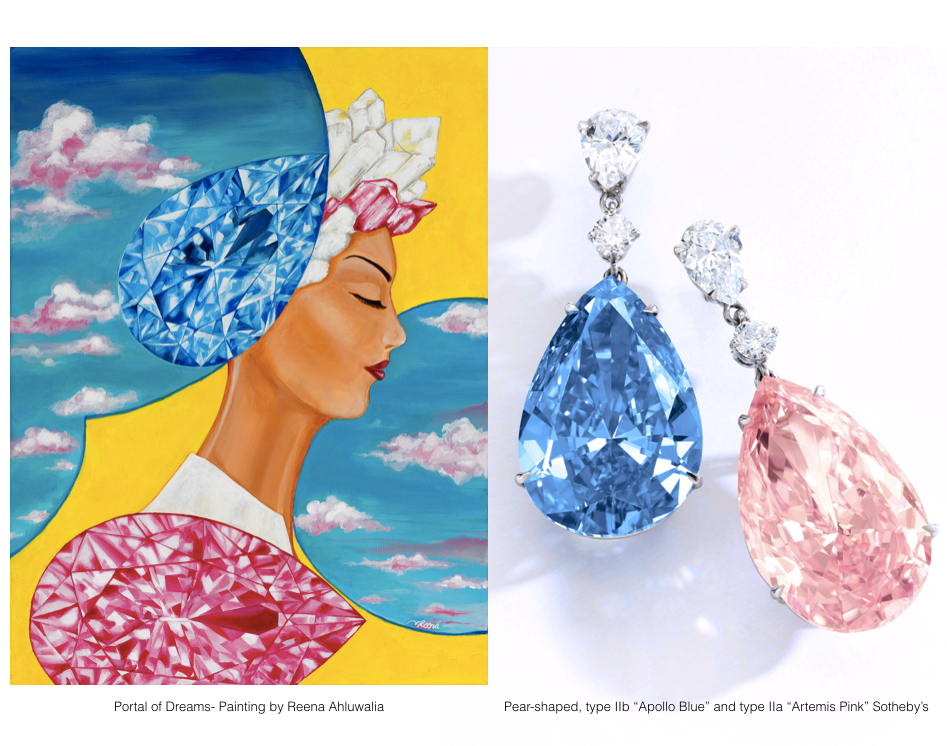
Pear-shaped, Type IIa “Artemis Pink” and Type IIb “Apollo Blue”, Sotheby's + Reena Ahluwalia 'Portal of Dreams' diamond painting.

The Artemis Pink is a Type IIa, Fancy Intense Pink Diamond weighing 16.00 carats. Image: Sotheby's
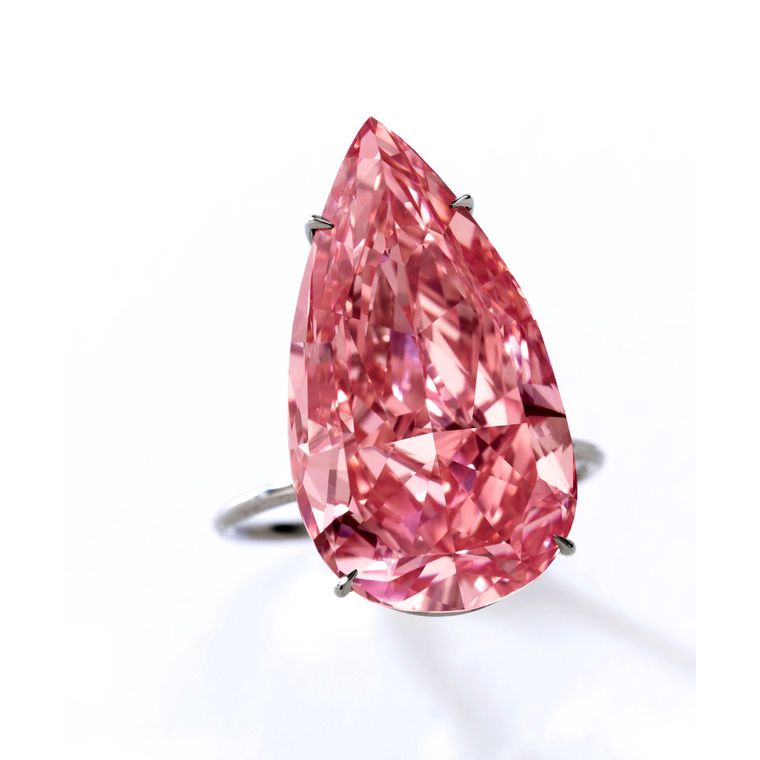
Unique Pink, a 15.38 ct. fancy vivid pink diamond, the largest fancy vivid pink pear-shaped diamond ever offered at auction. Image: Sotheby's 2016
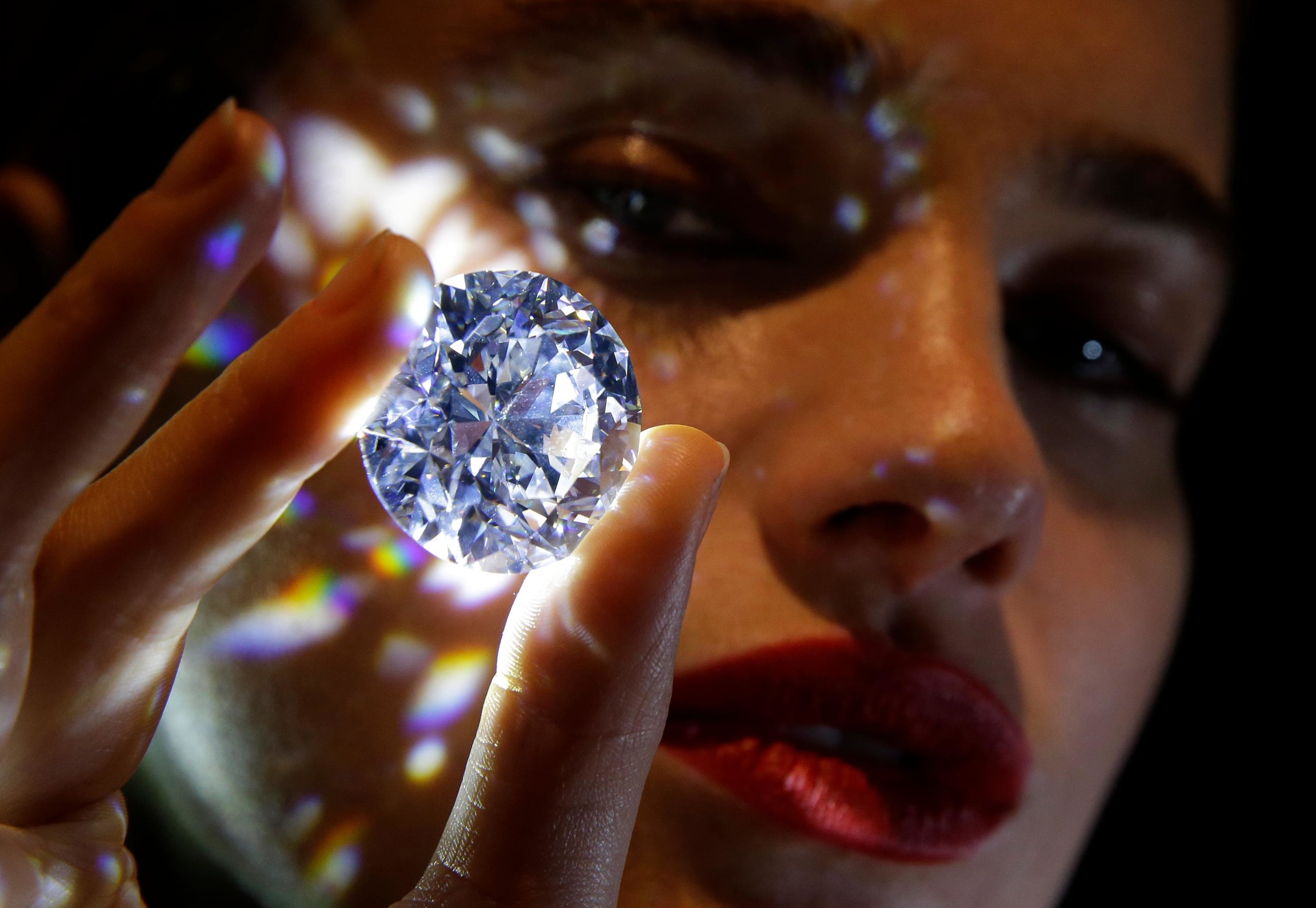
The largest D flawless, Type IIa, round brilliant diamond in the world. 102.34 carat. At 102.34 carats, this masterpiece of nature is the rarest white diamond ever to come to the market and the largest, round D colour flawless diamond known to man. The only stone of its kind ever graded by the GIA, the diamond has achieved the highest rankings under each of the criteria by which the quality of a stone is judged. The diamond is D colour; of exceptional clarity (it is completely flawless, both internally and externally); and has excellent cut, polish and symmetry. As with the famous Cullinan I and Koh-i-noor diamonds, which are part of the British Crown Jewels, the stone is part of the rare subgroup comprising less than 2% of all gem diamonds, known as Type IIa. Diamonds in this group are the most chemically pure type of diamond and often have exceptional optical transparency. Image: (AP Photo/Alastair Grant) / Sotheby's / 2018

The largest D flawless, Type IIa, round brilliant diamond in the world. 102.34 carat. Image: (AP Photo/Alastair Grant) / Sotheby's / 2018

Dubbed as the 'RAREST WHITE DIAMOND' - Sotheby's 102.34 ct, D Flawless, Type IIa. Was cut from a 425-carat rough mined by the De Beers Group in Botswana. 2018. Image: Nils Jorgensen/REX

Dubbed as the 'RAREST WHITE DIAMOND' - Sotheby's 102.34 ct, D Flawless, Type IIa. Was cut from a 425-carat rough mined by the De Beers Group in Botswana. 2018. Image: WENN

THE QUEEN OF KALAHARI - an ultra-rare 342-carat, Type II A, D-Flawless diamond found by Lucara Diamond Corp in 2010 at Karowe, Botswana.

THE QUEEN OF KALAHARI - an ultra-rare 342-carat, Type II A, D-Flawless diamond found by Lucara Diamond Corp in 2010 at Karowe, Botswana. This magnificent stone was transformed into THE GARDEN OF KALAHARI, a collection of six jewellery creations by Caroline Scheufele, Chopard. http://www.chopard.com/diary/the-queen-of-kalahari/

THE GARDEN OF KALAHARI, a collection of six Type II A diamond jewellery creations by Caroline Scheufele, Chopard. http://www.chopard.com/diary/the-queen-of-kalahari/

THE GARDEN OF KALAHARI, a collection of six Type II A diamond jewellery creations by Caroline Scheufele, Chopard. http://www.chopard.com/diary/the-queen-of-kalahari/

Lucara Diamond sold giant Type IIa, 813-ct. Constellation diamond for $63M US in May 2016. Just to put all this in perspective, it is the the highest price ever achieved for the sale of a rough diamond. Image: Lucara Diamond Corporation

At 1109-carat, the "Lesedi La Rona" is the largest gem-quality rough diamond to be discovered in over a century and the largest Type IIa rough diamond in existence today. Image: Lucara Diamond Corporation

At 118.78 carats, the “The Graff Venus” is the world’s largest D-color, Type IIA, flawless heart-shaped diamond. The Graff Venus was cut from a 357-carat rough diamond discovered in 2015 at the Letšeng Mine in Lesotho. Image: Graff Diamonds
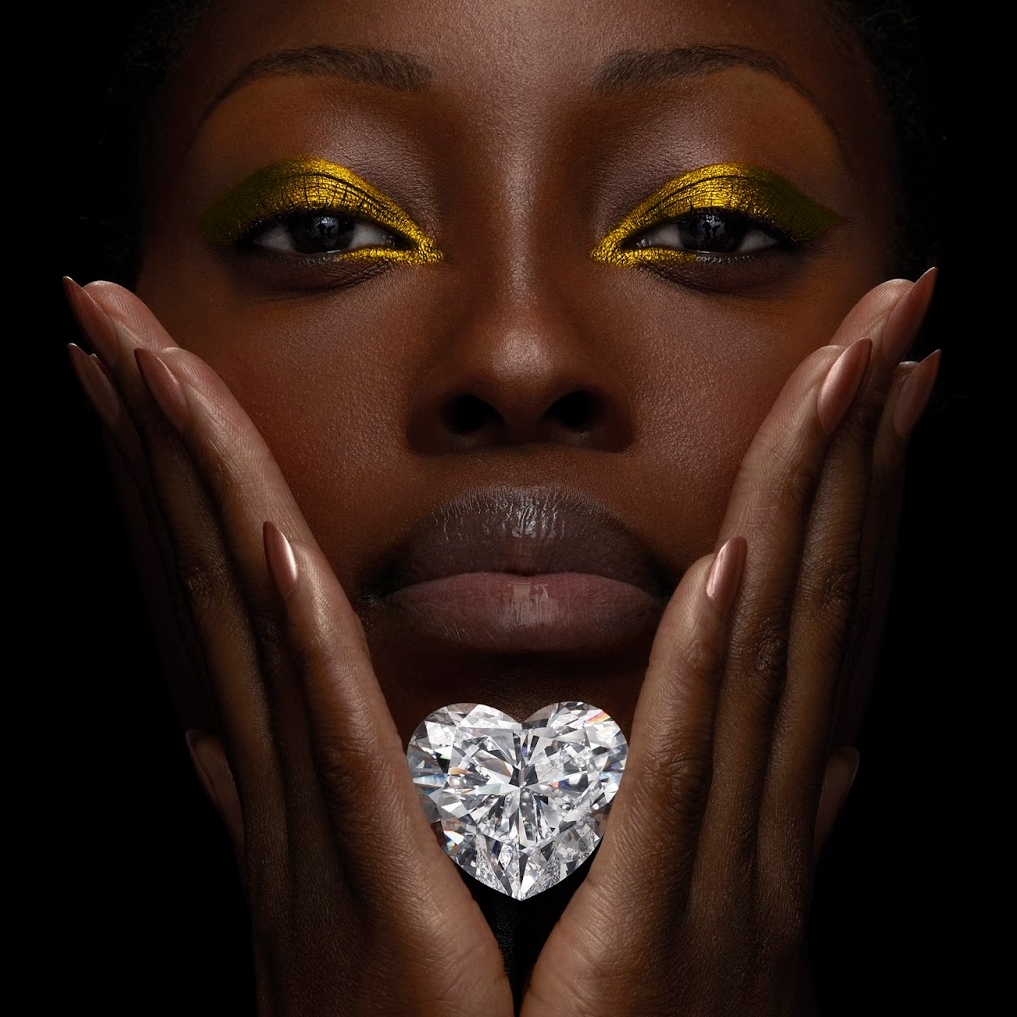
At 118.78 carats, the “The Graff Venus” is the world’s largest D-color, Type IIA, flawless heart-shaped diamond. The Graff Venus was cut from a 357-carat rough diamond discovered in 2015 at the Letšeng Mine in Lesotho. Image: Graff Diamonds
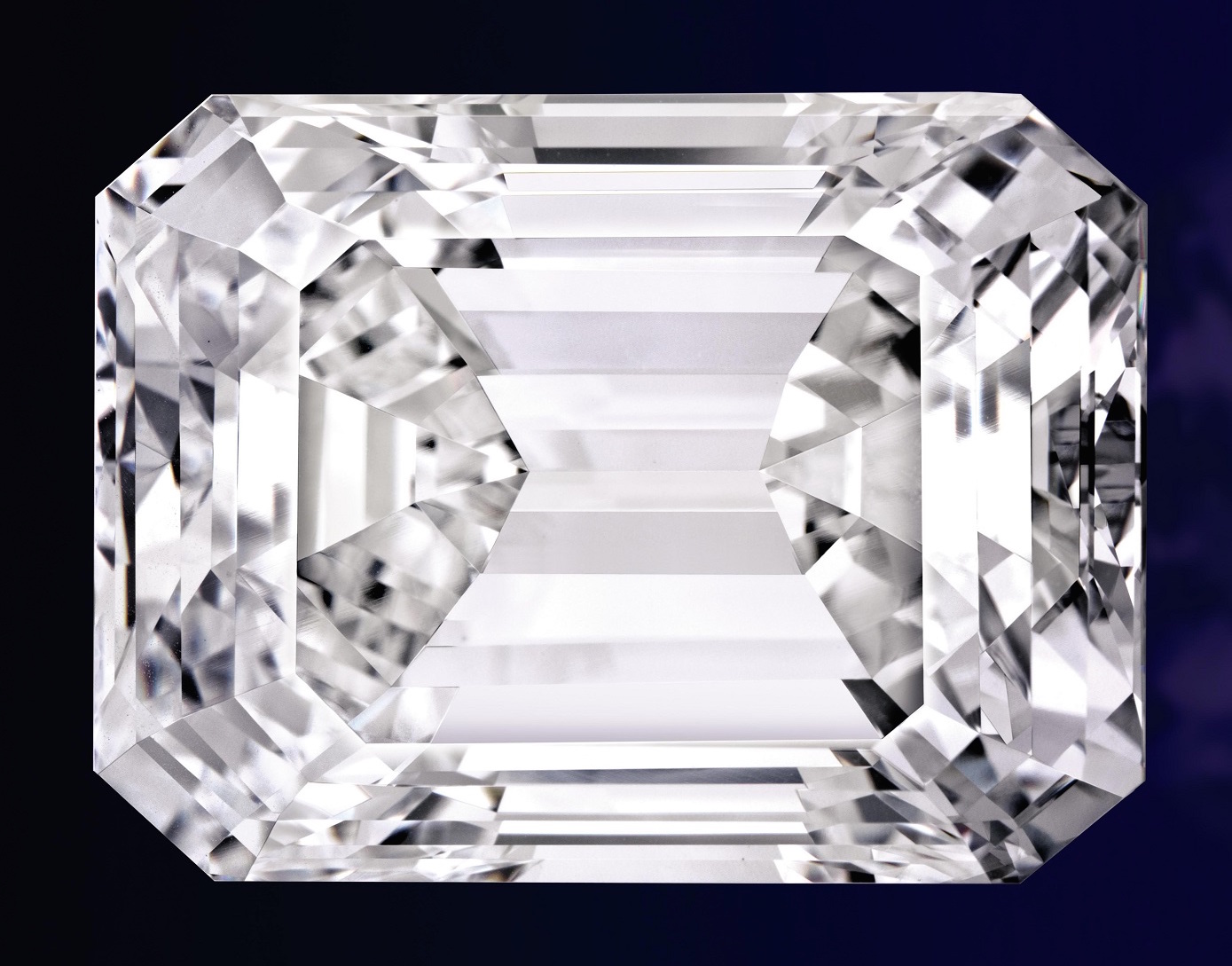
100.20-Carat, Type IIa, Internally Flawless 'Perfect Diamond' could fetch $25 Million in auction in New York in 2015. Photo courtesy: Sotheby's

100.20-Carat, Type IIa, Internally Flawless 'Perfect Diamond' could fetch $25 Million in auction in New York in 2015. Photo courtesy: AP

100.20-Carat, Type IIa, Internally Flawless 'Perfect Diamond' could fetch $25 Million in auction in New York in 2015. Photo courtesy: Reuters

The 100.20-carat "Perfect" diamond during the cutting and polishing process. The original rough weighed more than 200 carats and was mined by De Beers in southern Africa. It took more than a year to study, cut and polish the rough into the 100-carat diamond. Photo courtesy: Sotheby's
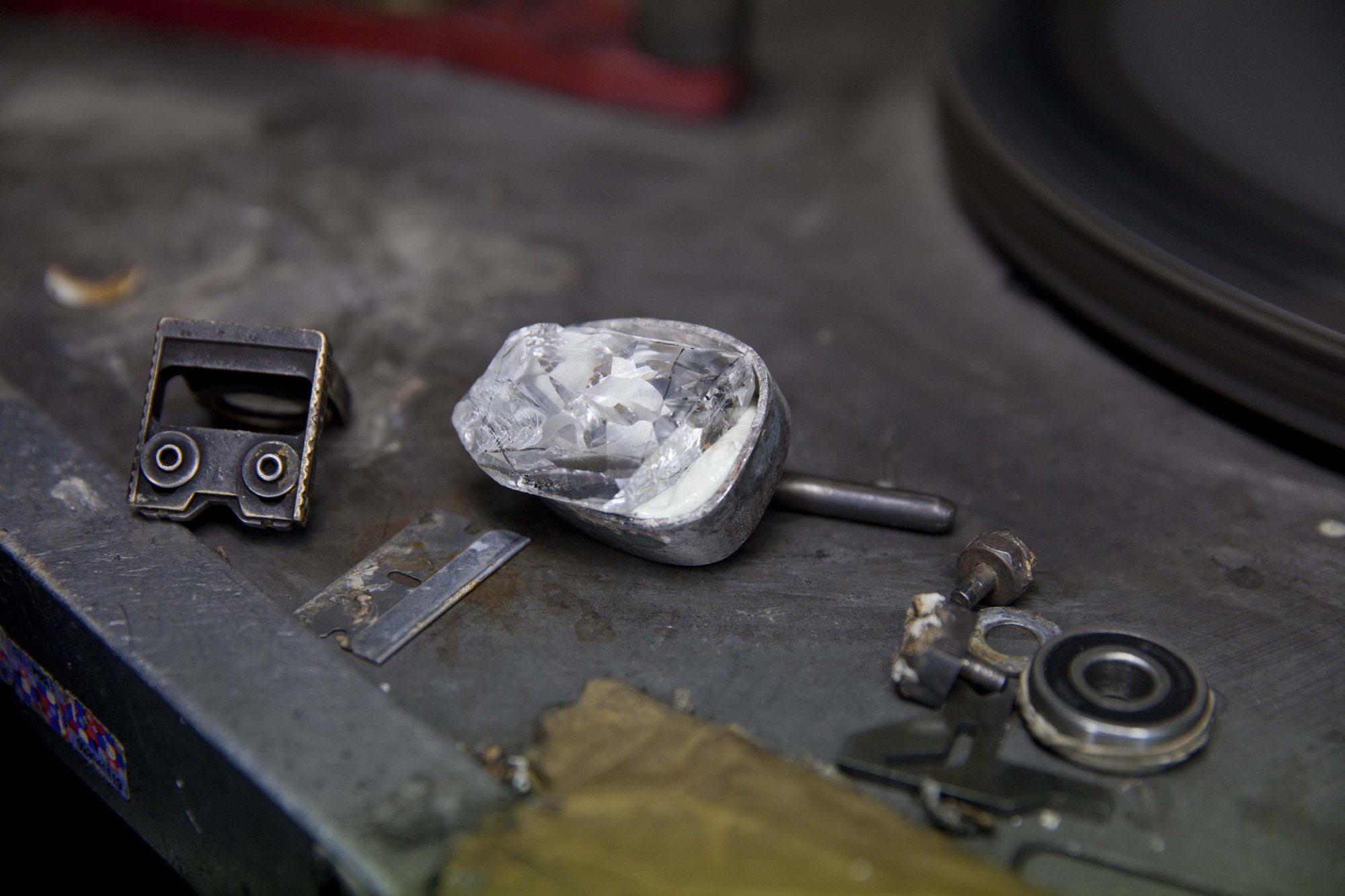
The 100.20-carat "Perfect" diamond during the cutting and polishing process. The original rough weighed more than 200 carats and was mined by De Beers in southern Africa. It took more than a year to study, cut and polish the rough into the 100-carat diamond. Photo courtesy: Sotheby's

The 'Winston Legacy' is the largest white diamond ever to come to auction. The 101.73ct, Type IIa, pear-shaped, D colour, flawless diamond was sold to Harry Winston at Christie's auction of jewels in Geneva on 15 May 2013. Its the "largest of its type" ever offered for public sale. Christies Images Ltd 2013.
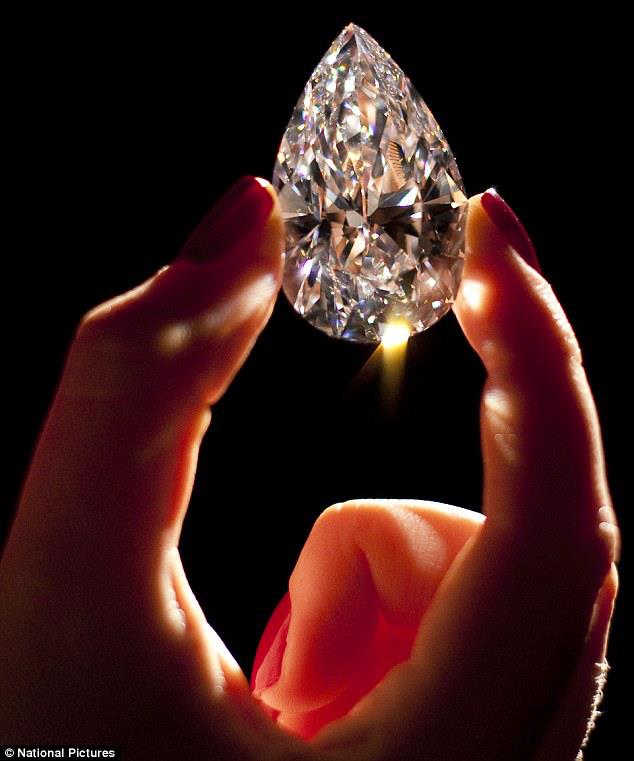
World’s largest "flawless" D-color, colorless diamond at 101.73 carat. The stone was recently cut from a rough diamond, weighing 236 carats, that had been found at the Jwaneng mine in Botswana. It took 21 months to polish. The diamond is a Type IIa, less than 1% of the world's diamonds are Type IIa.

D-colour, internally flawless, Type IIa diamond of 56.15 cts. In 2011, sold at auction, and becoming a world auction record for any heart-shaped diamond. Image: Christie's

The “Elizabeth Taylor Diamond” (formerly known as the “Krupp Diamond”), a 33.19-carat Type IIA diamond. I had the honor of trying out this legendary beauty at Christie's New York. Memorable moment!

The “Elizabeth Taylor Diamond” (formerly known as the “Krupp Diamond”), a 33.19-carat Type IIA diamond. Purchased for $300,000 in 1968 by Richard Burton, the ring became one Elizabeth Taylor’s most cherished white diamonds; one she wore nearly every day. Of the ring, she once said, “[It] gives me the strangest feeling for beauty. With its sparks of red and white and blue and purple, and on and on, really, it sort of hums with its own beatific life.” The Asscher-cut diamond ring recently sold at auction for a whopping $8.8 million.

The Archduke Joseph Diamond. 76.02cts., D color, Internally Flawless, Type IIA. Image: APF
Type IIa and connection with Golconda Diamonds.
A Golconda diamond is a diamond from a specific geographic area within the historic Kingdom of Golconda in India. Diamonds with proven Golconda provenance are of a specific type of rare, pure carbon diamond known as Type IIa. Less than 1-2% of the world's diamonds are Type IIa.
The kingdom of Golconda is situated in India's Deccan plateau. Golconda was a region located between the lower reaches of the Godavari, Wainganga, Wardha and Krishna-Venva rivers, in the present-day states of Maharashtra and Andhra Pradesh, central India.
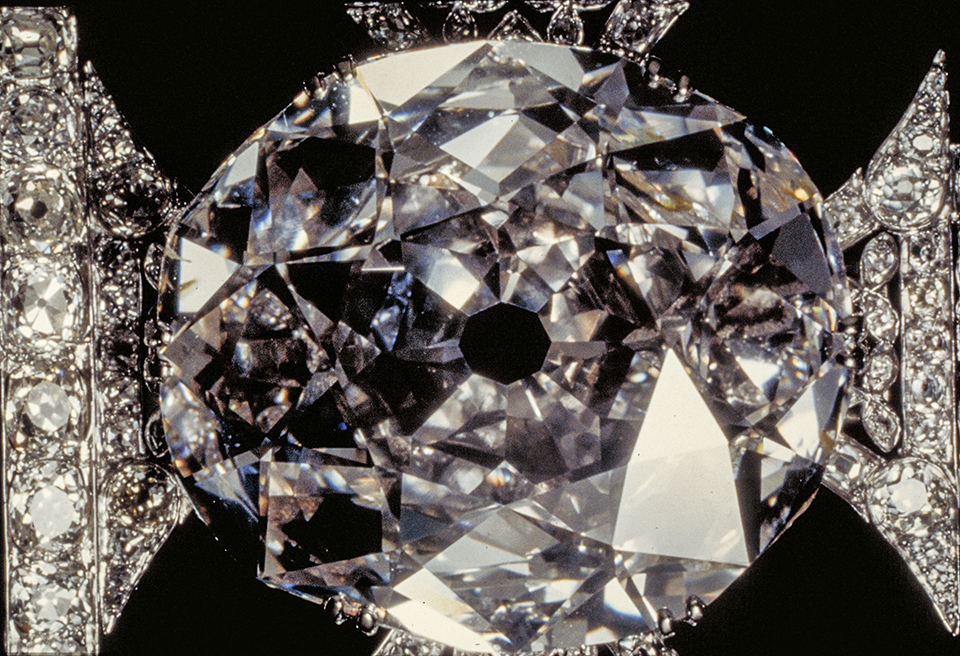
Koh-i-noor is one of the most celebrated Indian diamonds and perhaps the best-known. A modified oval brilliant cut, the 105.60 ct diamond is set in Queen Elizabeth the Queen Mother’s Crown. This is the name of the platinum crown that was designed for Queen Elizabeth, consort (or wife) of George VI, to wear at the Coronation of her husband in 1937. The Koh-i-noor is now on display in the Tower of London. Photo: Kenneth Scarratt. Courtesy: The Gemmologists, the Crown Jewels. Via GIA

The Idol’s Eye is Type IIb diamond, a 70.20 ct Very Light blue diamond that has been described as being between and round and a pear shaped brilliant cut It is believed to have originated from the Golconda region. This famous diamond is an early 17th century stone, an antique triangular modified brilliant cut light blue diamond. Named because of the legend that it once formed the eye of a temple statue, the diamond traveled through a number of international collections. Image Via GIA
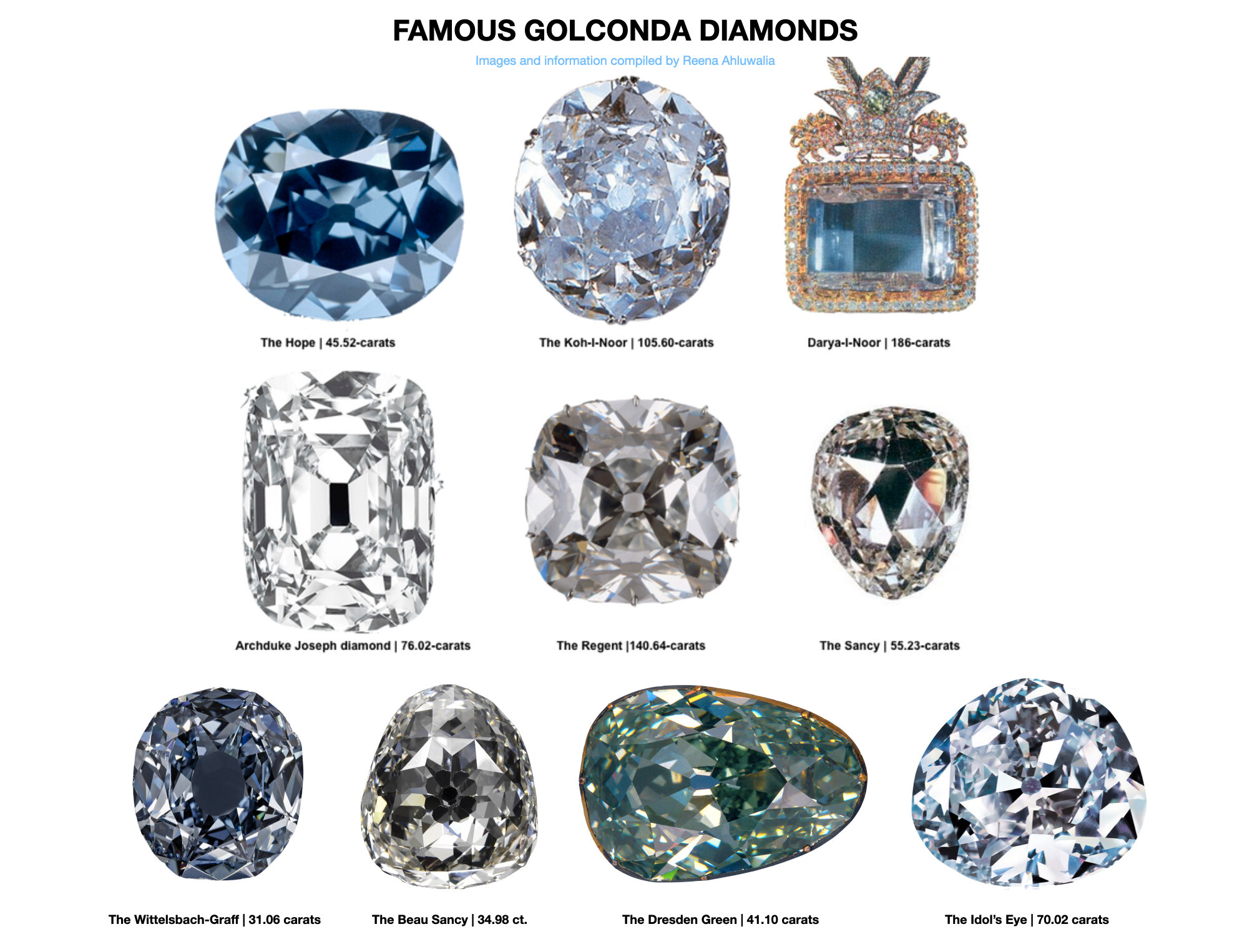
Famous Golconda Type IIa Diamonds.
Top Row: Hope (Golconda, but a Type IIb diamond) | Koh-I-Noor | Darya-I-Noor. Middle Row: Archduke Joseph | Regent | Sancy. Bottom Row: Wittelsbach-Graff | Beau Sancy | Dresden Green | Idol’s Eye.
Images and information complied by Reena Ahluwalia.

Golconda Diamonds: Rahul Kadakia, Department Head, Jewelry, Christie's Americas, describes these very special and rare diamonds. (2005) (RT 3:13)
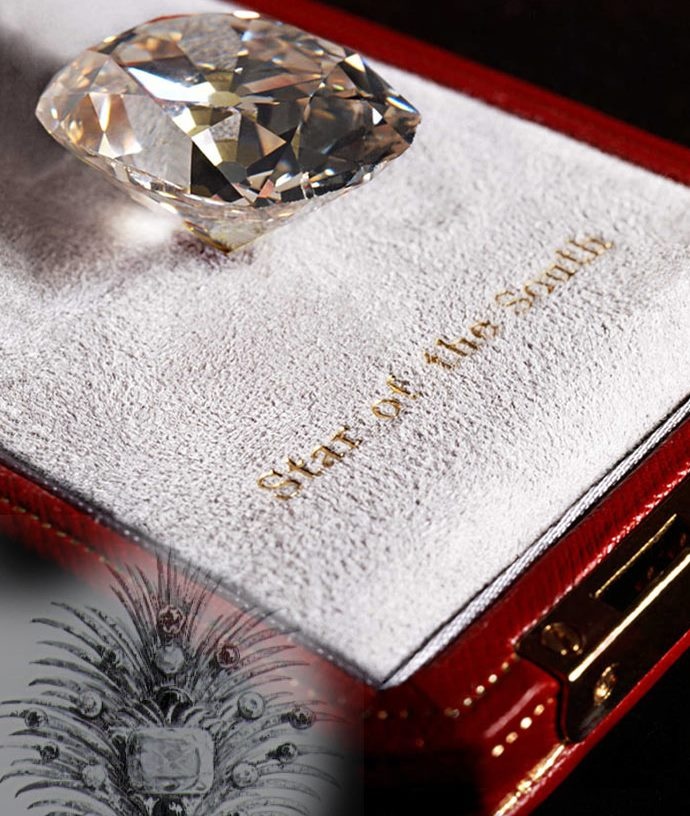
The Star of South Diamond. 128.48-carat, Type IIa, fancy light pinkish-brown diamond. It was discovered in 1853 and became the first Brazilian diamond to receive international acclaim.

From The Treasury of Baroda - a magnificent three-tired diamond necklace, shown here worn by the Maharani of Baroda, Sita Devi in 1948. Khande Roe, Gaekwar of Baroda, had this necklace made to display two important diamonds - The 128.48-carat, Type IIa, Star of the South (fancy light pinkish-brown) and the 78.5-carat English Dresden below it. Necklace photo: circa 1880.

The Beau Sancy Diamond. Type IIa, 34.98 ct., modified pear, double rose cut diamond. The stone has passed through four European Royal families. Image: Sotheby's


Esperanza Diamond is a Type IIa, internally flawless, D-color, 4.65-Carat ‘Triolette’, cut by master cutter Mike Botha.
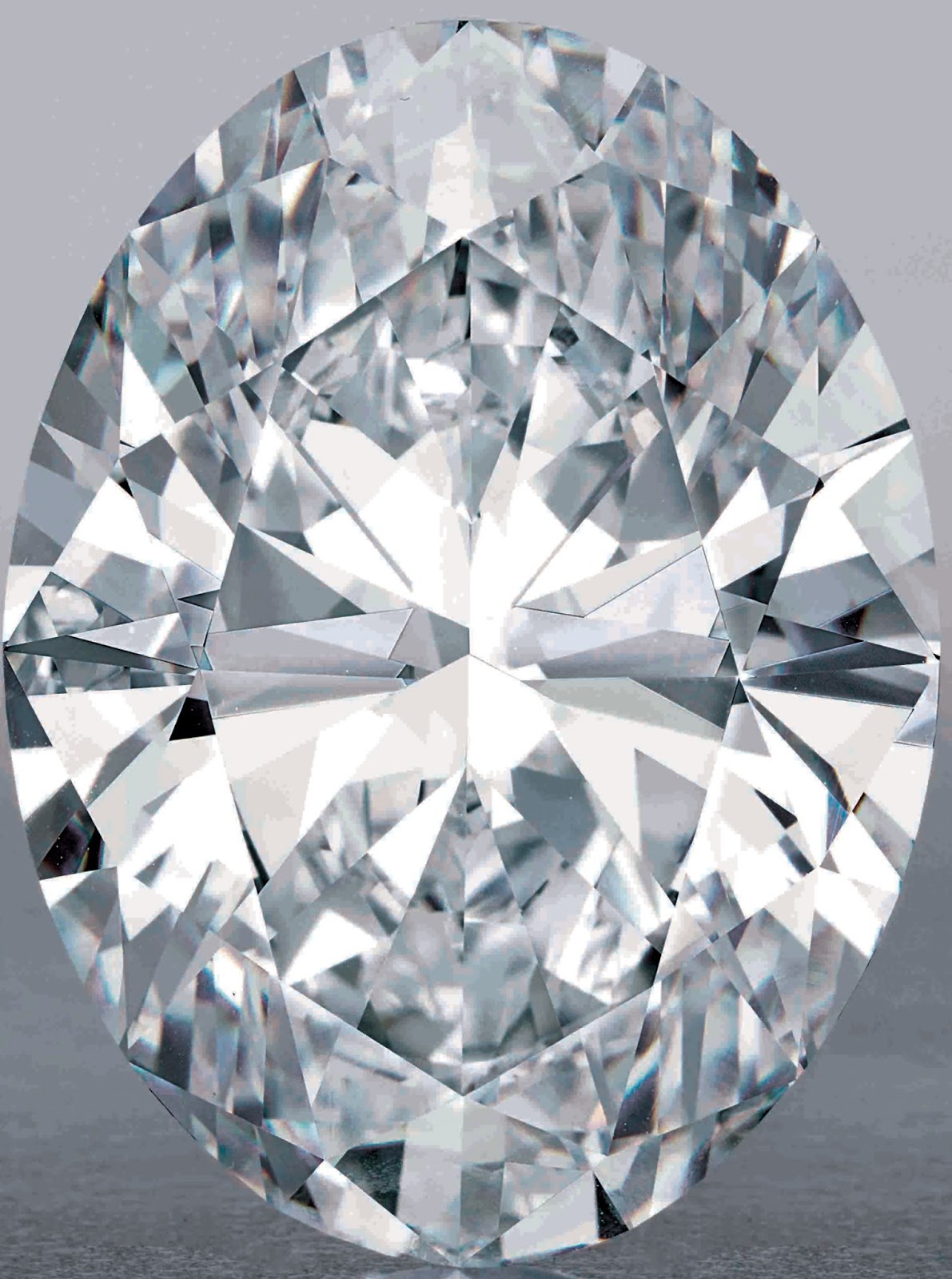
118.28-carat, D-color, flawless, Type IIa, magnificent oval diamond. Image: Sotheby's

A model holds a 118.28-carat, flawless diamond dubbed the 'Magnificent Oval Diamond' during a media preview at Sotheby's Hong Kong auction house on September 19, 2013. The stone broke a world record on October 7, 2013 when it fetched more than 30 million USD on auction. Photo: Laurent FIEVET
In the past I have authored posts on, Bejeweled Maharaja & Maharani of Mysore, Koh-i-Noor Diamond, Diamonds on World Postage Stamps, Top Ten - Largest Diamonds Discovered In The World, Splendors of Mughal India, The Magnificent Maharajas Of India, Mystery & History Of Marquise Diamond Cut, Ór - Ireland's Gold, The Legendary Cullinan Diamond, Bejeweled Persia - Historic Jewelry From The Qajar Dynasty, Famous Heart-Shaped Diamonds, Type II Diamonds, Green Diamonds, Red Diamonds and more. Over years, I have spent countless hours in self-driven studies on diamond, jewelry history and research. I wrote these blogs for a simple reason - to share my collected knowledge with all who are interested, so that more can benefit from it. Take a look and enjoy! -- Reena
Ór - Ireland's Gold
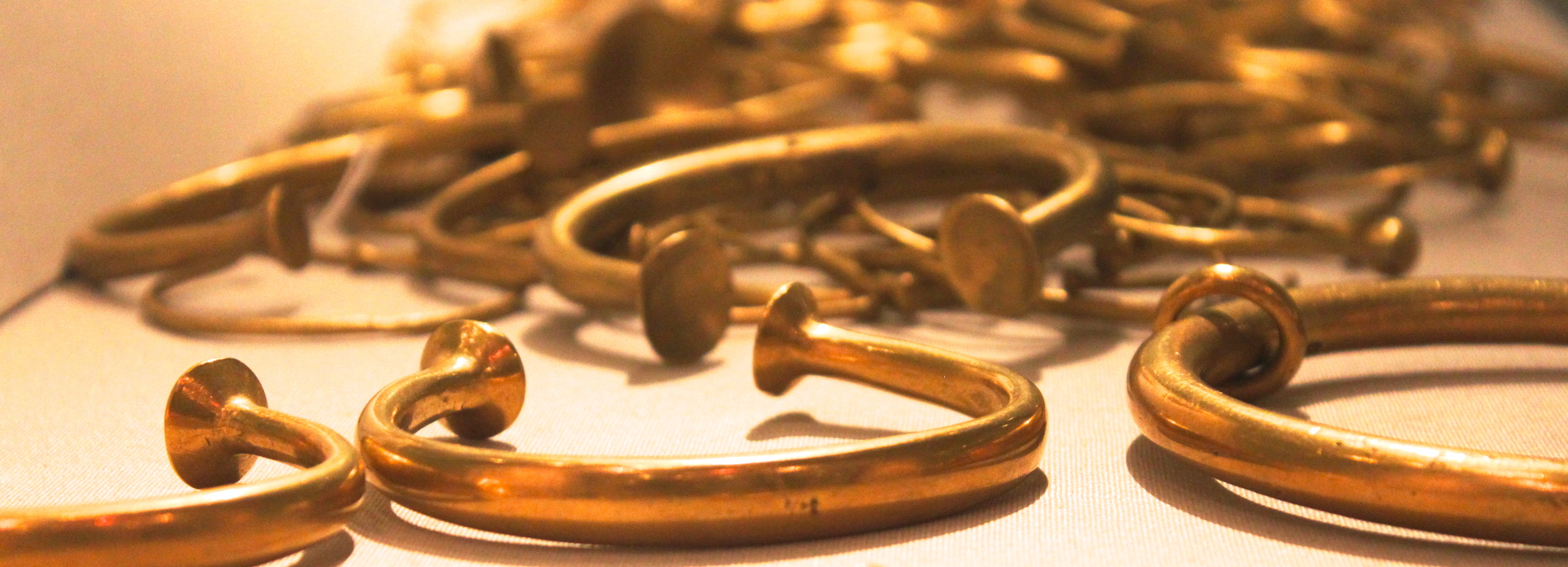
May the rocks in your field turn to gold. -- Irish blessing
Glorious gold! It dazzled me on my recent visit to Dublin, Ireland. I was awestruck! The gold-work history is fascinating and so are the forms and textures. Hope you enjoy this blog post as much as I enjoyed learning about the history of gold in Ireland!
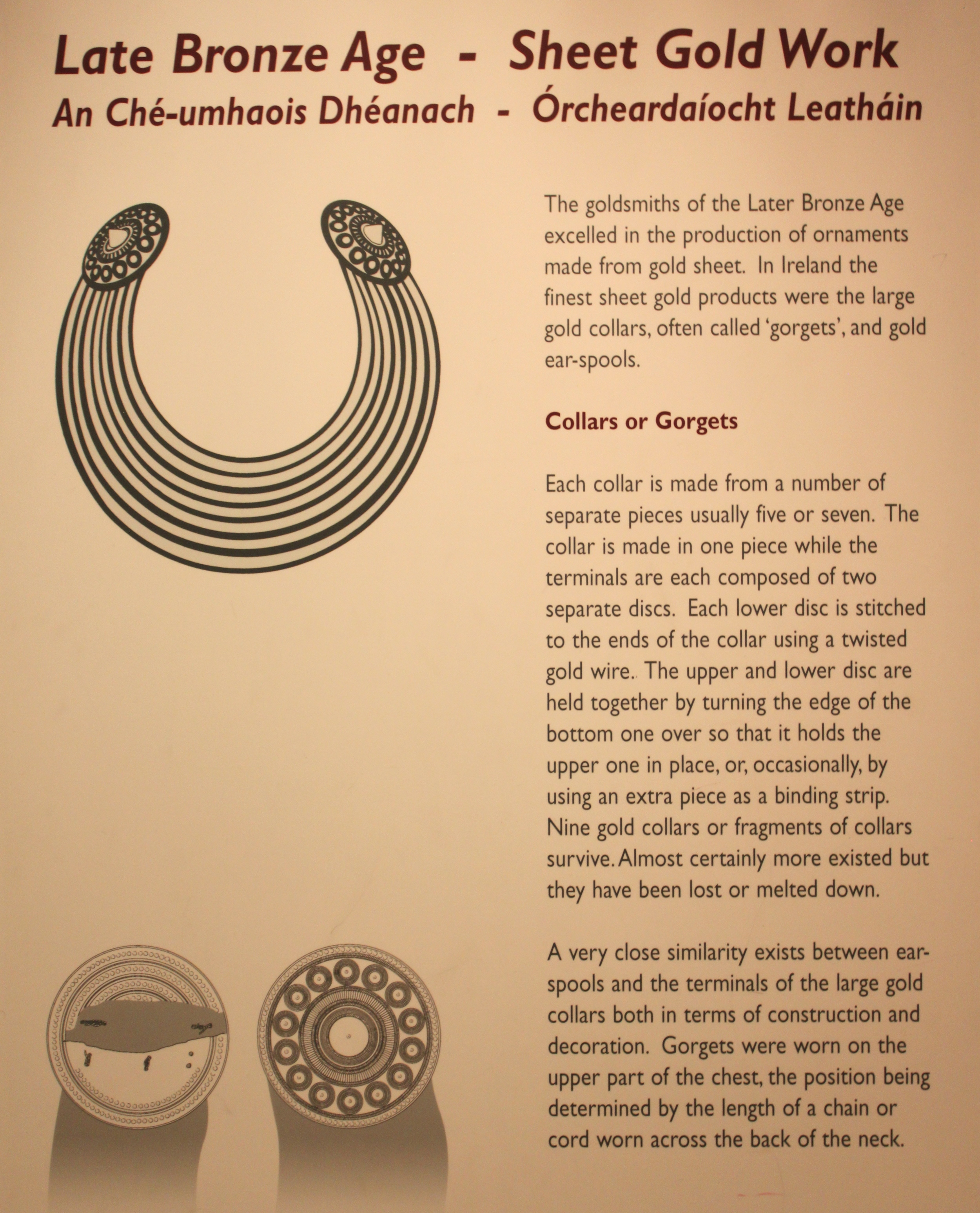
The National Museum of Ireland's collection of prehistoric gold-work, ranging in date between 2200 BC and 500 BC, is one of the largest and most important in western Europe. Most are pieces of jewellery but the precise function of some is unknown.
During the Early Bronze Age the principal products were made from sheet gold, and include sundiscs and the crescentic gold collars called lunulae. Around 1200 BC new gold working techniques were developed. During this time a great variety of torcs were made by twisting bars or strips of gold.
Styles changed again around 900 BC and the goldwork of this period can be divided into two main types. Solid objects such as bracelets and dress-fasteners contrast dramatically with large sheet gold collars and delicate ear-spools.
Although gold has been found in Ireland at a number of locations, particularly in Co. Wicklow and Co. Tyrone, it has not yet been possible to identify the ancient sources where gold was found. The sites most likely to have been recognized and exploited by prehistoric people are alluvial deposits from rivers and streams. This ‘placer’ gold is weathered out from parent rock and can be recovered using simple techniques such as panning.
In Europe, the earliest evidence for gold-working dates to the fifth millennium BC. By the end of the third millennium gold-working had become well established in Ireland and Britain together with a highly productive copper and bronze working industry. While we do not know precisely how the late Neolithic people of Ireland became familiar with metalworking, it is clear that it was introduced as a fully developed technique. Essential metalworking skills must have been introduced by people already experienced at all levels of production, from ore identification and recovery through all stages of the manufacturing process.
Source: National Museum of Ireland - Archaeology
Photographs shown below are taken by Reena Ahluwalia at the National Museum of Ireland, Archaeology, unless otherwise stated.

Reena Ahluwalia at the National Museum of Ireland - Archaeology. Dublin

Gold Ribbon Torc. Near Belfast. 3rd century BC. National Museum of Ireland

The Broighter Gold Collar. Concentric arches drawn by compass highlight raised decoration of S-shaped scrolls, trumpet shapes and lentoids. From the hoard of gold objects. Broighter, county Derry. 1st century BC.
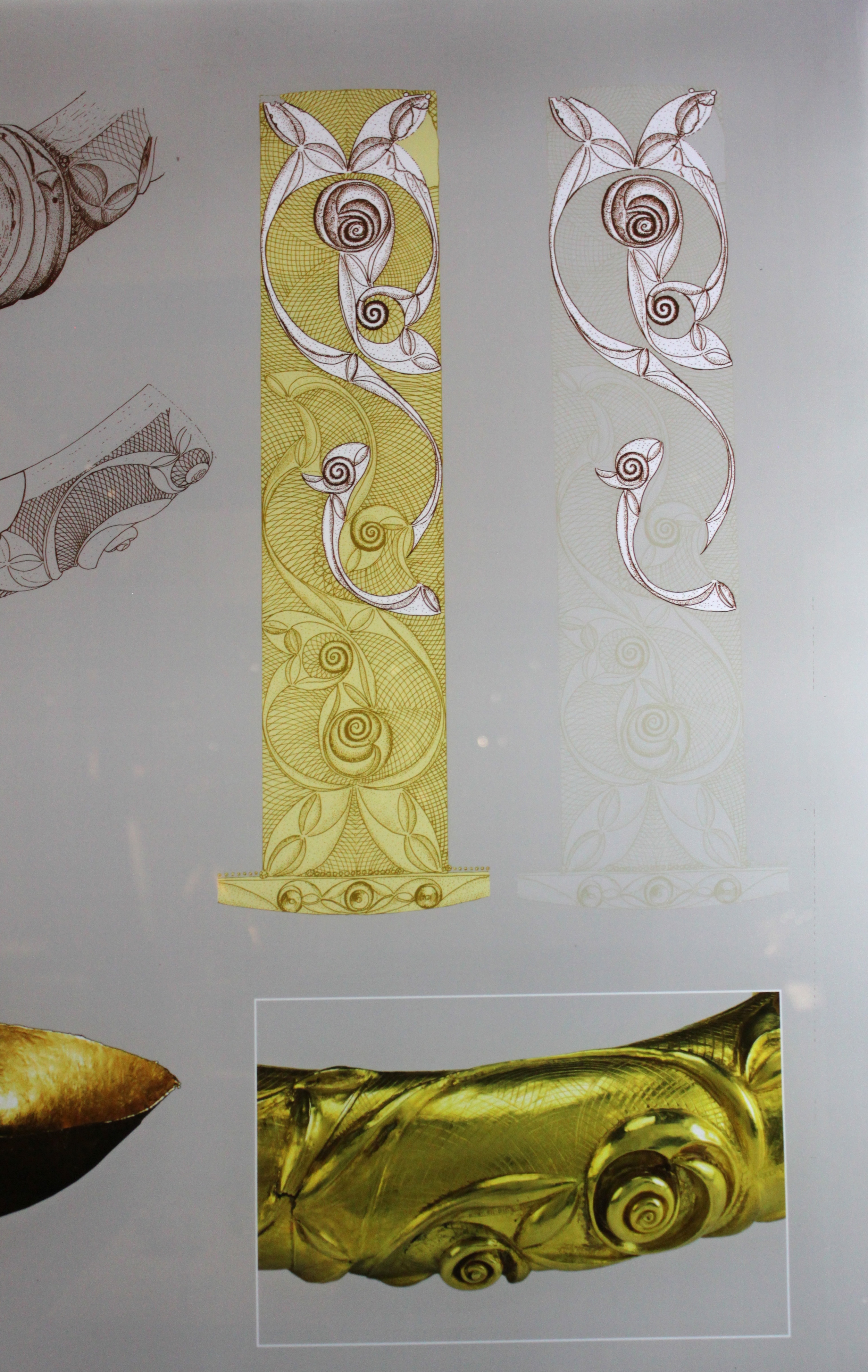
The Broighter Gold Collar. From the hoard of gold objects. Broighter, county Derry. 1st century BC. Concentric arches drawn by compass highlight raised decoration of S-shaped scrolls, trumpet shapes and lentoids. Collars are especially associated with Celtic kings and gods. The sea god Manannán mac Lir was associated with Lough Foyle and may have had special significance for a local king, perhaps as a protective deity or divine ancestor.

The Tara brooch. 8th century. This brooch was found not in Tara but near the seashore at Bettystown, Co. Meath, in 1850. Its provenance was attributed to Tara by a dealer in order to increase its value. It is made of cast and gilt silver and is elaborately decorated on both faces. The front is ornamented with a series of exceptionally fine gold filigree panels depicting animal and abstract motifs that are separated by studs of glass, enamel and amber. The back is flatter than the front, and the decoration is cast. The motifs consist of scrolls and triple spirals and recall La Tène decoration of the Iron Age.
A silver chain made of plaited wire is attached to the brooch by means of a swivel attachment. This feature is formed of animal heads framing two tiny cast glass human heads. Along with such treasures as the Ardagh Chalice and the Derrynaflan Paten, the Tara Brooch can be considered to represent the pinnacle of early medieval Irish metalworkers’ achievement. Each individual element of decoration is executed perfectly and the range of technique represented on such a small object is astounding. National Museum of Ireland.

Silver Chalice, (The Ardagh Chalice). Reerasta, Ardagh, county Limerick. Ireland. 8th Century BC.
The Ardagh Chalice is one of the greatest treasures of the early Irish Church. It is part of a hoard of objects found in the 19th century by a young man digging for potatoes near Ardagh, Co. Limerick. It was used for dispensing Eucharistic wine during the celebration of Mass. The form of the chalice recalls late Roman tableware, but the method of construction is Irish. The bowl and foot of the chalice are made of spun silver. The outer side of the bowl is decorated with applied gold, silver, glass, amber and enamel ornament. The underside of the foot is also highly decorated and contains a polished rock crystal at the centre.

Detail. Silver Chalice, (The Ardagh Chalice). Reerasta, Ardagh, county Limerick. Ireland. 8th Century BC.

Detail. Silver Chalice, (The Ardagh Chalice). Reerasta, Ardagh, county Limerick. Ireland. 8th Century BC.

The Bell of St. Patrick and its Shrine. Armagh, Ireland. 8th-9th century AD. This bell is reputed to have belonged to St. Patrick. It is made of two sheets of iron which are riveted together and coated with bronze. This bell is frequently mentioned in written sources as one of the principal relics of Ireland.
An inscription on its surface indicates that the shrine for the bell was made around AD 1100. It is trapezoidal in shape, echoing the shape of the bell it was made to cover. Formed of a series of bronze plates joined at the edges by tubular bindings, the shrine is topped by a curved crest which covers the handle of the bell. The front of the shrine is covered with a silver-gilt frame that originally held thirty gold filigree panels. These are arranged in the shape of a ringed cross. The sides of the shrine are adorned with openwork panels depicting elongated beasts intertwined with ribbon-bodied snakes. The back of the shrine is plainer and flatter, and is decorated with an openwork silver plate featuring interlocking crosses. The inscription along the edge of the backplate records the name of the craftsman and his sons who made the shrine, and Domhnall Ua Lochlainn, King of Ireland between AD 1094 and 1121, who commissioned the shrine; Cathalan Ua Maelchallain, the keeper of the bell, is also mentioned. Remarkably, the shrine remained in the possession of this family until the end of the 19th century.

Side View. The Bell of St. Patrick and its Shrine. Armagh, Ireland. 8th-9th century AD.
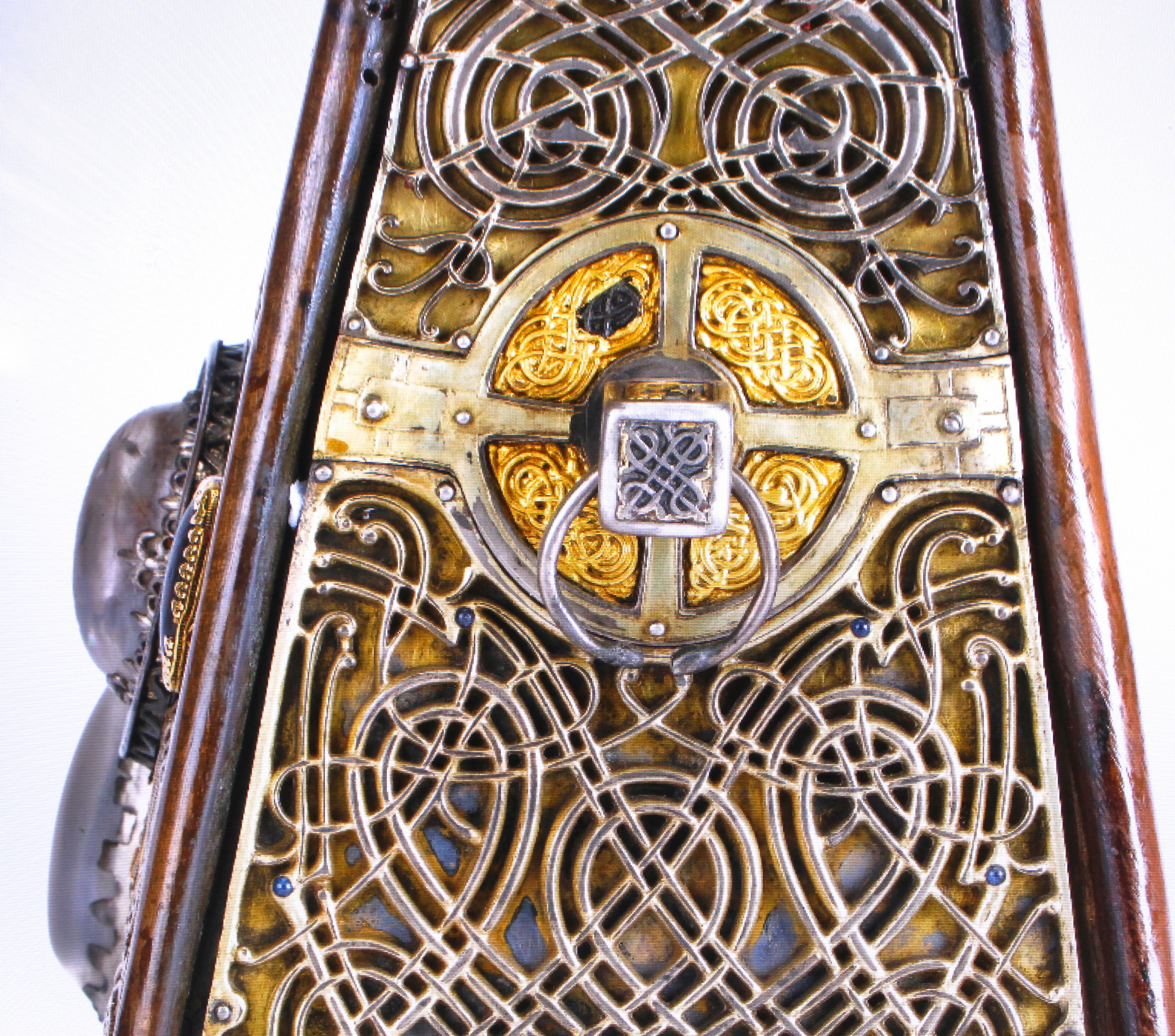
Detail. The Bell of St. Patrick and its Shrine. Armagh, Ireland. 8th-9th century AD. This bell is reputed to have belonged to St. Patrick. It is made of two sheets of iron which are riveted together and coated with bronze.

The Cross of Cong. County, Mayo. Ireland. Early 12th century AD. The Cross of Cong represents the conclusion of a long tradition of distinctively Irish church metalwork.
It was made to enshrine a relic of the True Cross, known from written sources to have been acquired in AD 1122 by Toirrdelbach Ua Conchobair (Turlough O’Conor), High King of Ireland. The cross was designed for processional use, although it may have been mostly used as an altar cross. It has an oak core which is covered by plates of cast bronze. A large polished rock crystal on the front of the cross at the junction of the arms and shaft was intended to protect the relic, which does not survive. The rock crystal is set in a conical mount surrounded by a flange decorated with gold filigree, niello and blue and white glass bosses. The bronze plates on the surfaces of the cross are cast openwork and are decorated with ribbon-shaped intertwined animals in the Scandinavian-derived Urnes style.
The inscription on the sides of the cross identifies Toirrdelbach Ua Conchobair as the patron and Máel Ísú mac Bratáin Uí Echach as the craftsman. Two prominent churchmen are also mentioned. The inscription, which is in Irish, is framed by two identical lines in Latin that translate as ‘by this cross is covered the cross on which the creator of the world suffered’.

Detail. The Cross of Cong. County, Mayo. Ireland. Early 12th century AD. The Cross of Cong represents the conclusion of a long tradition of distinctively Irish church metalwork.

Example of a borrowed woodcarving technique known as kerbschnitt (German) or chip-carving. Surface of object is cut away in oblique cuts to give it a faceted look and added brilliance when gilded. National Museum of Ireland.

Example of a borrowed woodcarving technique known as kerbschnitt (German) or chip-carving. Surface of object is cut away in oblique cuts to give it a faceted look and added brilliance when gilded. National Museum of Ireland.

Gold Dress Fastener. Clones. County, Monaghan. Ireland. 800-700 BC.
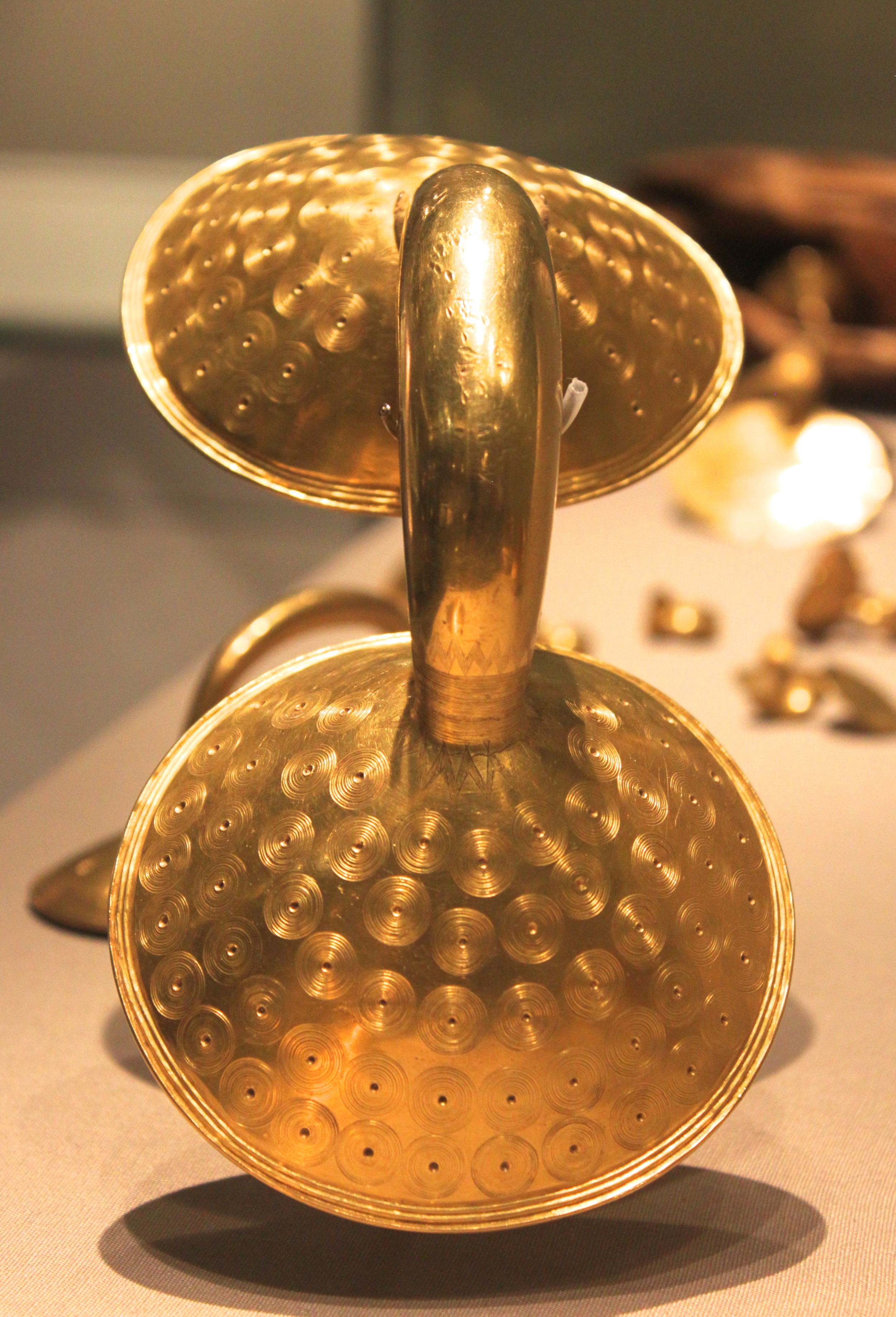
Gold Dress Fastener. Clones. County, Monaghan. Ireland. 800-700 BC.

Miniature Gold Boat, as an offering to sea god. From the hoard of gold objects. Broighter, county Derry. 1st century BC.

Museum of Ireland. Irish man, late Bronze Age.

Gold Collars. 800-700 BC. National Museum of Ireland.

Gold Collar. 800-700 BC. National Museum of Ireland.

Gold Collar. 800-700 BC. National Museum of Ireland.

Gold Collar. 800-700 BC. National Museum of Ireland.

Gold disc, perhaps a terminal from a collar or ear spool. 800-700 BC. National Museum of Ireland.

Hollow gold balls. Late Bronze Age, Ireland. Graduated sizes and with holes suggest that these balls could have been strung together to form a necklace.
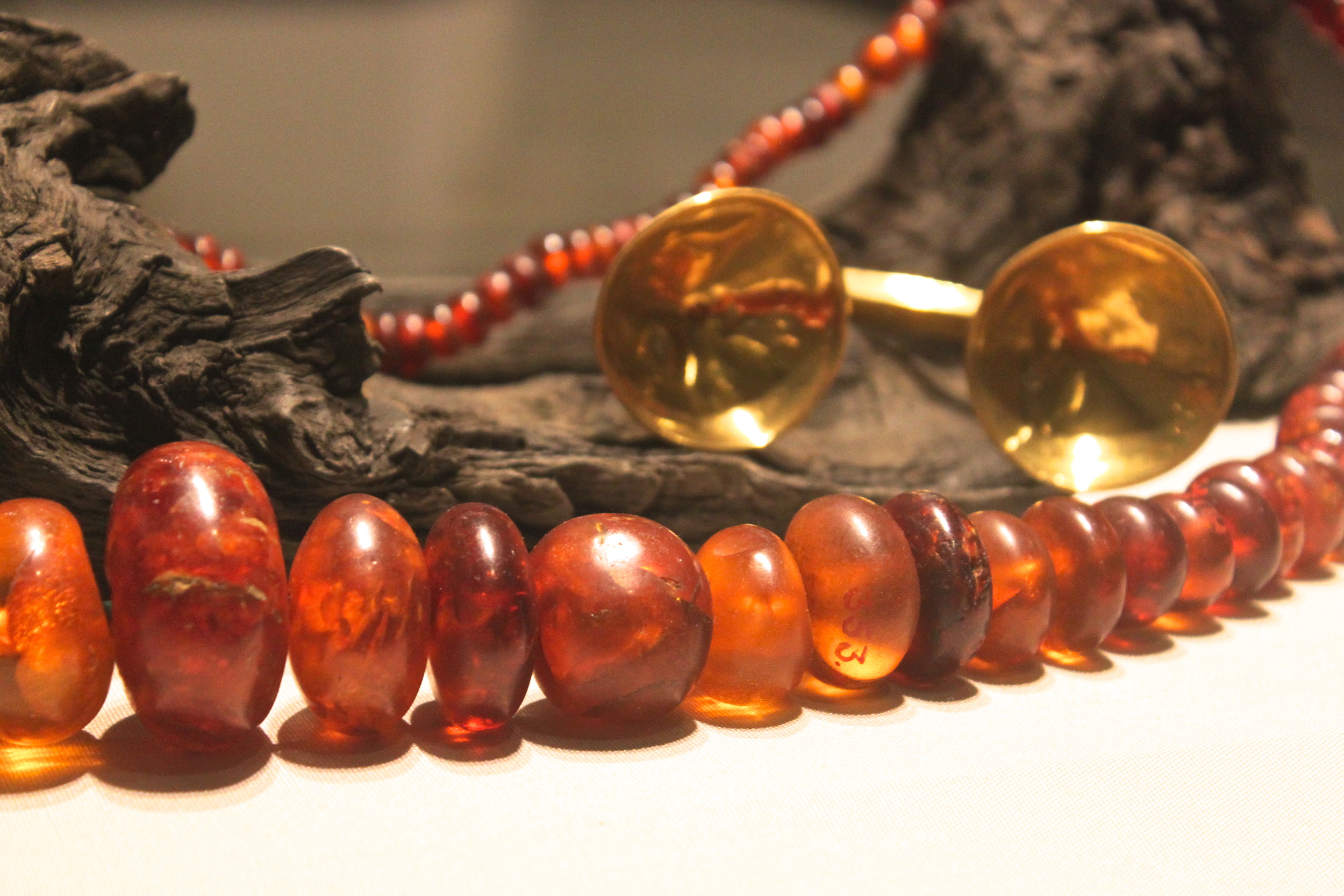
An Amber necklace and a gold dress fastener. 800-700 BC. Ireland.
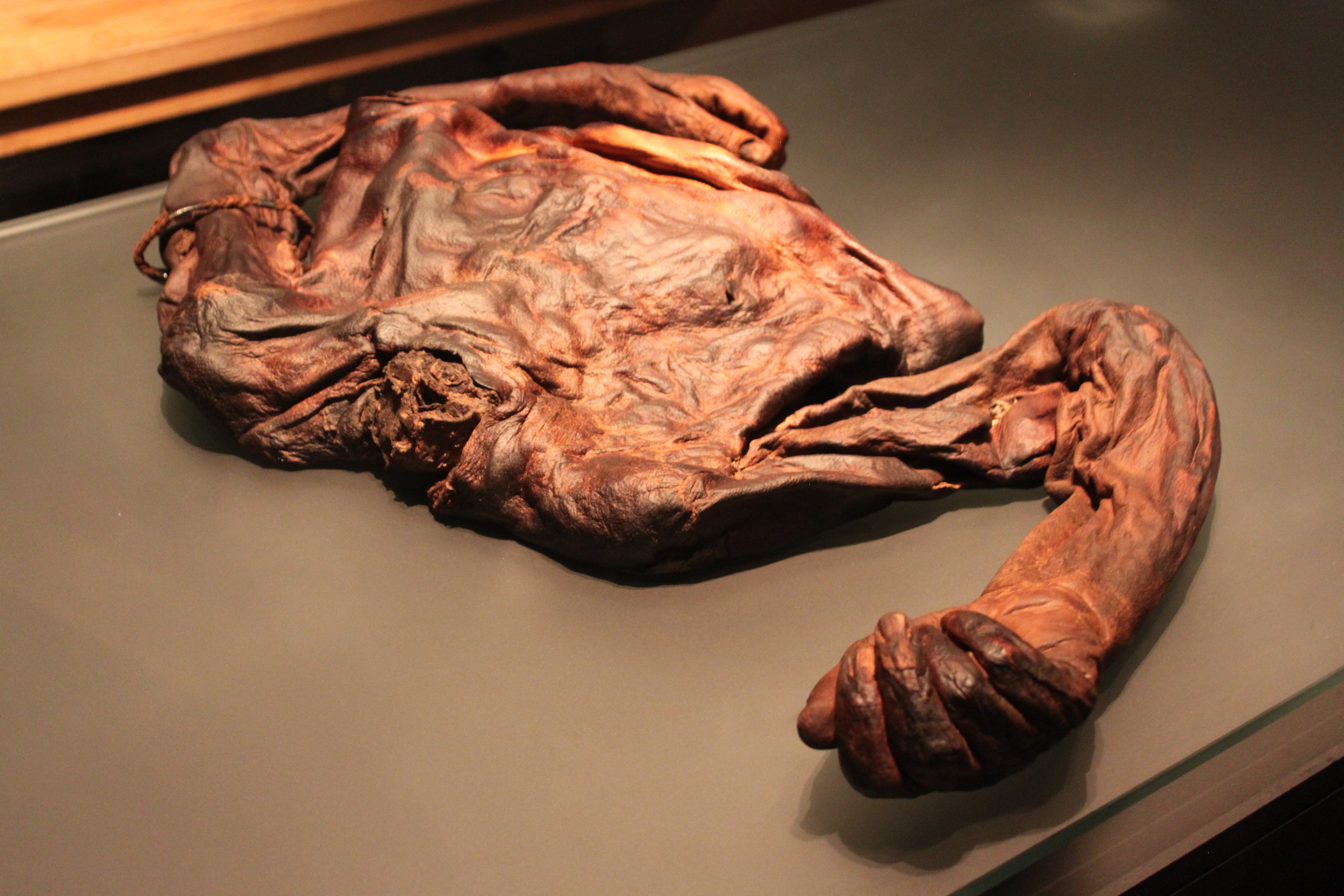
2300 yr old mummified Bog body of Old Croghan Man, with leather and Celtic metal binding.National Museum of Ireland.

2300 yr old mummified Bog body of Old Croghan Man, with leather and Celtic metal binding.National Museum of Ireland.

Amazing to see these rings! Oldest known Claddagh rings in Ireland at Thomas Dillon Jewellers. Galway, Ireland.

Designer Reena Ahluwalia at Aran Island. Ireland. 2013
In the past I have authored posts on, Bejeweled Maharaja & Maharani of Mysore, Koh-i-Noor Diamond, Diamonds on World Postage Stamps, Top Ten - Largest Diamonds Discovered In The World, Splendors of Mughal India, The Magnificent Maharajas Of India, Mystery & History Of Marquise Diamond Cut, Ór - Ireland's Gold, The Legendary Cullinan Diamond, Bejeweled Persia - Historic Jewelry From The Qajar Dynasty, Famous Heart-Shaped Diamonds, Type II Diamonds, Green Diamonds, Red Diamonds and more. Over years, I have spent countless hours in self-driven studies on diamond, jewelry history and research. I wrote these blogs for a simple reason - to share my collected knowledge with all who are interested, so that more can benefit from it. Take a look and enjoy! -- Reena
Splendors of Mughal India
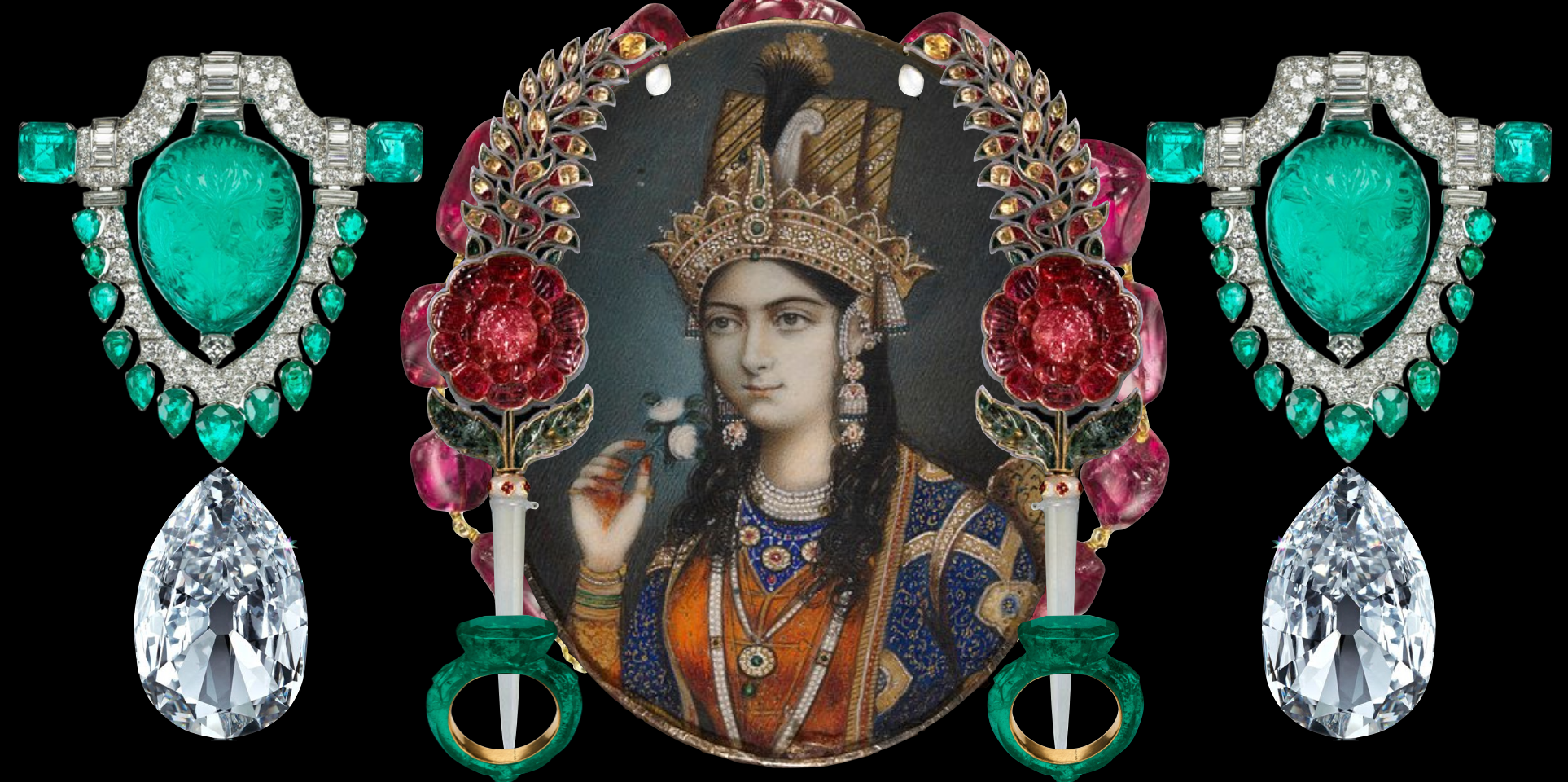
Image complied by Reena Ahluwalia.
I love world cultures! My curiosity over years has made me spend a lot of my time conducting self-studies on various cultures, their rituals, customs, and of course, jewelry. I hope you enjoy my curated list of Mughal jewelry and artifacts in this blog post!
I have tried my best to attribute images to their creators and original sources. Please contact me if you know the source of images that are not attributed.
Mughal emperors were lovers of precious stones, numerous references show the strong cultural belief in gemstone properties. The Timurids, ancestors of the Mughals, had begun the tradition of engraving titles and names on stones of outstanding quality and, along with diamonds and emeralds, large spinel beads were their favorite. As much as these gems were a symbol of the opulence and dignity of the empire, they were also treasured as protective talismans.
Emeralds were enormously popular with the Mughal Court, whose emperors referred to them as “Tears of the Moon” because of their opaque transparency.

One of the most treasured jewel in Indian history: The Taj Mahal Emerald. Circa 1630-1650. A hexagonal-cut emerald, weighing approximately 141.13 carats, it is carved with stylized chrysanthemum, lotus and Mughal poppy flowers, within asymmetrical foliage, to the plain reverse and beveled border. This intricately carved stone is one of a small group of exquisite emeralds commissioned by the Mughal Court, possibly during the reign of Emperor Shah Jahan. The name of the emerald is derived from its intricately carved surface of lotus, poppy flowers, and other foliage that mirrors the decoration of the Taj Mahal. At the Paris Exhibition of 1925, 'The Taj Mahal Emerald' was one of three large Mughal emeralds that featured prominently in Cartier’s Collier Bérénice, a spectacular shoulder ornament that also boasted pearls, diamonds, and black enamel.

The Taj Mahal Emerald, Cartier. Hexagonal-shaped carved tablet emerald of 141.13 carats, circular-cut diamonds, platinum and 18k white gold. Mount by Cartier. Image: Christie’s
The rulers of Mughal India often ordered their names and titles to be inscribed on rubies, emeralds and diamonds, a practice which originated in Iran under the Timurids (1370-1507). Some of these gems ended up in the collection of the Mughal emperors who continued the tradition. In some cases, as the gems were passed down further names were added below those of the previous owners. Many were repolished, recut and re-set as they were handed down. The inscriptions were executed using the traditional cutting wheel or diamond-tipped stylus.

The rectangular-cut emerald known as 'The Mogul Mughal' weighing 217.80 carats. It's a magnificent emerald with a great back story! Carved emerald with a Shi`ite invocation; Mughal or Deccani, 1695-1696. The reverse carved all over with foliate decoration, the central rosette flanked by single large poppy flowers, with a line of three smaller poppy flowers either side, the bevelled edges carved with cross pattern incisions and herringbone decoration, each of the four sides drilled for attachments, 2 1/16 x 1 9/16 x 7/16 in. (5.2 x 4x 1.2 cm.) Originally mined in Colombia, it was sold in India, where emeralds were much desired by the rulers of the Mughal Empire.
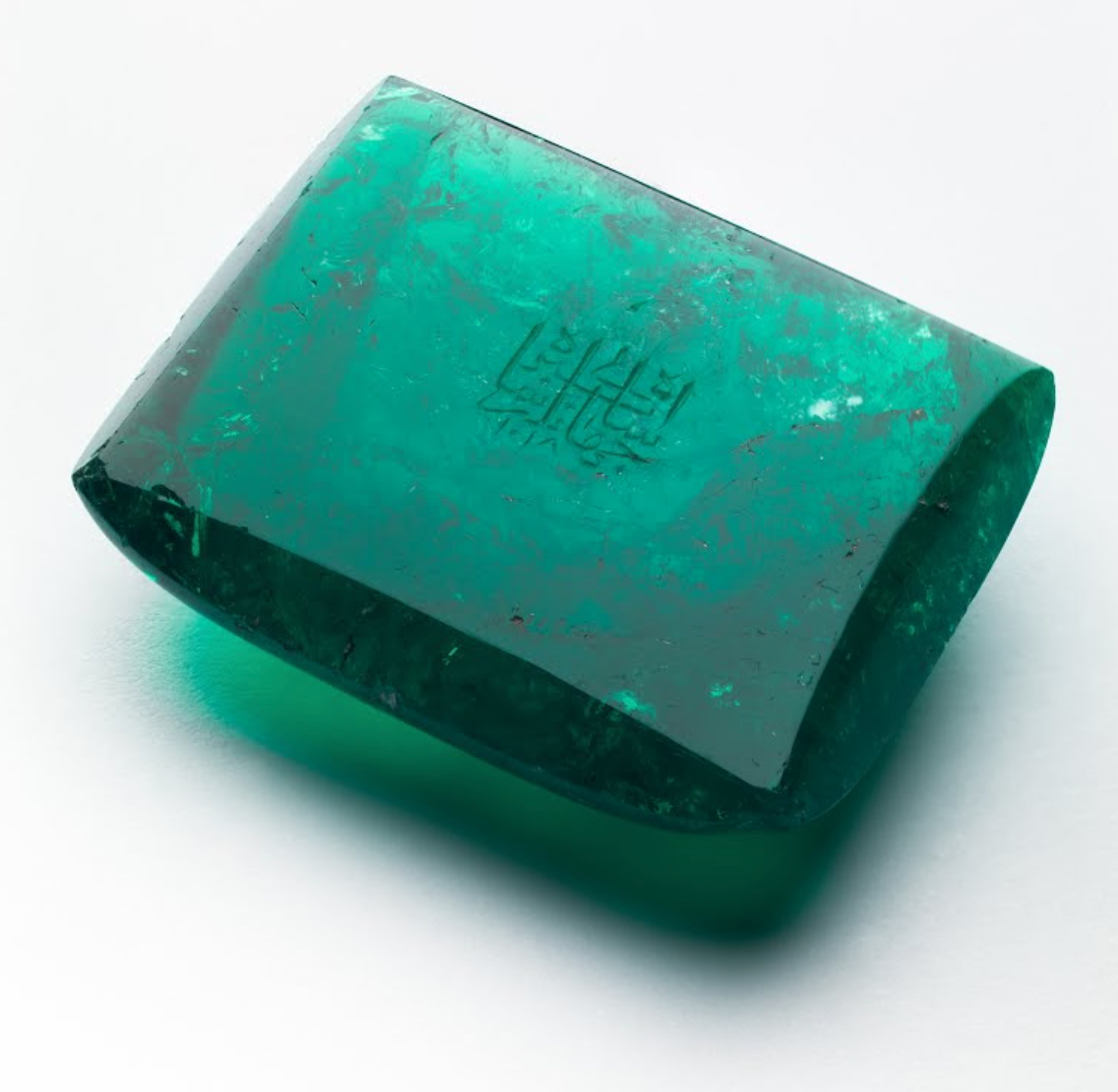
This magnificent, rectangular-cut emerald bears the inscription “Jahangir Shah-i Akbar Shah” and the year 1018 AH (1609-1610 CE) in its centre, and is the only known inscribed and dated Mughal emerald from the reign of the Emperor Jahangir (r. 1014-1037 AH/1605-1627 CE). Usually adorned with Qur'anic verses, mystical sayings, or pious formulas, emeralds – unlike spinels, which were often inscribed with royal titles – were rarely engraved with the names of their sovereigns. The tradition of inscribing stones with royal titles was inherited by the Mughals from their ancestors, the Timurids, and dates back to the 14th century. Believed to possess various healing powers, emeralds were often worn to repel illnesses and evil spirits. Image copyright: The Museum of Islamic Art, Qatar.

Mughal Carved Emerald Necklace comprising five superb Colombian emeralds with an approximate total weight of 1,150 carats, centering on a monumental 470-carat emerald inscribed with the name 'Ahmad Shah Durr-I Durran', founder of the Durrani Empire of Afghanistan and northwest India. This significant inscription also appears on two of the world’s most legendary gems—the Timur Ruby and the Koh-I-Noor diamond—both of which shared a parallel journey with this emerald through the annals of Mughal history from 1612 onward. Image: Christie’s | Magnificent Mughal Jewels: Property from a Royal Collection | 2025

Mughal Carved Emerald Necklace comprising five superb Colombian emeralds. Image: Christie’s | Magnificent Mughal Jewels: Property from a Royal Collection | 2025

Mughal Multi-Gem and Emerald Necklace, featuring four exceptional Colombian emeralds weighing nearly 800 carats. The discovery of fine large emeralds in Colombia during the 16th and 17th centuries brought these treasures to the courts of the Ottoman Turks, the Safavid Persians, and the Mughal Indians. Highly prized by the Mughal dynasty, emeralds of this caliber were celebrated for their natural beauty and often transformed into beads or incorporated into intricate gold works. Image: Christie’s | Magnificent Mughal Jewels: Property from a Royal Collection | 2025

Turban Ornament Ca. 1733 to 1767 CE Gold, Enamel, Emerald, Diamond. Image copyright: The Museum of Islamic Art, Qatar.
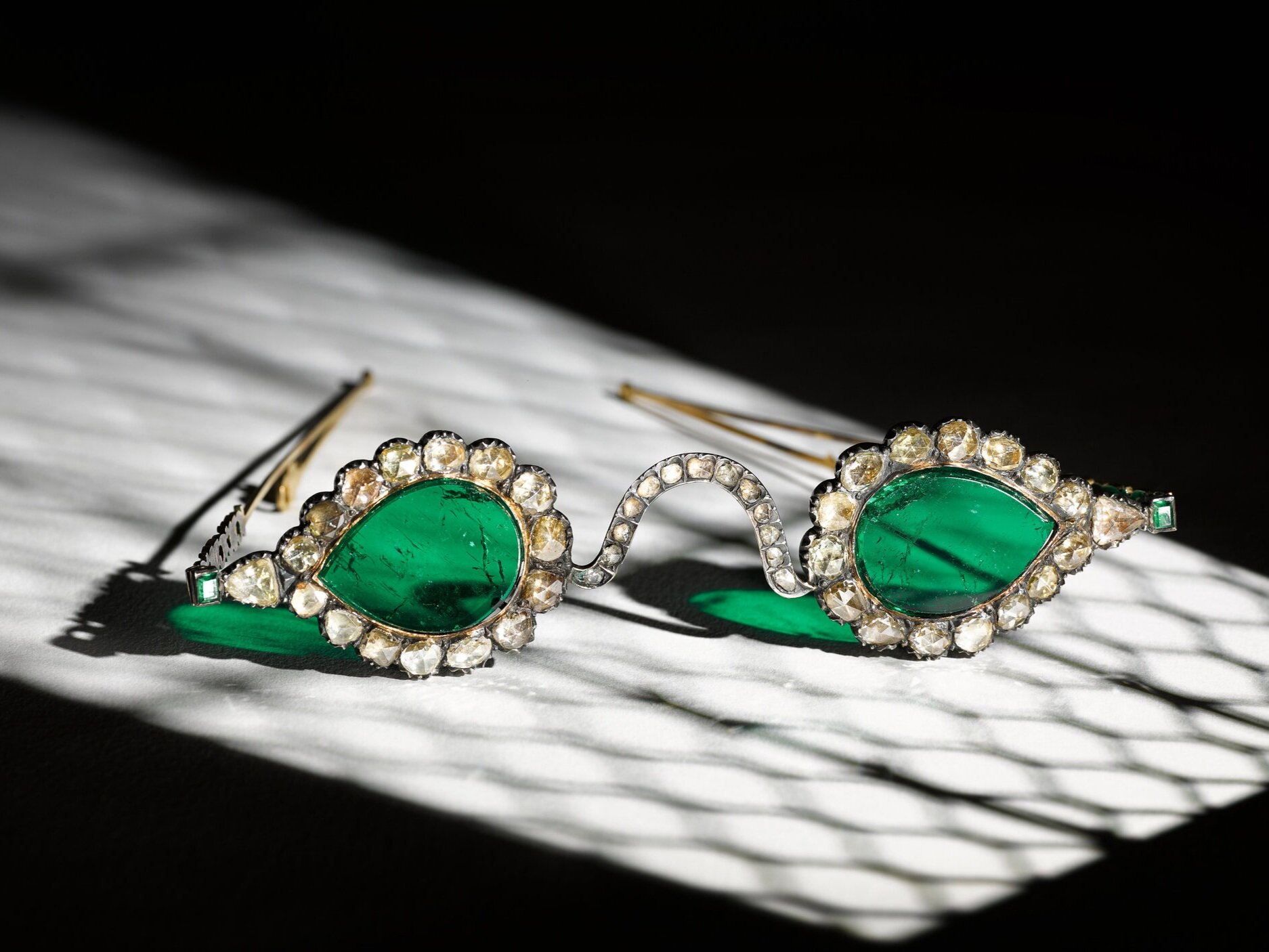
The 17th century jewel-encrusted spectacles, which feature lenses made from diamond and emerald rather than glass, are believed to have originally belonged to royals in the Mughal Empire, which once ruled over the Indian subcontinent. The green lenses spectacles dubbed the "Gate of Paradise," are believed to have been cut from a Colombian emerald weighing over 300 carats. Any gemstone of this size, magnitude or value would have been brought straight to the Mughal court. Image: Sotheby’s, 2021 / Source: CNN
According to Sotheby's, a story surrounds Mughal emperor Shah Jahan, who is said to have used emeralds to soothe his tired eyes after weeping for days following the death of his wife Mumtaz Mahal (for whom he built the Taj Mahal as a tomb).
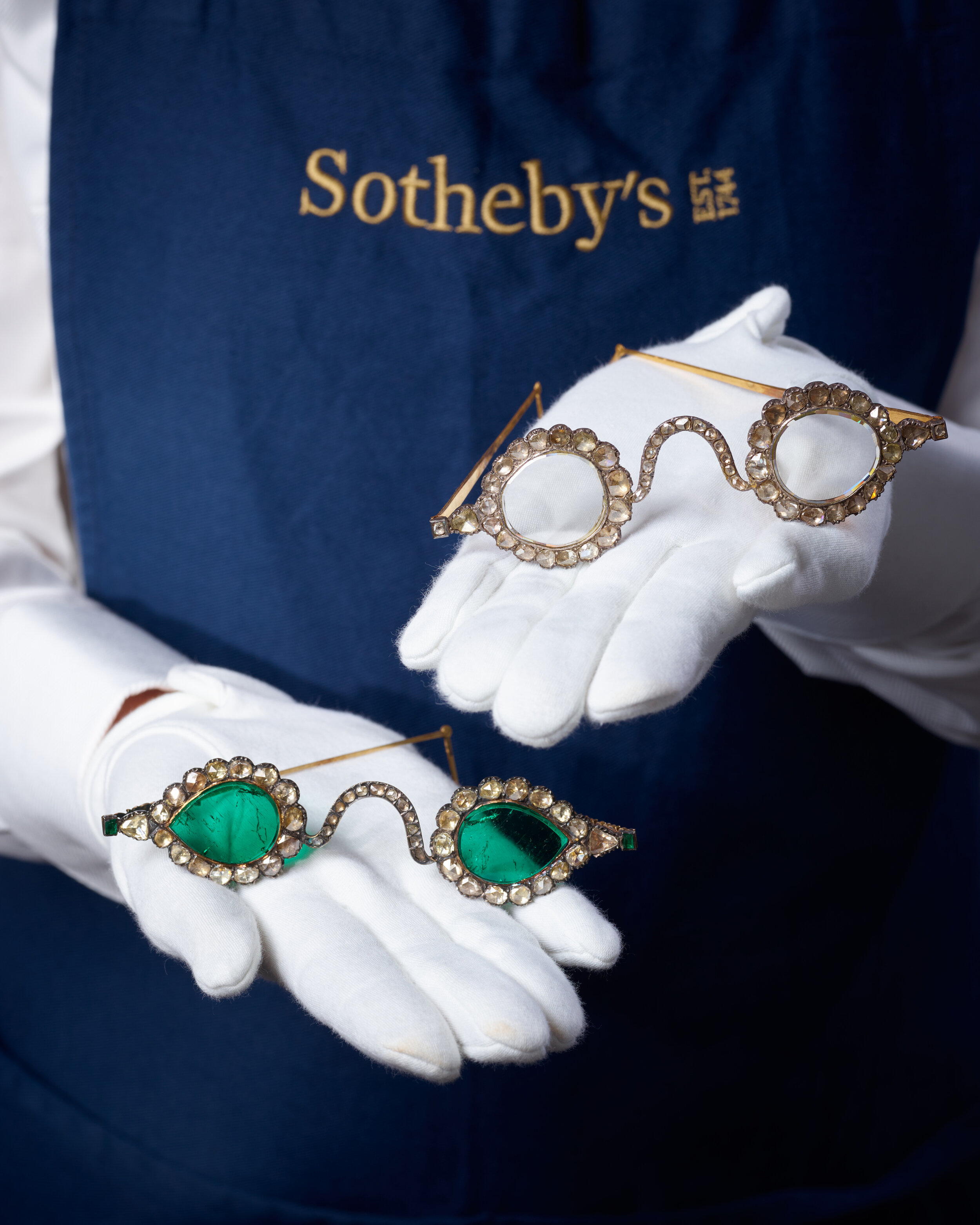
The 17th century jewel-encrusted spectacles, which feature lenses made from diamond and emerald rather than glass, are believed to have originally belonged to royals in the Mughal Empire. The lenses in one pair, known as the "Halo of Light" spectacles, are believed to have been cleaved from a single 200-carat diamond found in Golconda, a region in the present-day Indian states of Andhra Pradesh and Telangana. The green lenses spectacles dubbed the "Gate of Paradise," are believed to have been cut from a Colombian emerald weighing over 300 carats. Any gemstone of this size, magnitude or value would have been brought straight to the Mughal court. Image: Sotheby’s, 2021 / Source: CNN

The 17th century lenses in this pair, known as the "Halo of Light" spectacles, are believed to have been cleaved from a single 200-carat diamond found in Golconda. Any gemstone of this size, magnitude or value would have been brought straight to the Mughal court. Image: Sotheby’s, 2021 / Source: CNN

The Halqeh-e Nur or the "Halo of Light" spectacles, are believed to have been cleaved from a single 200-carat diamond found in Golconda in the 17th century. The frame was made in the 19th century. Any gemstone of this size, magnitude or value would have been brought straight to the Mughal court. Image: William Dalrymple Twitter.

The Shah Jahan Emerald.
North India or Deccan, dated AH 1031 (1621–22)
Inscribed in Persian: Shihab al-din Muhammad Shah Jahan Padshah Ghazi 1031 (“Shihab al-din Muhammad Shah Jahan Ghazi Emperor 1031”). Usually adorned with pious formulas, Koranic verses or mystical sayings, emeralds – unlike spinels or balas rubies often inscribed with royal titles – were rarely engraved with the names of the sovereigns who owned them, hence the singularity of this cabochon-cut emerald bearing the name of Shah Jahan. Image courtesy: Al Thani Collection
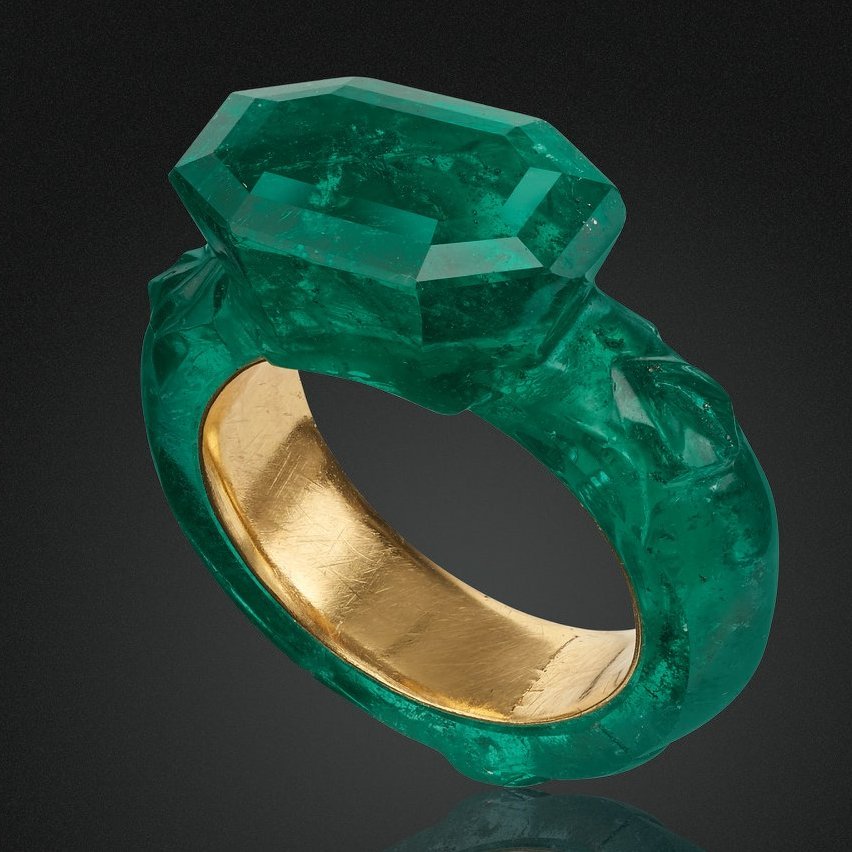
A colossal sole emerald carved into a ring! With a sleeve of gold (later addition). 16th century, India. Verdant Colombian emeralds were revered by the Mughal Emperors and symbolized the force of life. Image: Al Thani Collection / Christie's. Today, it will be very difficult to find an enormous size and quality of emerald (such as this) to be carved into one sole ring. This is an epic piece of gemological and Mughal history.
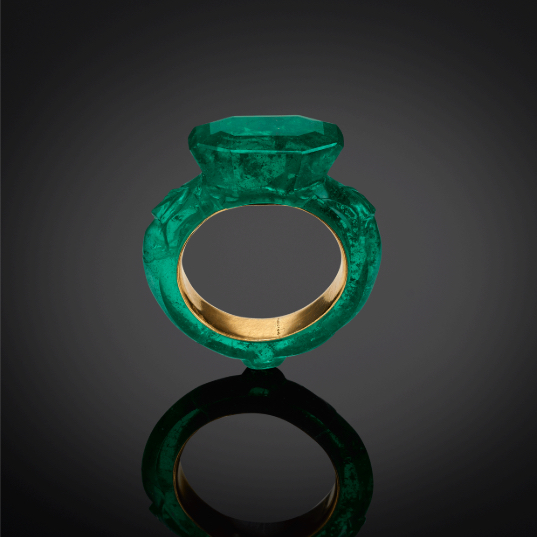
Ring. India, sixteenth century. Emerald, with gold sleeve. Image courtesy: Al Thani Collection

An emerald, diamond and seed pearl necklace, Colombian emeralds, mid- to late-19th century. Image: Christie’s

Brooch, carved emerald from Mughal India is set in a jeweled platinum mount produced in the early twentieth century by Cartier in New York. Image: The Metropolitan Museu

Detail. Brooch, carved emerald from Mughal India is set in a jeweled platinum mount produced in the early twentieth century by Cartier in New York. Image: The Metropolitan Museum of Art.
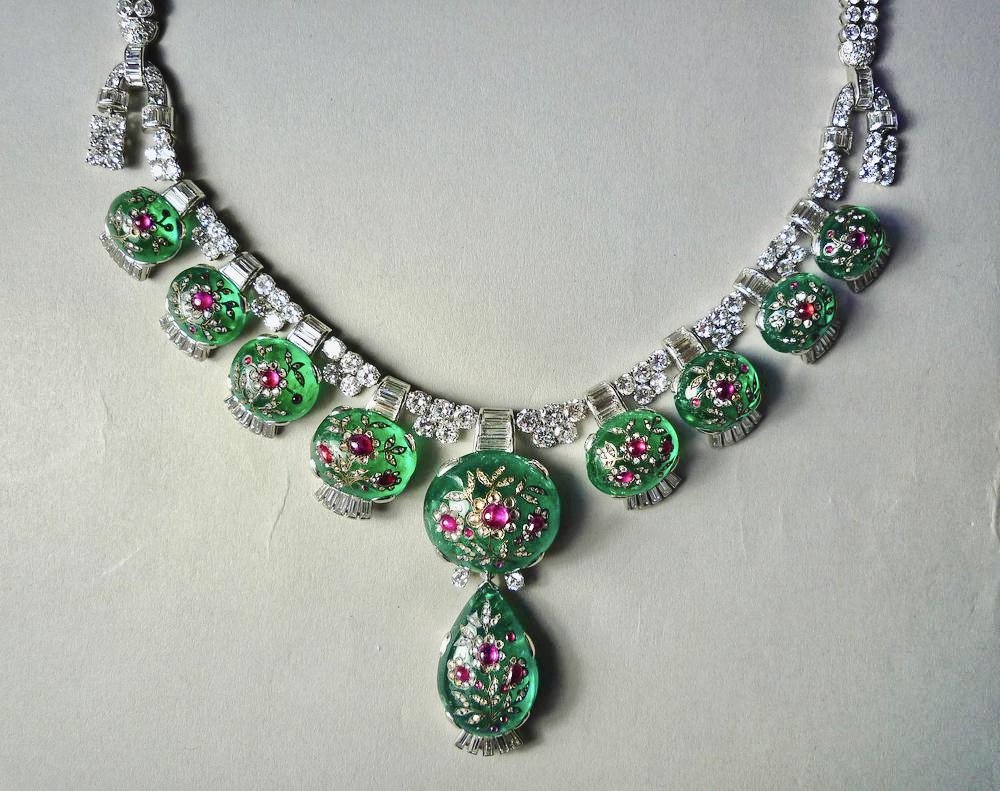
Inlaid emeralds necklace with rubies, diamonds. Mughal Indian work of the 18th-19th century, mounted by Cartier in the 1930s. Image credit: British Museum
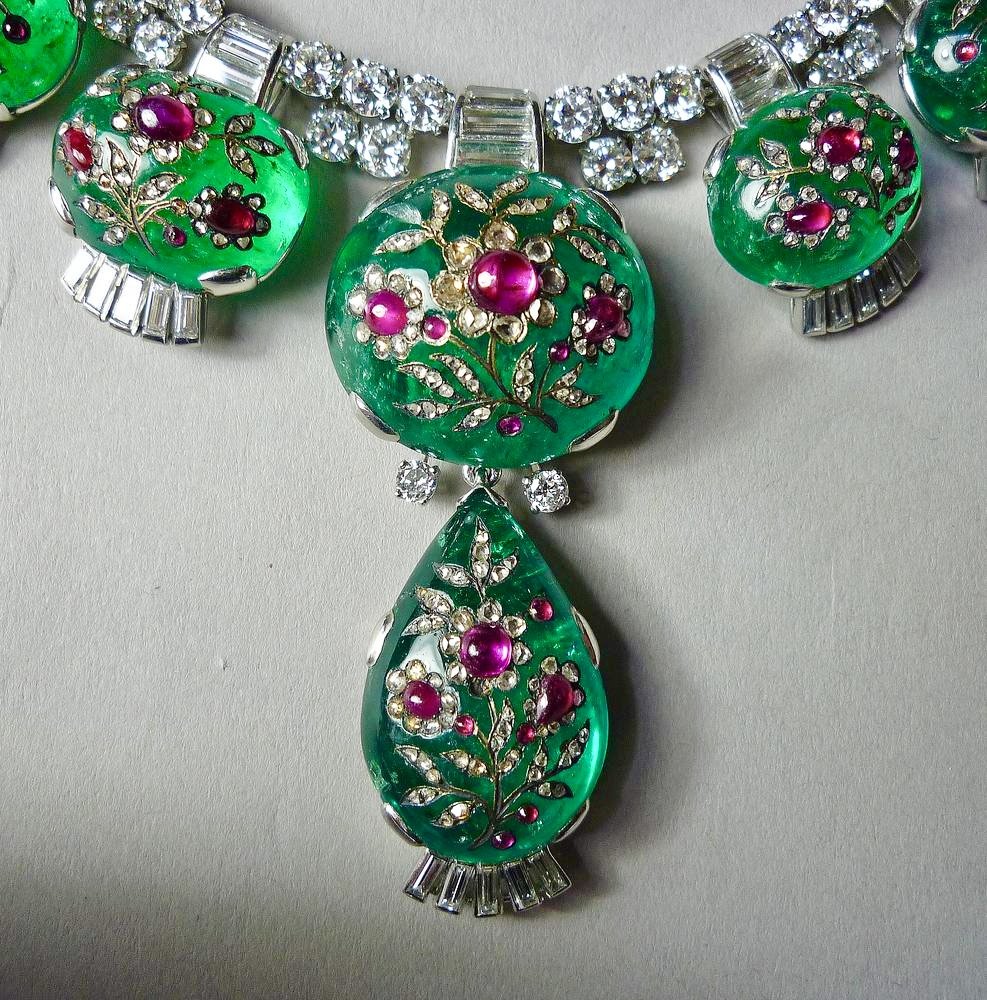
Details. Inlaid emeralds necklace with rubies, diamonds. Mughal Indian work of the 18th-19th century, mounted by Cartier in the 1930s. Image credit: British Museum
The legendary Koh-i-Noor Diamond - a gemstone that witnessed Mughal history
The Koh-i-Noor was set in the Peacock Throne, the world’s most expensive gem-set throne. Set atop the Peacock Throne, the Koh-i-Noor witnessed reigns of many Mughal emperors - Shah Jahan (commissioned the Peacock Throne in 1628), Aurangzeb, Bahadur Shah I, Jahandar Shah, Farrukhsiyar, Rafi Ul-Darjat, Rafi Ud-Daulat, Nikusiyar, Muhammad Ibrahim and Muhammad Shah ‘Rangila’, who eventually lost the Peacock Throne and the Koh-i-Noor diamond in an invasion-loot by Nader Shah of Persia in 1739.
The Peacock Throne (Hindustani: Mayūrāsana, Sanskrit: मयूरासन, Urdu: تخت طاؤس, Persian: تخت طاووس, Takht-i Tāvūs)

Portrait of Mughal Emperor Shah Jahan on the bejewelled Peacock Throne. 19th century. Image credit: The Metropolitan Museum of Art (Image of Koh-i-Noor added by Reena Ahluwalia for this educational blog). In 1628, Mughal ruler Shah Jahan commissioned this magnificent, gemstone-encrusted throne. Among the many precious stones that adorned the throne were two particularly enormous gems that would, in time, become the most valued of all: the Timur Ruby—more highly valued by the Mughals because they preferred colored stones—and the Koh-i-Noor diamond. According to eyewitness account of Persian historian, Muhammad Kazim Marvi, of the 1739 invasion of Northern India by Nader Shah, Marvi notes: “On top of this was placed a peacock made of emeralds and rubies; on to its head was attached a diamond the size of a hen’s egg, known as the Koh-i-Noor – the Mountain of Light.”
The Koh-i-Noor Diamond, meaning "Mountain of Light" in Persian, is a legendary diamond of Indian origin. The diamond has been a subject of desire, intrigue and conquests for centuries. A widely traveled gem, it has passed through the hands of the Mughals emperors, Persian Shahs, Emirs of Afghanistan and Maharajas of Punjab. The stone later ended up in the British Crown Jewels in 1849, when a ten-year-old Maharaja Duleep Singh was persuaded to hand over the Koh-i-Noor to Queen Victoria when the Punjab Region of India was annexed. Since then, Koh-i-Noor has remained in the British Crown Jewels, becoming a symbol that many attach to the humiliation and pain of colonial past, conquests and the British Raj.
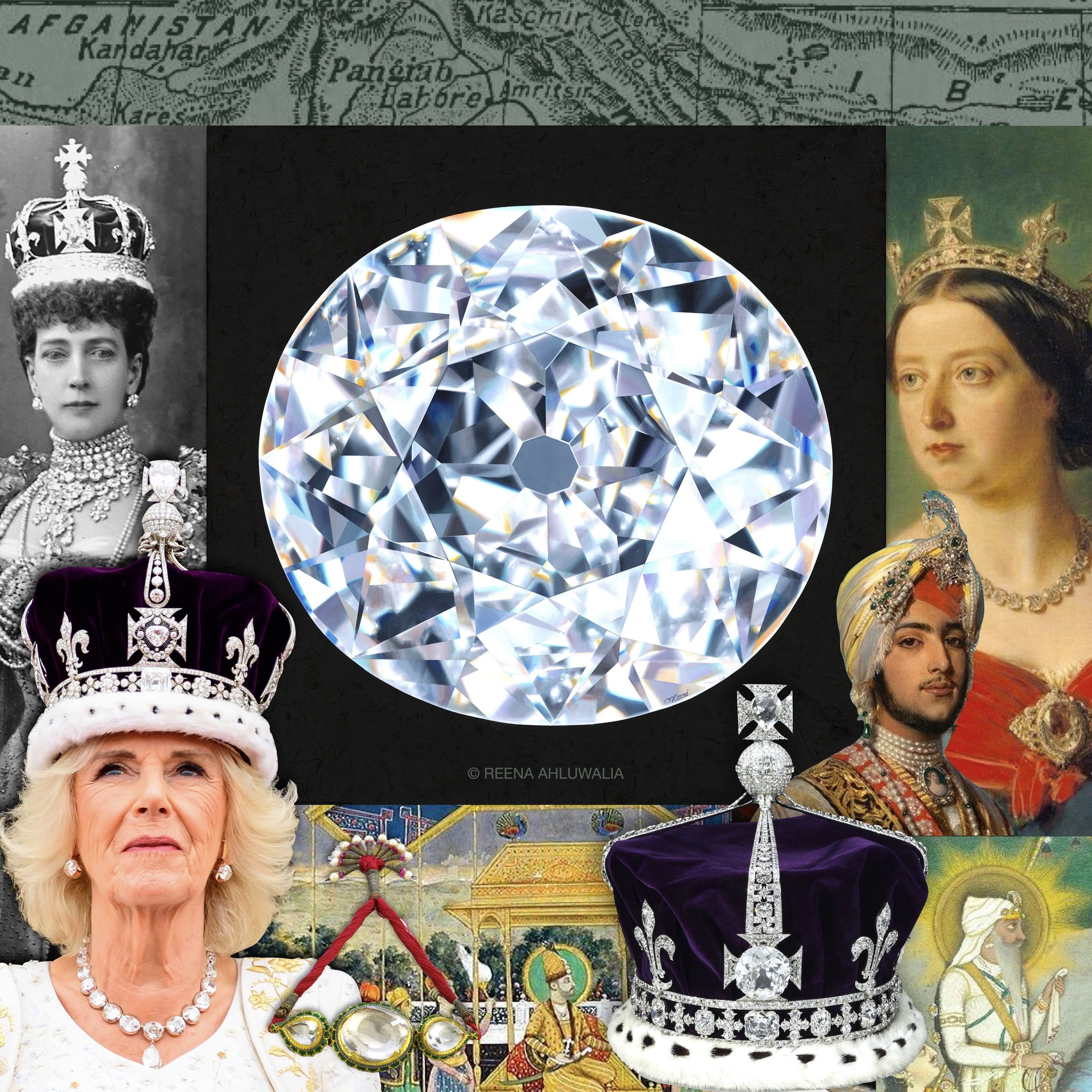
The world’s most famous, Koh-i-Noor is a diamond of monumental stature. Image: Compliled by Reena Ahluwalia, with Reena’s painting of the Koh-i-Noor diamond at it’s center.

The Arcot II Diamond. Pear brilliant-cut diamond of 17.21 carats. The Arcot Diamond, a D-colour stone was one of two such diamond ear drops sent as gifts to Queen Charlotte (1744-1818), the wife of King George III, from the Nawab of Arcot. The diamonds were later acquired at auction by the Marquess of Westminster and subsequently mounted in the Westminster Tiara, which was worn at the coronation of Queen Elizabeth II. Image: Christie’s

The Nizam of Hyderabad Necklace. Diamond, emerald and enamel necklace. The eight modified triangular-shaped table-cut golconda diamonds, variously-shaped faceted and rose-cut diamonds, carved emerald bead, green enamel, foil, gold, engraved on the reverse with foliate motif, 16 in, late 19th century. The modified brilliant-cut of these diamonds reflect the advancement of gem faceting in India. Additionally, the openwork setting and symmetrical nature of the necklace's design is the direct result of Western influence. Image: Christie’s

Wine cup made for the Emperor Shah Jahan, 1657, India, white nephrite jade. Museum no. IS.12-1962, © Victoria and Albert Museum, London. This unique wine cup of white nephrite jade is an outstanding example of jade craftsmanship and is one of the most exquisite surviving objects from the court of the Mughal dynasty that ruled the Indian subcontinent from about 1526 to 1857. The cup was made in 1657 for Shah Jahan who ruled the Mughal Empire from 1628 to 1658.
The wine cup of Shah Jahan
The cup consists of a gourd shape with a handle shaped like the head of a ram. The base features acanthus leaves radiating out from a lotus flower which is raised to form a pedestal for the cup. The different features of the cup reflect the variety of cultural and artistic influences that were welcomed at the Mughal court. Persian in their cultural background and Indian by adoption, the Mughals were also open to new ideas from the West. Jesuits at the Mughal court, entertaining futile ideas of converting an Empire, were welcomed for their learning; ambassadors and merchants for their exotic gifts and promises of trade. Craftsmen-adventurers were especially welcomed for their skills and knowledge of unfamiliar technologies.
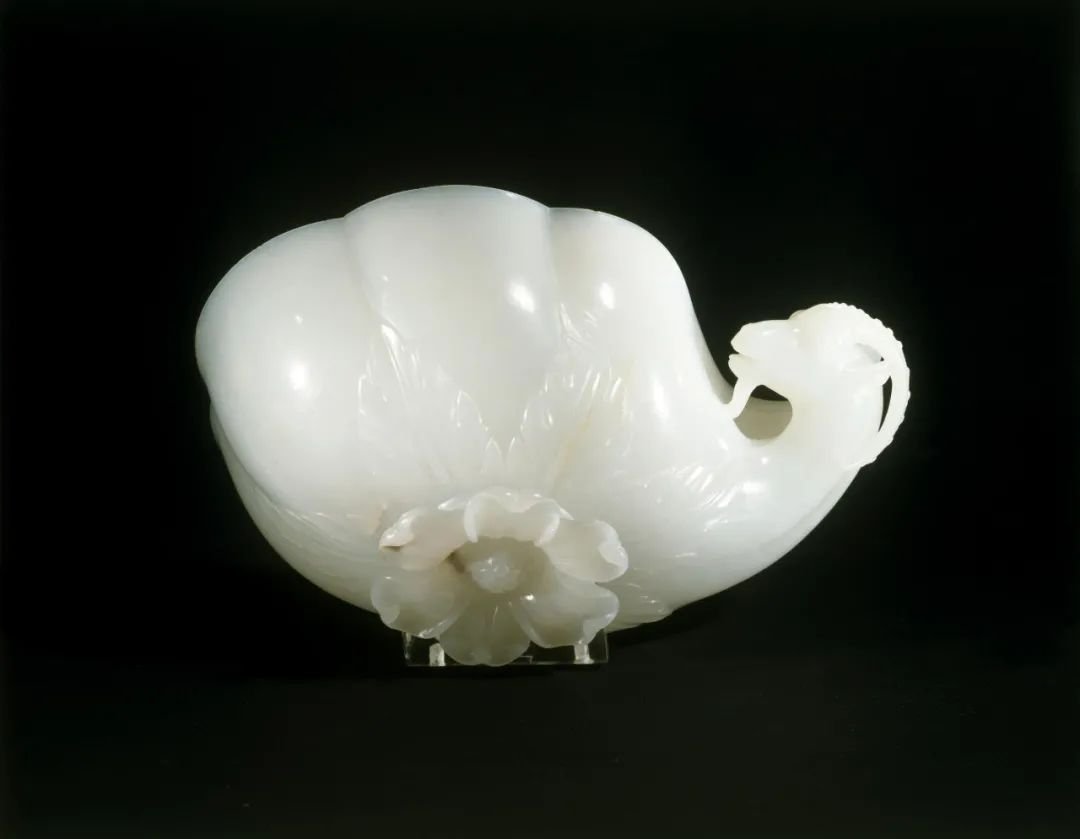
Wine cup made for the Emperor Shah Jahan, 1657, India, white nephrite jade. Museum no. IS.12-1962, © Victoria and Albert Museum, London.
The use of a gourd form for the body of the cup is Chinese in inspiration, while the lotus petals and sensitivity of animal portraiture are characteristic features of Hindu art. The ideas of the pedestal support and the use of acanthus leaves are also European in origin and parallel similar elements in the decoration of Mughal architecture during Shah Jahan's reign.

An enamelled and gem set model of a parrot, Hyderabad, Deccan, circa 1775-1825. Set with diamonds, rubies and emeralds and with a pendant emerald hanging from its beak, on a stand similarly decorated, base decorated with two central flowers in green and white enamel and four leaves in each corner. Image: Christie’s
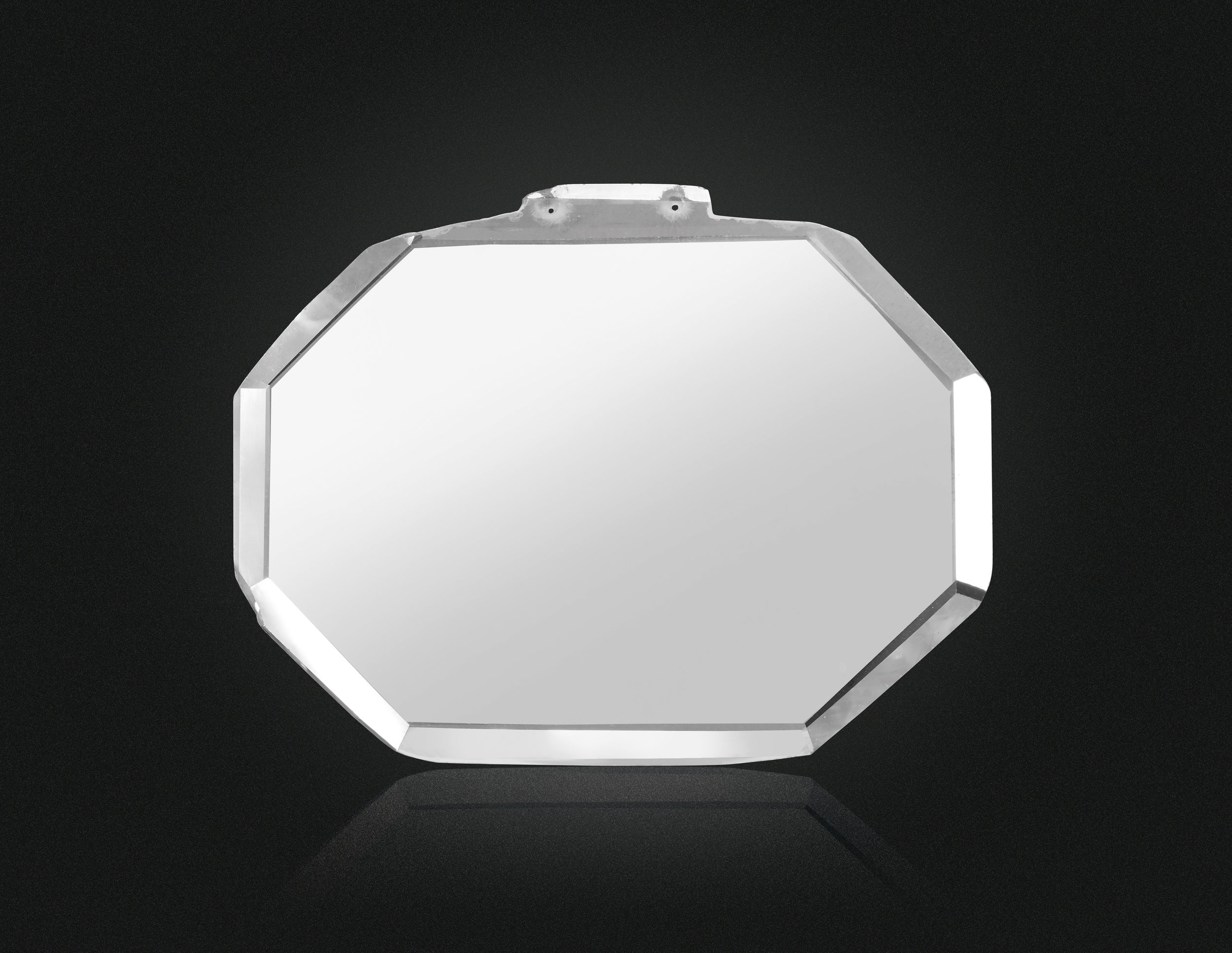
A Mughal cut-cornered rectangular portrait-cut Golconda diamond of 20.22 carats, Type IIa. The present diamond also exhibits a feature common in gems shaped for Mughal use, a pair of drilled holes by which a stone could be sewn to a turban or garment to impart both pomp and courtly fashion. Image: Christie’s.
Portrait diamonds, also called lasques, are among the earliest cut diamonds preserved to this day. Extremely shallow, they consist of virtually nothing but two tables separated by a tiny row of girdle facets. They were sometimes used to cover miniature paintings and therefore came to be known as portrait diamonds. Due to their extreme flatness, they were unsuited for later recutting and their original shape was preserved, making them historically significant.
Large portrait diamonds are extremely rare and among few famous examples is one seen on a portrait of Shah Jahan from 1616, where he holds a turban ornament set with an emerald and a portrait diamond or the ‘Russian Portrait Diamond’, dating around 1820, covering a miniature portrait of Czar Alexander I in a bracelet.
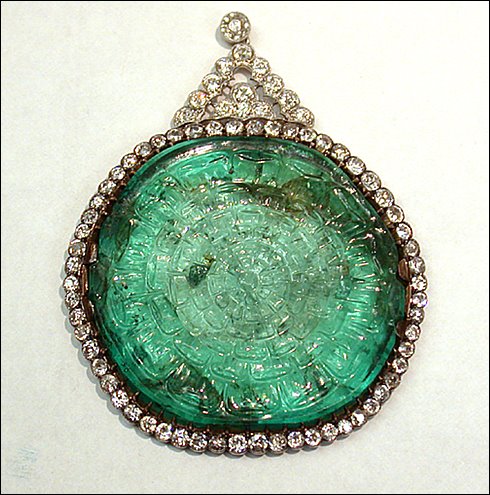
This carved flat emerald is set in a platinum, gold, and diamond pendant necklace. The emerald was discovered in Colombia, possibly by Spanish conquistadors, and found its way to India for cutting. Smithsonian, photography by Ken Larsen.

Historic and remarkable Mughal Emerald necklace. Small drill holes in the sides of the emerald, possibly used to attach the stone to a cloak or turban, also are consistent with a Mogul origin. The emerald is surrounded by round diamonds and is suspended from a double row diamond necklace; the diamonds total approximately 50 carats. A hallmark indicates that the Mogul emerald was set into the pendant and necklace in France around the turn of the 20th century. Smithsonian, photography by Ken Larsen.

A Mughal carved emerald pendant set with enamelled parrot-shaped mounts, India, 19th century, with later pearl necklace. Previously in the family collection of Shaikh Gholam Muhyi ad-Din, Governor of Kashmir (1832-45). Image: Sotheby’s.

Marjorie Merriweather Post’s platinum brooch from the 1920s, featuring a spectacular 60-ct. carved Mughal emerald surrounded by diamonds.
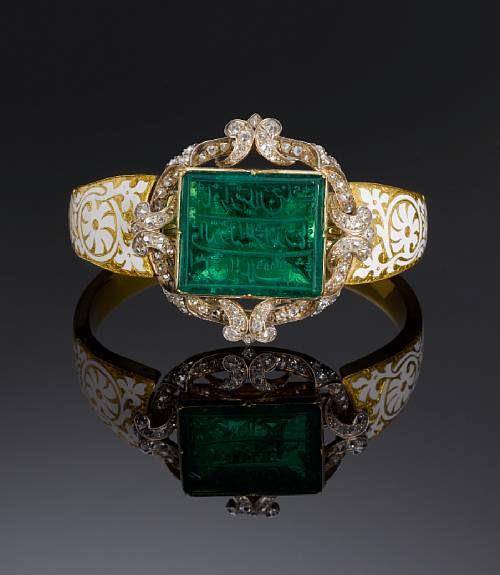
An inscribed Mughal emerald personal seal set in a diamond encrusted gold bangle and bearing the name of Major Alexander Hannay, an East India Company officer. Photo Bonhams

Mughal emerald and diamond sarpech. Mid-18th century. 78 emeralds are of Colombian origin. Photo: Christie's
Spinels (balas rubies) were highly prized in the Mughal court and were usually drilled as beads and used as pendant gemstones on necklaces, turban ornaments or earrings. Abu'l Fazl treasury historic records indicate a hierarchy of gems where spinels were listed in advance of diamonds, rubies, sapphires and emeralds. They were admired for their colour which followed the Persian literary tradition of representing wine and the sun, evoking the light of dusk.
Tavernier reported that he counted 108 large balas rubies (spinels, it is believed) mounted on the famous Peacock Throne, all cabochon cut, the smallest weighing about 100 carats and some 200 carats or more.

A 128.10 carat inscribed Mughal Spinel Bead. Engraved 'Jahangir Shah Akbar Shah', dated 'AH 1018/1609-10 AD', and 'Shah Jahan, Jahangir Shah', dated 'AH 1049/1639-40 AD', to the fabric torsade necklace. Jahangir was a great connoisseur of gems. He was described by a contemporary English visitor, the Rev. Edward Terry, as ‘the greatest and richest master of precious stones that inhabits the whole Earth’. His passion for gems was continued by his son, Shah Jahan. The origin of the spinel is Tajikistan, with no indications of heating. Together with the historical context of such spinels, this jewel can be considered a true treasure of nature. Image: Christie's (2016)

An Imperial Mughal spinel necklace with eleven polished baroque spinels for a total weight of 1,131.59 carats. Three of the spinels are engraved. Two with the name of Emperor Jahangir (1569-1627), one with the three names of Emperor Jahangir, Emperor Shah Jahan and Emperor Alamgir, also known as Aurangzeb.

Inscribed royal spinel (balas ruby) weighing 249.3 carats. This majestic stone is inscribed with the names of its six imperial owners and has the distinction of having the second-most number of such inscriptions. It was a gift from the Safavid Shah Abbas the Great of Iran to the Mughal emperor Jahangir in 1621. Image courtesy of © The Al-Sabah Collection.
Rulers mentioned in inscriptions:
1. Timurid, Ulugh Beg (before 1449)
2. Safavid, Shah Abbas I (1617)
3. Mughal, Jahangir (1621)
4. Mughal, Shah Jahan (undated)
5. Mughal, Alamgir (Aurangzeb) (1659 – 1660)
6. Durrani, Ahmad Shah (1754 – 1755)

Detail: Inscription on an Imperial Mughal spinel necklace. These spinels mainly originated from the Badakhshan mine, in the 'Pamir' region (on the frontier between Afghanistan and Tajikistan). This province gave its derived name to spinels, described as 'Balas rubies' for decades.

Mughal Three-Strand Spinel and Natural Pearl Necklace with eight exquisitely inscribed stones, following the revered Mughal tradition of memorializing gemstones to record their illustrious provenance, these spinels bear the names of some of the most powerful figures in history — from Muhammad ibn Tughluq-Shah, the Sultan of Delhi, to the first Mughal emperor Babur, and later, Emperors Jahangir and Shah Jahan. With an approximate total weight of over 2,000 carats, the spinels showcase the vibrant and coveted color that has been prized by royalty for centuries. Image: Christie’s | Magnificent Mughal Jewels: Property from a Royal Collection | 2025

Mughal Three-Strand Spinel and Natural Pearl Necklace with eight exquisitely inscribed stones, following the revered Mughal tradition of memorializing gemstones to record their illustrious provenance, these spinels bear the names of some of the most powerful figures in history — from Muhammad ibn Tughluq-Shah, the Sultan of Delhi, to the first Mughal emperor Babur, and later, Emperors Jahangir and Shah Jahan. With an approximate total weight of over 2,000 carats, the spinels showcase the vibrant and coveted color that has been prized by royalty for centuries. Image: Christie’s | Magnificent Mughal Jewels: Property from a Royal Collection | 2025

Ring with Shah Jahan’s Spinel
North India, the spinel dated AH 1053 (AD 1643– 44); the ring, c. 1900Gold with enamel, the spinel inscribed in Persian: Sahib qiran-i thani (“Second Lord of the Auspicious Conjunction”)
Dating from 1643, this spinel is engraved on the reverse “Sahib qiran-I thani” which translates as “Second Lord of the Auspicious Conjunction”, the title of Emperor Shah Jahan who ruled 1628 - 1658. The title was chosen by Shah Jahan himself in reference to Timur (Tamerlane), the Mughals’ dynastic ancestor, who bore the title “Lord of the Auspicious Conjunction”. It is most likely that the engraving on the spinel was also the sovereign’s personal seal. Image courtesy: © The Al Thani Collection

The Taj Mahal Diamond [circa 1621] - a diamond with extraordinary provenance! Owned by Jahangir, ruler of Mughal India and father of Shah Jahan who built the Taj Mahal. The Taj Mahal diamond was gifted by Richard Burton to Elizabeth Taylor for her 40th birthday. Diamond is inscribed in Arabic on either side.
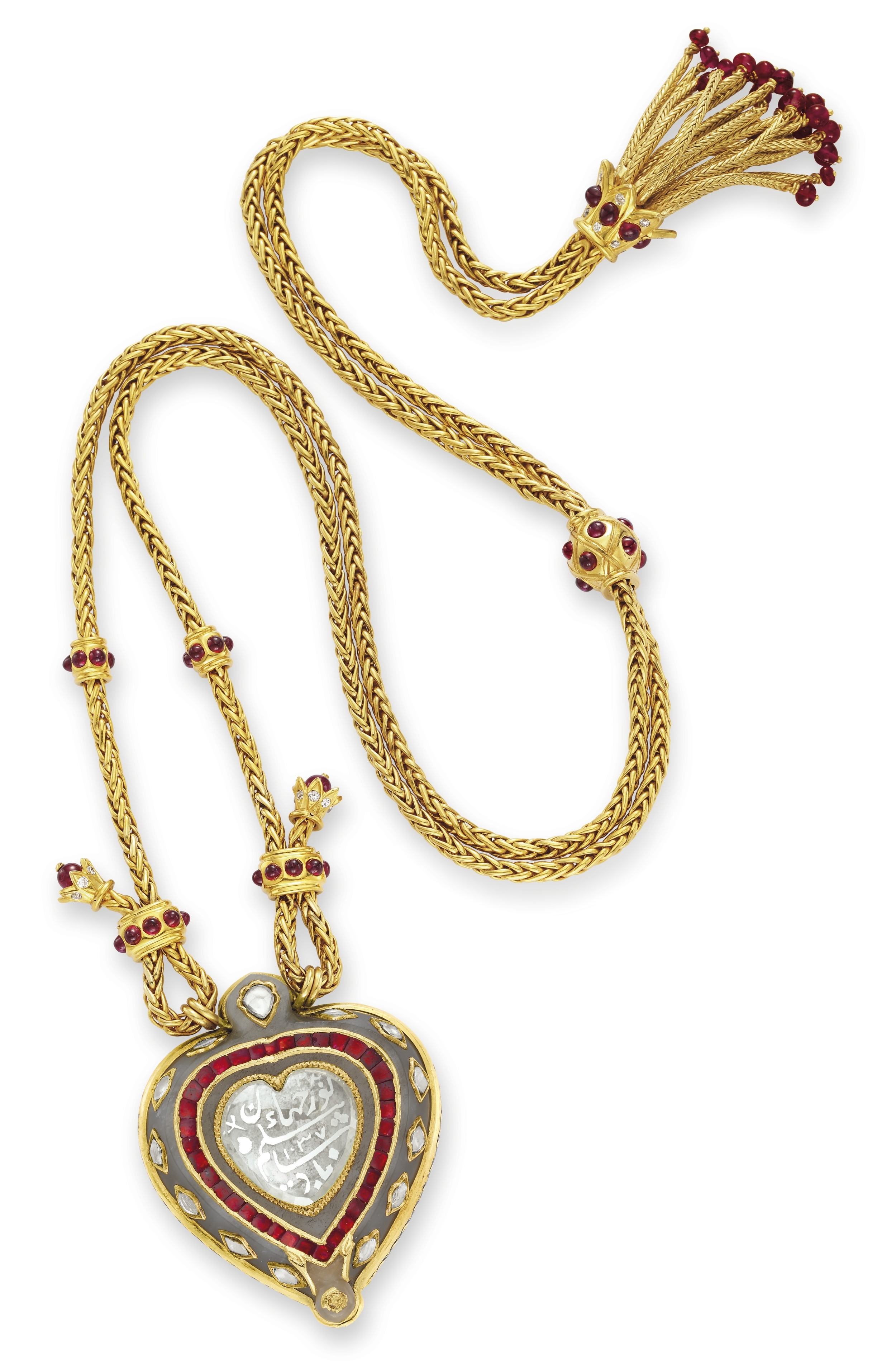
Legendary Taj Mahal Diamond. I was fortunate to privately view and hold this diamond in the palm of my hand at Christie's New York in December 2011. It's an incredibly piece of diamond history.

This massive Mughal baroque pearl must have been prized for its size and perfectly imperfect shape. It was drilled for suspension as a pendant, perhaps from a necklace, and given a decorative gold setting in the form of petals that were originally enamelled. Marks in the gold cap of the pearl have been read as the number 982, and interpreted as representing a year, corresponding to 1574-75 CE, which falls during the reign of the Mughal emperor Akbar (r. 1556-1605 CE). Image, copyright: The Museum of Islamic Art, Qatar.

Rare image of Mughal Coins. Mughal emperors. Photo: The David Collection

Gold coin of Emperor Jahangir. Ajmer. Ninth year of reign. 20.5 mm. On deposit from Christ Church, Oxford. Credit: Ashmolean Museum
The Emperor Jahangir (r. 1605–27) showed exceptional engagement with his coinage, which represents the height of Mughal Indian numismatic art in calligraphy and design. The front of this example features a portrait of Jahangir sitting cross-legged, reclining against a bolster on a hexagonal throne and holding a goblet-like ornament in his hand. It has been described as a wine goblet, showing the Emperor's attachment to his favourite pastime. The Farsi inscription around the portrait reads, ‘Destiny has made the picture of a likeness of venerable king Jahangir on this gold coin’. Jahangir issued coins bearing his portrait, by his own admission, to be given to his followers as a special gift which they could ‘wear on their turbans or sashes’ to show that they had been graced by imperial favour.

Reverse. Gold coin of Emperor Jahangir. Ajmer. Ninth year of reign. 20.5 mm. On deposit from Christ Church, Oxford. Credit: Ashmolean Museum.
On the reverse is a central sun burst with compartments on either side. The one on the left mentions Ajmer as the place where the coin was made (Jahangir had moved his court there in 1615–19 and 1023, the Islamic (Hijri) year of its issue. On the right are the words ‘O Assister’, followed by ‘Year 9’, the year of the reign. The Farsi inscription reads ‘The words “Jahangir” and “Allahu Akbar” are equal in value till the Day of Judgement’. Based on the so-called Abjad system, which applied numerical value to each letter of the alphabet, the words ‘Jahangir’ and ‘Allahu Akbar’ (‘Allah is greater’) were considered to add up to the same total.

Gold coin. (whole) Lion surmounted by sun. (reverse) Portrait of Jahangir. (obverse). AD 1611. Credit: The British Museum.

Mughal gold coin, issued by Jahangir. Constellation of Tora (Taurus)/Vrishabha. AD 1605-1627. Image credit: Classical Numismatic Group.
Jahangir (1605-1628), Emperor Akbar’s son and immediate successor, used the Ilahi Era to great artistic effect by issuing two series of mohurs that incorporated Ilahi Era elements. The earliest series, known as the portrait series, since the coins show the emperor on the obverse, all show the constellation Leo superimposed over the sun – a reference to Jahangir’s birth in August. This series was struck within a three-year span early in Jahangir’s reign and are quite rare. The second series, known as the zodiac series, since each of the twelve constellations of the Zodiac is represented on the reverse, was a much larger series. Struck both in gold and silver, the zodiac series was issued from several mints (with Agra being the primary), and like the previous series, minted over three or four years. Since the Ilahi months were solar months and corresponded with the solar ecliptic (an imaginary line in the sky that marks the annual path of the sun), each month was represented by an appropriate sign of the Zodiac, recording its particular month of issue. Because many of these coins had been recalled and melted by Jahangir’s successor, Shah Jahan, original strikes are very rare.
“Previously to this, the rule of the coinage was that on the face of the metal they stamped my name, and on the reverse the name of the place and the year of the reign. At this time it entered my mind that in place of the month they should substitute the figure of the constellation which belonged to that month...in each month that was struck, the figure of the constellation was to be on one face, as if the sun was emerging from it.” ~ The Memoirs of Jahangir [Tuzk-e Jahangiri] (Entry for 20 March 1619)

Gold Zodiac coins / Gold dinars of Jahangir. Credit: Ashmolean Museum

The powder flask was an essential firearm accessory and held the fine powder needed to make the gun fire. Gunmakers in India during the Mughal era (1526-1858) specialized in carving ivory powder flasks with animal figures. Often, as this example, the decoration consists of intertwined and composite creatures that seem to grow out of or attack one another. 18th century. Note: International trade in ivory is banned (The Convention on International Trade in Endangered Species (CITES).

An unusual ivory Archer's Ring in the form of a Falcon probably Mughal, 18th Century formed by a three dimensional bird with ruby-set eyes and folded wings. Photo: Bonhams.

A rare Mughal archers thumb-ring of hippo ivory, India, 17th/18th Century. Sotheby's

Jade archer's thumb-ring. Mughal dynasty, 17th century AD. India. British Museum

1650. Thumb rings of this type were originally used in archery as a way of releasing the bow-string accurately without injuring the hand. Thumb rings made with precious materials became objects of royal status in the Mughal courts of India. Photo: V&A

Dress archery ring of Mughal emperor, Shah Jahan. Second quarter of the 17th century. Gold set with carved and polished uncut diamonds, rubies and emeralds. Photo: State Hermitage Museum.
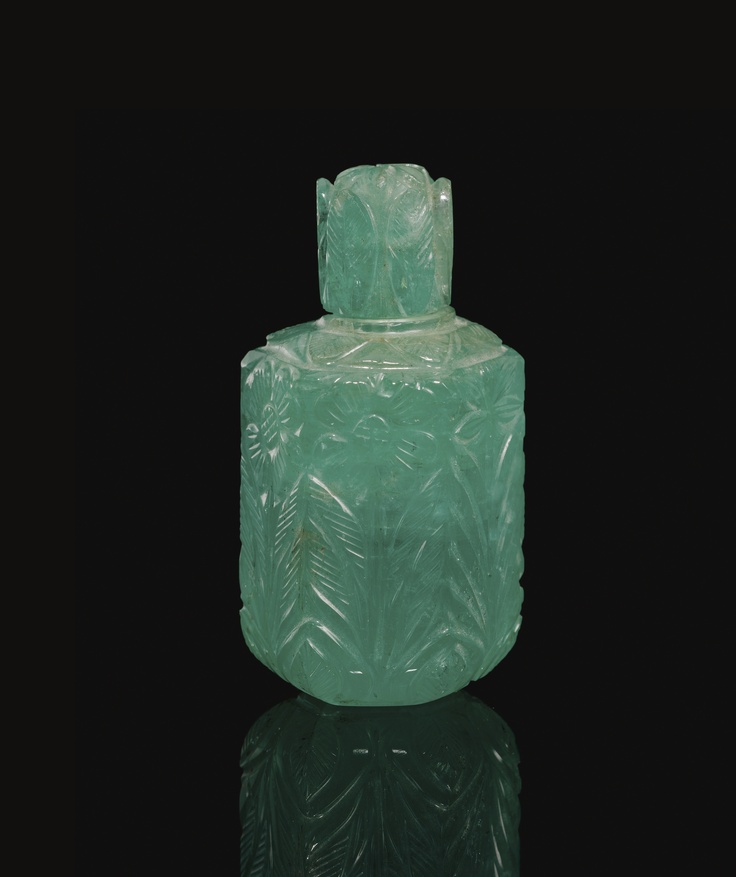
A Mughal carved emerald flask with stopper, India, circa 18th century. The body of faceted hexagonal form, cut and carved on each face with a floral stem, the stopper carved with eight stylised leaves and a star design to the top. Sotheby's
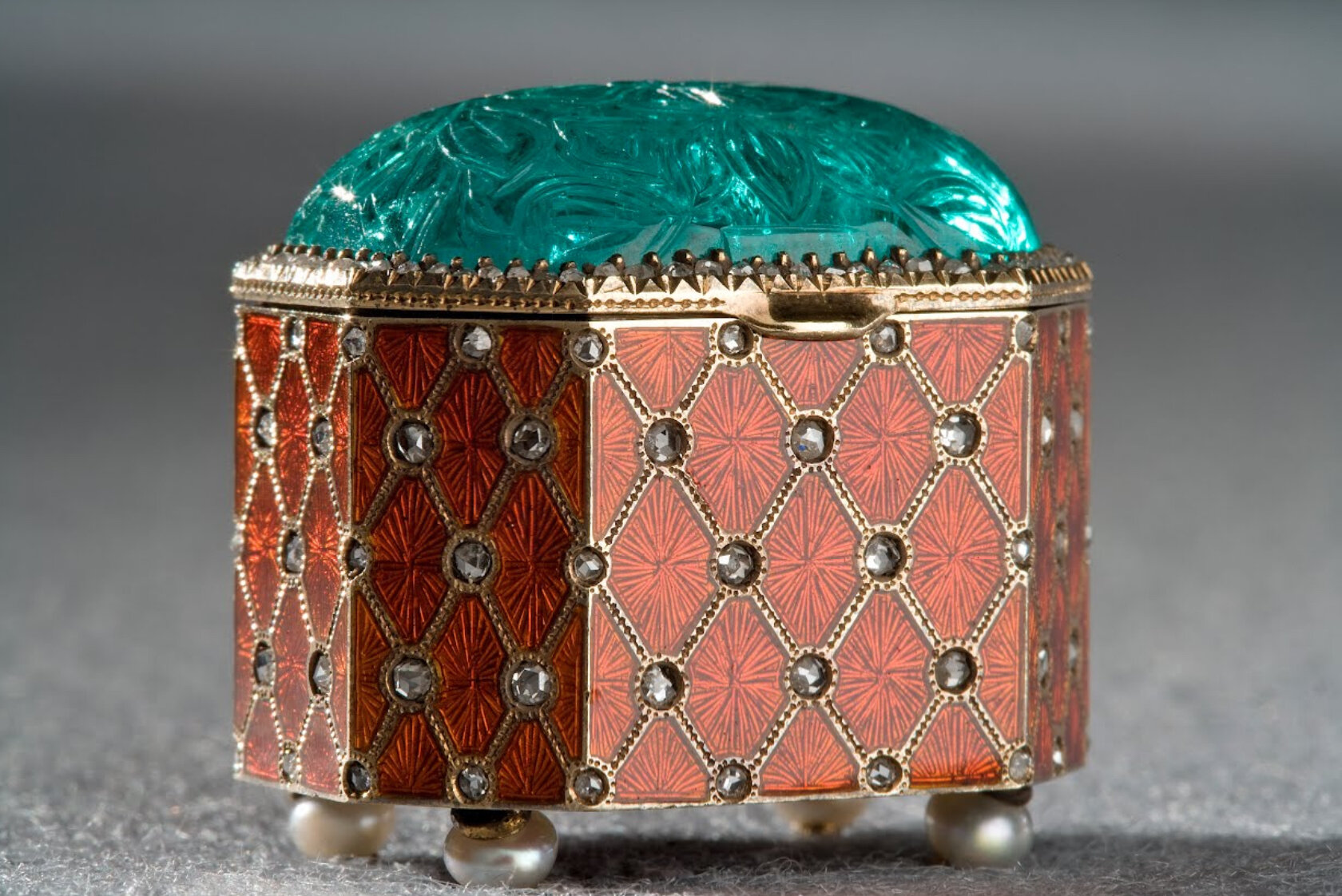
Engraved Emerald Gem Set box. 16 century Mughal India. Image copyright: The Museum of Islamic art. Qatar.
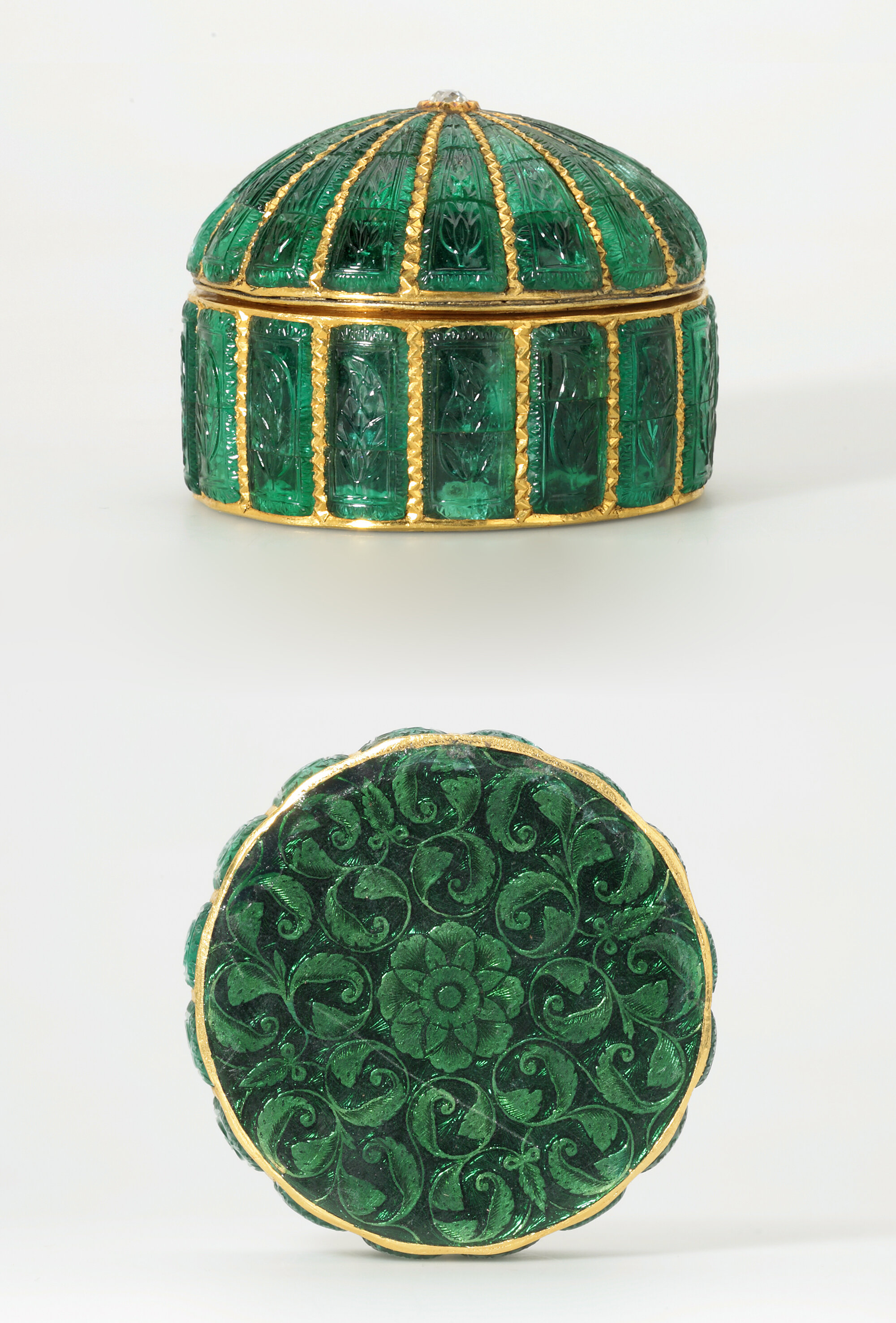
Emerald-ser box, Mughal India. 1635. Gold sheet, set with carved Colombian emeralds and a faceted diamond in gold kundan, with an enamelled base. The sides and lid of this spectacular gold box are set with 103 emeralds, perfectly matched and fitted. They are carved in shallow relief to depict cypress trees within borders of repeated stylized leaves. Similar boxes made of various precious materials appear in Indian miniatures from the early 17th century on. They could have been for medicines (including opium, a Mughal panacea) or to hold even more precious objects, such as uncut diamonds. The decoration suggests European influence, which presumably came into Mughal court art during the first half of the 17th century with the European craftsmen in the service of Jahangir and Shah Jahan. It is possible that the designs were influenced by engravings from the studio of Bernard Salomon who worked at Lyons in the mid-16th century. Image: The Nasser D. Khalili Collection of Islamic Art

Mango-shaped scent bottle Mid-17th century Rock crystal with rubies and emeralds set in gold. Mughal India. Image: Asia Society

Mango-Shaped Flask, mid-17th century India Rock crystal, gold and gemstone inlay. Photo: The Metropolitan Museum of Art.
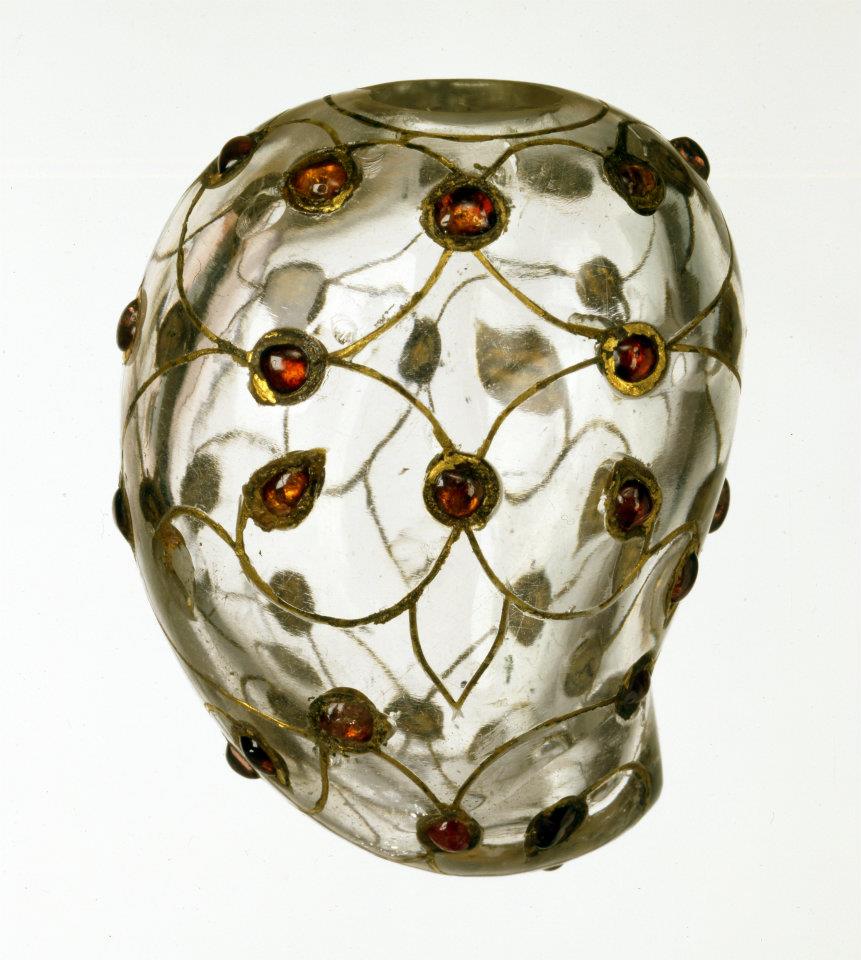
Mango-shaped container, rock crystal, inlaid with gold and rubies. India, Mughal; 17th century. The princes of the Mughal dynasty had a special love for semi-precious stones like jade and rock crystal, and their artists achieved a very high degree of perfection in carving objects such as dagger hilts, bowls, and rings from these materials. Grooves cut into the materials could then be inlaid with gemstones and gold. Photo: The David Collection

Holding Mughal history in my hand at the Natural History Museum, London! A rare private viewing from the vaults of NHM of a 31-ct., faceted 'rose cut' #sapphire in a Quartz 'rock crystal' button inlaid with gold, rubies, emeralds. Purchased by Sir Hans Sloane for £43 (!), late 17th century. Image credit: Taken by Reena Ahluwalia at the Natural History Museum, London. 2016

Claude Martin's Mughal Dagger. The hilt of this magnificent Mughal dagger is fashioned from rock crystal inlaid with gold and set with rubies, emeralds and diamonds. The dagger was formerly owned by Claude Martin, one of the most prominent East India Company officials. It was under his patronage that great Lucknavi artists, such as Bahadur Singh and Mihr Chand, combined their Mughal training with European conventions and materials to produce innovative works of art. Image credit: The Wallace Collection

Details. Claude Martin's Mughal Dagger. Image credit: The Wallace Collection
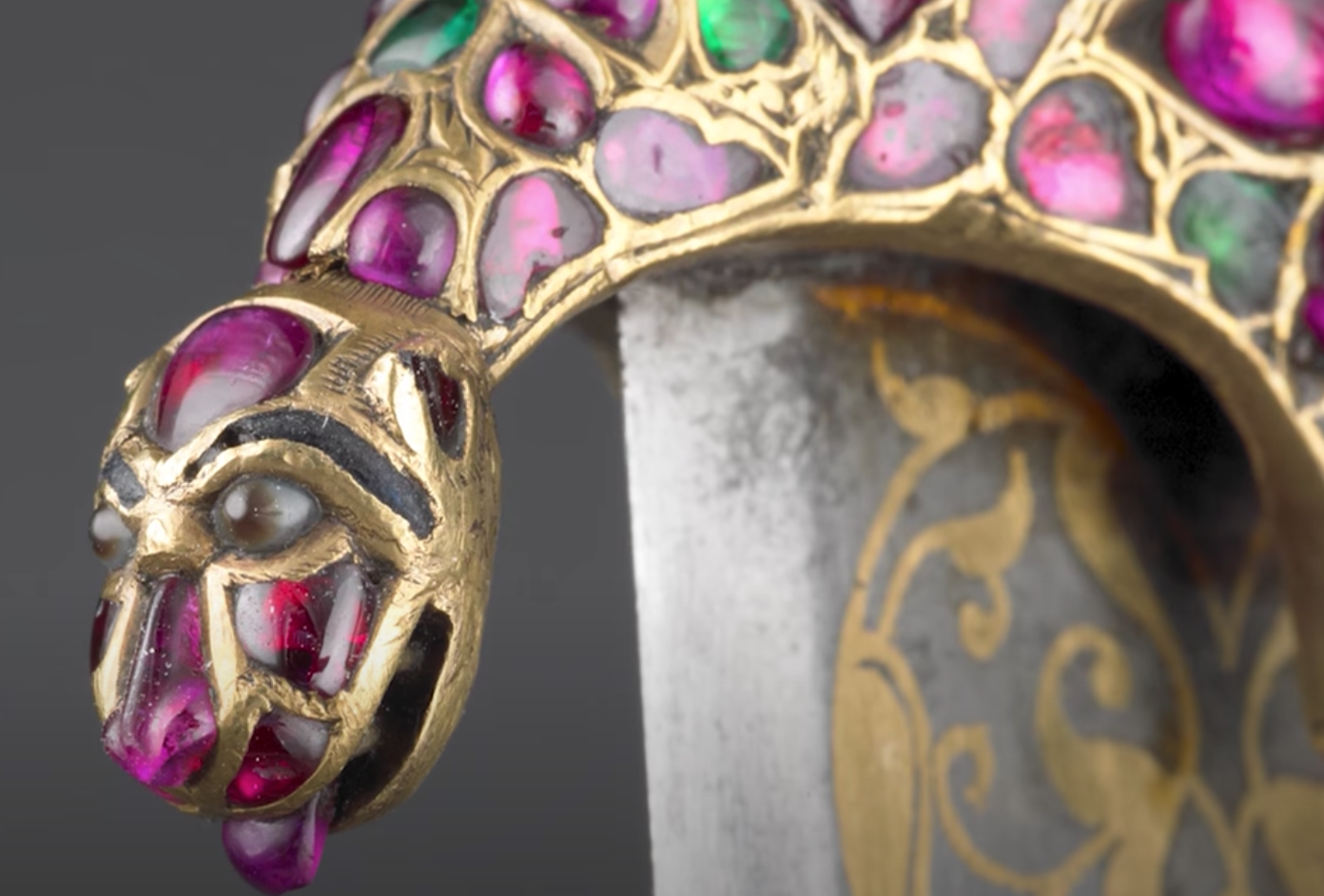
Details. Claude Martin's Mughal Dagger. Image credit: The Wallace Collection

Details. Claude Martin's Mughal Dagger. Image credit: The Wallace Collection

Details. Claude Martin's Mughal Dagger. Image credit: The Wallace Collection

Crown of the Emperor Bahadur Shah II (the last Mughal emperor). 1850. Gold, turquoises, rubies, diamonds, pearls, emeralds, feathers and velvet. The Royal Collection©

A Mughal gem-set silver and gold rosewater sprinkler. North India, , 17th/18th century. Photo: Christie's

An Indian gem-set gilt-metal casket with bird-head finial. Mughal, India. Photo: Sotheby's
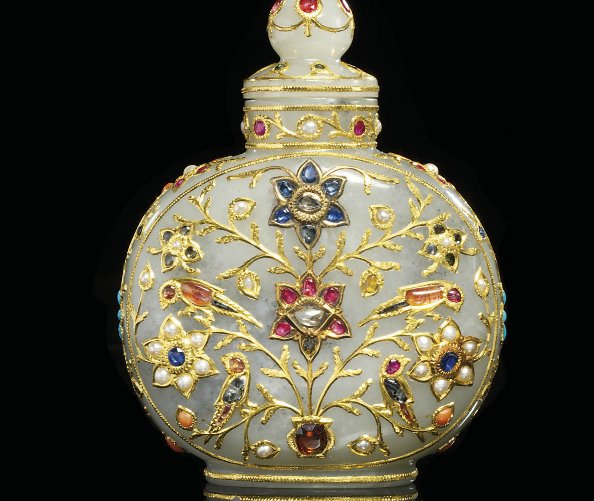
A Mughal-style gemstone-encrusted white jade scent bottle. 18th/19th century. Of flattened circular shape on a short oval foot, the cylindrical neck fitted with a screw-top cover with a knop finial, the body inlaid in gold and inset with gem stones including diamonds, rubies, sapphires and emeralds, depicting two panels on the front and back enclosing birds and blossoming branches, the sides with further blossoms.

Highly detailed plate. 17th century, Mughal India. Gold, kundan setting technique, uncut diamonds, rubies, emeralds and enamel. Presented by the ambassadorial mission of Iranian ruler Nadir-Shah to the Russian Imperial Court, 1741. Photo: State Hermitage Museum.

A diamond-inset and enamelled bowl and stand. Deccan or Mughal India, late 18th century. Photo: Christie's

Dish, colorless glass, decorated with enamel and gilded. India, Mughal; c. 1700. The flowers on the dish were contoured on the inside with gold and filled in with red and yellow enamel, while the outside was painted solely in yellow. This produces a kind of three-dimensional effect that is characteristic of Mughal glass art with painted decoration. Photo: The David Collection

Turban ornament. 1700-1750. Wearing plumes in a turban indicated royal status in Mughal India. Nephrite jade, gold inset with rubies, emeralds, probably topaz, with gold foil, rock crystal and pearl. Photo: V&A

Kundan set eagle pendant. Mughal, India. Rubies, diamonds, pearls, enamel. Photo: The Al-Sabah collection.

Mughal parrot finger ring (c.1600–1625) with a three-dimensional bird that can rotate and bob (possibly providing hours of entertainment for its owner) is set with rubies, emeralds, diamonds and a single sapphire. Photo: The Al-Sabah collection.
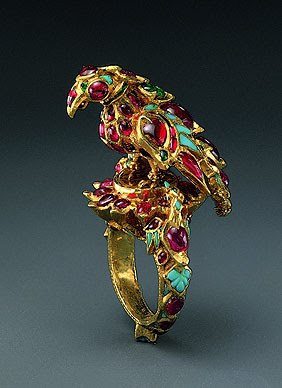
Bird Finger Ring (1st quarter of the 17th century), Indian, Mughal or Deccan - Gold, rubies, emeralds, turquoises; carving, kundan technique. Photo: The Al-Sabah collection.

Pendant in the form of an eagle, Mughal India, 18th century. Gold, cast and chased, set with foiled diamonds, rubies, emeralds, and sapphires in gold kundan. Photo: © Nour Foundation

This extraordinary figurine comes from the Mughal dynasty of India. Gold, pearl, ruby, diamond and enamel squatting duck on a stand. Photo: British Museum

Gold and enamel figurine of an elephant with large natural baroque pearl forming its back and diamonds on its head. Mughal, India. Image credit: British Museum

Golden spoon, quite literally!
A rare Mughal gem-set gold spoon, India, 17th-18th century. The back is delicately inlaid on the reverse with a lotus rosette comprised of radiating foil-backed diamond petals and rubies, the faceted tapering shaft inlaid with emeralds and bands of ruby quatrefoils within an engraved and chiseled gold framework. Photo: Sotheby's.
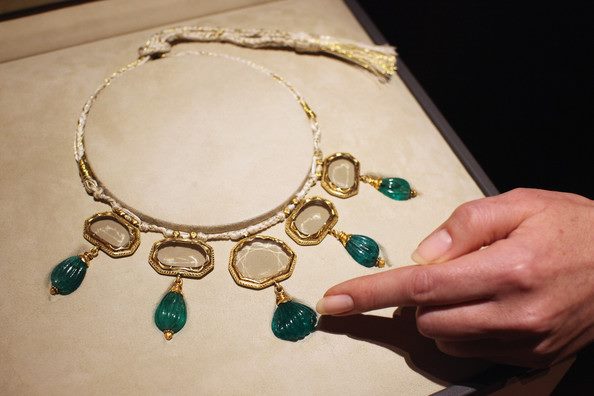
A Mughal masterpiece. The necklace features five pendant diamonds (Origin: Golconda mines, India) with emerald drops. The central stone weighs 28 cts. and is the largest table-cut diamond known. The five surrounding stones—weighing 96 cts. collectively—comprise the largest known Matching set of table-cut diamonds from the 17th century. It is believed that the jewel once belonged to a Mughal emperor.

Mughal ruler Shah Jahan's Wine Cup. Jade. 1657. Jade cup carved in the form of a shell or gourd with carved handle terminating in the head of an Ibex & large floret shaped foot, left side underside view. This large cup is the finest known example of Mughal jade-carving. The Emperor's titles are carved on its side along with the date. Source: V&A Museum

Huqqa (water pipe) of emerald-green glass decorated with gold and yellow enamel
Northern India; 1st half of 18th century.
The motif was painted “in reserve,” which means that the gold was largely used as the background for the motifs – poppies and cypresses along with various leaf borders. A few details, such as the ribs or little leaves, were executed in gold or yellow enamel. A special refinement is the use of enamel inside, behind the flower heads. Photo: The David Collection

Portrait of Mumtaz Mahal (Arjumand Banu Begum). She was the favourite wife of the Mughal Emperor Shah Jahan. She died shortly after giving birth to her fourteenth child in 1631. The following year the emperor began work on the mausoleum that would house her body. The result was the world-famous Taj Mahal. Photo: V&A
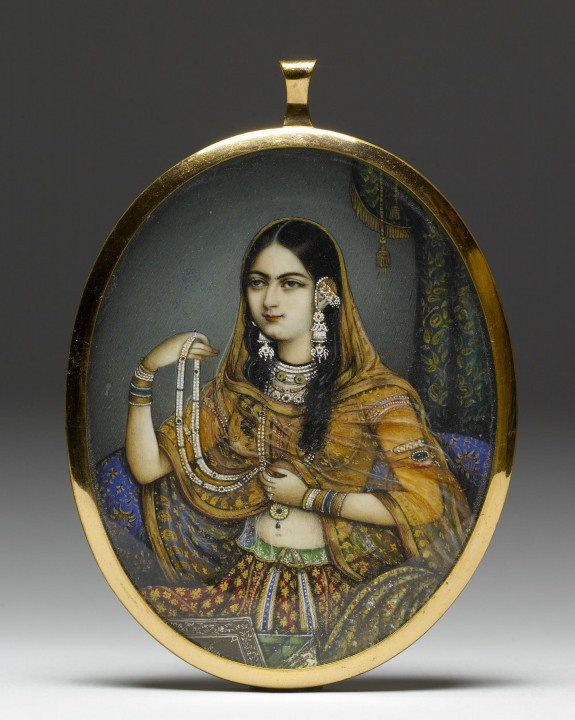
Miniature portrait pendant. Watercolor on ivory, gold, glass. 1830-1850, India. In this instance, an artist from Delhi has portrayed a courtesan dressed as a princess wearing elaborate Mughal gold and gem-set jewelry. Photo: The Walters Art Museum

A Bejeweled Maiden with a Parakeet. Illustrated single work. ca. 1670–1700, Mughal. India, Golconda, Deccan. The bird sits on the maiden’s henna-reddened fingers, each one of which is separately adorned by a diamond ring. She also wears strands of pearls, with emeralds and rubies.

This sensitive portrait jewel was probably painted shortly after Shah Jahan came to the throne of the powerful Mughal Empire in 1628 after the death of his father, Jahangir. Hashim (Indian, active 1598-c.1650). Credit: Cleveland Art

Oval portrait of a woman in a Chaghtai hat c. 1740-50 India, Mughal, 18th century Opaque watercolor and gold on paper. This woman’s hat has been studded with jewels and strings of pearls. The portrait jewel format that was once reserved for the emperor has now been expanded to include ladies of the court. The woman holds a jade wine cup and wears a draped upper garment with a woven or embroidered border similar to the fragment on display at the left. Credit: Cleveland Art

Pomander. 17th-18th Century Indian, Mughal Spherical rock crystal cover with enameled silver mounts. This tiny pear-shaped vial worn tied to a sash would have held scented water or oil. The lid opens to reveal a perforated sprinkler decorated with fine filigree and colorful enamel. A popular scent was attar of roses, made from the essential oil of rose petals. Credit: Cleveland Art

This tiny pear-shaped vial worn tied to a sash would have held scented water or oil. The lid opens to reveal a perforated sprinkler decorated with fine filigree and colorful enamel. A popular scent was attar of roses, made from the essential oil of rose petals. Credit: Cleveland Art

Pendant 1700s. Gold, emerald, diamonds, enamel, and pearl. India, Mughal, Rajasthan, Jaipur, 18th century. Credit: Cleveland Art

A rare Mughal pale green jadeite snuff bottle. 1800-1900. The flattened, rounded bottle is well carved on either side with a large flower reserved on a dense ground of overlapping leaves. Either shoulder is carved with a smaller flower head as is the top of the mouth rim. The translucent stone is of pale icy green tone. 2 in. (5 cm.) high, pink tourmaline stopper and bone spoon.

Mughal gold and enamel belt buckle in two pieces with inlaid diamonds. Enamel decoration on reverse of tiger attacking a boar. b. Rectangular element with small round ring through which oblong ring fits. Hook is attached to this. Enamel tiger attacking a deer in foliage on reverse of rectangular element. British Museum

Gold and enamel figurine of bird on a stand, set with diamonds, with a fish in its beak. Mughal. British Museum
In the past I have authored posts on, Bejeweled Maharaja & Maharani of Mysore, Koh-i-Noor Diamond, Diamonds on World Postage Stamps, Top Ten - Largest Diamonds Discovered In The World, Splendors of Mughal India, The Magnificent Maharajas Of India, Mystery & History Of Marquise Diamond Cut, Ór - Ireland's Gold, The Legendary Cullinan Diamond, Bejeweled Persia - Historic Jewelry From The Qajar Dynasty, Famous Heart-Shaped Diamonds, Type II Diamonds, Green Diamonds, Red Diamonds and more. Over years, I have spent countless hours in self-driven studies on diamond, jewelry history and research. I wrote these blogs for a simple reason - to share my collected knowledge with all who are interested, so that more can benefit from it. Take a look and enjoy! -- Reena
Mystery & History of Marquise Diamond Cut
Did you know?
The history and creation of the "Marquise" diamond cut is credited to King Louis XV of France, who allegedly commissioned the first marquise diamond to reflect the beautiful shape of the mouth of his mistress Madame de Pompadour.

In the past I have authored posts on diamond, and jewelry history, such as, Koh-i-Noor Diamond, Splendors of Mughal India, The Magnificent Maharajas Of India, Mystery & History Of Marquise Diamond Cut, Ór - Ireland's Gold, The Legendary Cullinan Diamond, Bejeweled Persia - Historic Jewelry From The Qajar Dynasty, Famous Heart-Shaped Diamonds, Type II Diamonds, Green Diamonds, Red Diamonds more. Being a curious artist that I am, over years I have spent countless hours in self-driven studies on jewelry history and in research. All good stuff, as I have accumulated a great deal of interesting knowledge, something that definitely informs my jewelry design and other artistic creations. I wrote these blogs for simple reasons - to share my collected knowledge with all who are interested so that more can benefit from it and for ease in accessibility. Take a look and enjoy!
Latest from JCK Las Vegas Show 2013
Las Vegas! A pilgrimage that jewelry folks make each year to showcase new designs, meet with old industry friends and make some new ones.
This year we brought color and uber chic cuffs ! Check out the latest blue and pink sapphire 'Shining Stars' collection from Royal Asscher & Reena Ahluwalia.

Shining Stars rings in 18K rose and white gold plated sterling silver with 0.80 ct pink and blue sapphires floating in globe. Pendant in 18K rose gold plated on silver with 1.72 ct. pink sapphires and 0.25 ct. diamonds in globe.

Floating-blue-pink sapphire ring, Shining Stars collection, Reena Ahluwalia for Royal Asscher Diamonds.

Floating-blue-pink sapphire pendants, Shining Stars collection, Reena Ahluwalia for Royal Asscher Diamonds.

Floating-pink sapphire ring, Shining Stars collection, Reena Ahluwalia for Royal Asscher Diamonds.

Floating-blue sapphire ring, Shining Stars collection, Reena Ahluwalia for Royal Asscher Diamonds.
I am thrilled about the overwhelming response there uber street chic cuffs generated at the show! Floating-diamonds cuff in leather and plated sterling silver. Aren't they cool ?

Floating-diamonds cuff from the Shining Stars collection.


Ultra chic leather and floating-diamonds cuff, a latest from our Shining Stars collection.

Latest from Royal Asscher & Reena Ahluwalia - Floating-diamonds cuffs in leather and plated gold!

Must be Vegas! Royal Asscher cocktail event, Vegas-style at Eye Candy Lounge at Mandalay Bay in Las Vegas.

Last, but not the least, an up-close view of Canoe Canadian diamond necklace by Reena Ahluwalia, showcased at Rio Tinto Diamonds booth at Luxury, JCK Las Vegas 2013.

Reena Ahluwalia at JCK Las Vegas show 2013.
The Art Of Spontaneity
Freshness, immediacy of moment and an impulse - I love spontaneity.
As a designer, what I have uncovered about spontaneous discoveries is very special. These unscripted moments have a tendency to come back to me, sometimes years later and manifest themselves into ideas. They some how connect and expand and become tangible. I don't over think these moments, I just let them fill me.
One day strolling on the streets of Santiago, Chile, this is what I unexpectedly found. No, I didn't come back and make a piece of jewelry that exactly resembles this seed bulb, nor did I name a jewelry collection after the city. Not as yet. What instead I did was this - nothing! I will let this spontaneous moment float somewhere in my mind and hope when the time is right it will come back.
Well, at least that's how spontaneous things work for me.

The Legendary Cullinan Diamond

This is what diamond dreams are made of!
At 3106.73-carat, Cullinan is the largest rough diamond ever found in the world, a part of British Crown Jewels, that was cut and polished by legendary diamond company - Royal Asscher. Stars of Africa initiative and collection is a jewelry collection, designed by Reena Ahluwalia for Royal Asscher Diamonds, and is named after this fabled diamond.
The Cullinan diamond was discovered in the Premier Mine in South Africa in 1905 and so named as the mine belonged to Thomas Cullinan. The Transvaal Government bought the diamond and presented it King Edward in 1907 as a sign of gratitude for passing government from British rule to the state.

Jewelry designer Reena Ahluwalia at Royal Asscher Diamonds headquarter in Amsterdam, holding the Cullinan diamond replica.

The Cullinan diamonds in the British Crown Jewels. King Charles III and Queen Camilla’s Coronation.
King Charles III with the Imperial State Crown. Set in The Imperial State Crown is a magnificent 317.4 carat Cullinan II diamond, also known as the Lesser Star of Africa. The Sovereign's Sceptre with Cross is set with the largest of the Cullinan diamonds known as the Star of Africa or Cullinan I that weighs 530.2 carats. The Sceptre is part of the Crown Jewels and the coronation ceremony.
Queen Consort Camilla wore Queen Mary's Crown with the Cullinan III, IV and V diamonds that were part of Queen Elizabeth's personal jewelry collection. What was removed from the crown was world's most famous and controversial diamond - the legendary Koh-i-Noor. Queen Camilla was also wearing the Coronation necklace made for Queen Victoria by Garrard. 2023.

Upon it's discovery, Cullinan crystal (rough) being handed from Fred Wells (right) to McHardy, who then hands it to Sir Thomas Cullinan (left). 1905

Cullinan Diamond. Photograph showing two models (replicas) of the original stone. The Cullinan Diamond was discovered in South Africa in 1905 and presented to King Edward VII in 1907. It was sent to Asschers (presently, Royal Asscher Diamond Company) of Amsterdam to be cleft in 1908. Image: Royal Collection © Her Majesty Queen Elizabeth II

Royal Asscher file image of tools used by Joseph Asscher to cleave the Cullinan Diamond.

Photograph of Mr Joseph Asscher standing to the right of a bench while holding a cutting tool resting on the Cullinan Diamond, held in a vice. He holds a hammer in his raised right hand about to strike the cutting tool. Image: Royal Collection © Her Majesty Queen Elizabeth II

Original tools used for cleaving the largest rough diamond ever found, The Cullinan diamond. Check out the large loop ! Joseph Asscher had to create new and significantly large tools for the fabled rough diamond. Image: Royal Asscher Archives

The diamond was presented to Great Britain’s King Edward VII who asked the Asscher brothers to cleave it. In 1908, Joseph Asscher cut the stone into 9 large stones and 42 small stones. Here are the replicas of Cullinan polished diamonds. Image: Taken by Reena Ahluwalia at the Royal Asscher HQ/Archives.

Replica of the 9 largest stones polished from the Cullinan diamond. Image: Taken by Reena Ahluwalia, at L'École des Arts Joailliers, Van Cleef & Arpels. Paris

The Imperial State Crown. Set in The Imperial State Crown is a magnificent 317.4 carat Cullinan II diamond, also known as the Lesser Star of Africa, was cut by the Asscher Diamond Company. Great Britain's Crown Jewels. Image: Royal Collection © His Majesty King Charles III.

The Sovereign's Sceptre with Cross that is set with the largest of the Cullinan diamonds known as the Star of Africa or Cullinan I that weighs 530.2 carats. The Sceptre is part of the Crown Jewels. Image via: The Jewellery Editor

The sceptre comprises a gold rod, formed in three sections, with enamelled collars at the intersections, surmounted by an enamelled heart-shaped structure, which holds a huge drop-shaped diamond, Cullinan I, or the Star of Africa, weighing 530.2 carats. The Sovereign's Sceptre with Cross. Credit: The Royal Collection Trust.

Cullinan diamond III and IV Brooch, commissioned by Queen Mary in 1911, and the Delhi Durbar Necklace and Cullinan Pendant, which is the Cullinan VII. Image: Roland Hoskins

Shown here are the replicas of the major Cullinan diamonds with a one carat (ct) diamond (bottom left) for scale. They were cut from the 3,106 ct Cullinan diamond crystal found in South Africa in 1905. This record-setting crystal produced nine major gems and 96 smaller diamonds. The two largest, the 530.20 ct Cullinan I and the 317.40 ct Cullinan II, are part of the British Crown Jewels, while the rest of the major diamonds (Cullinan III-IX) were privately owned by Queen Elizabeth II. In 2023, the Queen Consort Camilla will wear Queen Mary's Crown, which features 2,200 diamonds and was worn by Queen Mary when she took part in the coronation alongside her husband, King George V, in 1911. As a tribute to the late Queen Elizabeth, the headpiece will be reset with the Cullinan III, IV and V diamonds, which are part of the famous Cullinan diamond, the largest ever found. The jewels were a part of the late monarch's personal jewelry collection and were frequently worn as brooches. Image: GIA

Cullinan diamond III and IV Brooch: The third and fourth largest of the Cullinan gems - a pear-shaped drop of 94.4 carats (III) and the cushion-shaped 63.3 carat IV - were originally placed by Queen Mary on her new crown in 1911. The stones were most often worn hooked together as a pendant brooch.

Cullinan diamond VI and VIII brooch: Many pieces of Royal jewellery were created to be versatile. As well as the brooch, the 11.5 carat Cullinan VI has been used in a number of pieces including a diadem.

Cullinan IX The smallest of the nine stones, weighing 4.4 carats, was set into a platinum ring for Queen Mary in 1911. The pear shape is known as a pendeloque and is mounted in an openwork 12-claw setting. It was also inherited by The Queen in 1953. Image: MailOnline

King Charles III with the Imperial State Crown. Set in The Imperial State Crown is a magnificent 317.4 carat Cullinan II diamond, also known as the Lesser Star of Africa. The Sovereign's Sceptre with Cross is set with the largest of the Cullinan diamonds known as the Star of Africa or Cullinan I that weighs 530.2 carats. The Sceptre is part of the Crown Jewels and the coronation ceremony. 2023.

King Charles III and Queen Camilla. Queen Consort Camilla wore Queen Mary's Crown with the Cullinan III, IV and V diamonds that were part of Queen Elizabeth's personal jewelry collection. What was removed from the crown was world's most famous and controversial diamond - the legendary Koh-i-Noor. Queen Camilla was also wearing the Coronation necklace made for Queen Victoria by Garrard. 2023.

Queen Consort Camilla wore Queen Mary's Crown with the Cullinan III, IV and V diamonds that were part of Queen Elizabeth's personal jewelry collection.

King Charles III with the Imperial State Crown. Set in The Imperial State Crown is a magnificent 317.4 carat Cullinan II diamond, also known as the Lesser Star of Africa. WPA Pool/Getty Images

Her Majesty Queen Elizabeth II wearing the Imperial State Crown and holding the Sovereign's Sceptre, both of which contain stones cut from the Cullinan Diamond in this picture from her Coronation. Image: MailOnline
In the past I have authored posts on, Bejeweled Maharaja & Maharani of Mysore, Koh-i-Noor Diamond, Diamonds on World Postage Stamps, Top Ten - Largest Diamonds Discovered In The World, Splendors of Mughal India, The Magnificent Maharajas Of India, Mystery & History Of Marquise Diamond Cut, Ór - Ireland's Gold, The Legendary Cullinan Diamond, Bejeweled Persia - Historic Jewelry From The Qajar Dynasty, Famous Heart-Shaped Diamonds, Type II Diamonds, Green Diamonds, Red Diamonds and more. Over years, I have spent countless hours in self-driven studies on diamond, jewelry history and research. I wrote these blogs for a simple reason - to share my collected knowledge with all who are interested, so that more can benefit from it. Take a look and enjoy! -- Reena
Diamond "Carat"

Where does the term diamond "carat" come from?
The word carat comes from the Mediterranean Carob tree, whose seeds were used for centuries as the standard of weighing precious stones.

Thousand Words Imagery

Image: The Language of Water (2010) - Ink in water. ©John Grant
“It's somewhat imagery related.” -- Dan Cronin
I believe each interaction leaves an imprint. What we make of it, is left up to us.
It leads me to think about the countless images we come across each day. All deposited in our mind-bank. Mind that make associations, converts them into referential material, add layers of meaning that we tease out from time to time.
All that is left is observation. Imagination, my friends, will follow !
I came across John Grant's work in 2010, and still find it intriguing. A multitude of images, emotions and symbolism, all contained in a small glass of water. Enjoy!
Video: John Grant - The Language of Water (2010) - Ink in water.
To see a world in a grain of sand,
And heaven in a wild flower,
Hold infinity in the palm of your hand,
And eternity in an hour.
-- William Blake, Auguries of Innocence
For The Love Of Diagonals
Directional | Dramatic | Dynamic - Diagonals intrigue me.
One of the ways, I figure, I look at things is by finding the logic of mathematics in forms, shapes, patterns and their relation to each other. It happens seamlessly and rather quietly.
To me there is something special about how diagonals render activity, emphasis, movement, speed and emotion. I am in the process of generating ideas for a high-value diamond. I have a feeling that diagonals will play a decisive role in its final destiny.
When eyes follow, so does the emotions!
Image: Chapel in Villeaceron By Sancho Madridejos Architecture Office

Image: Marcel Breuer - Hungarian-born modernist, architect and furniture designer.
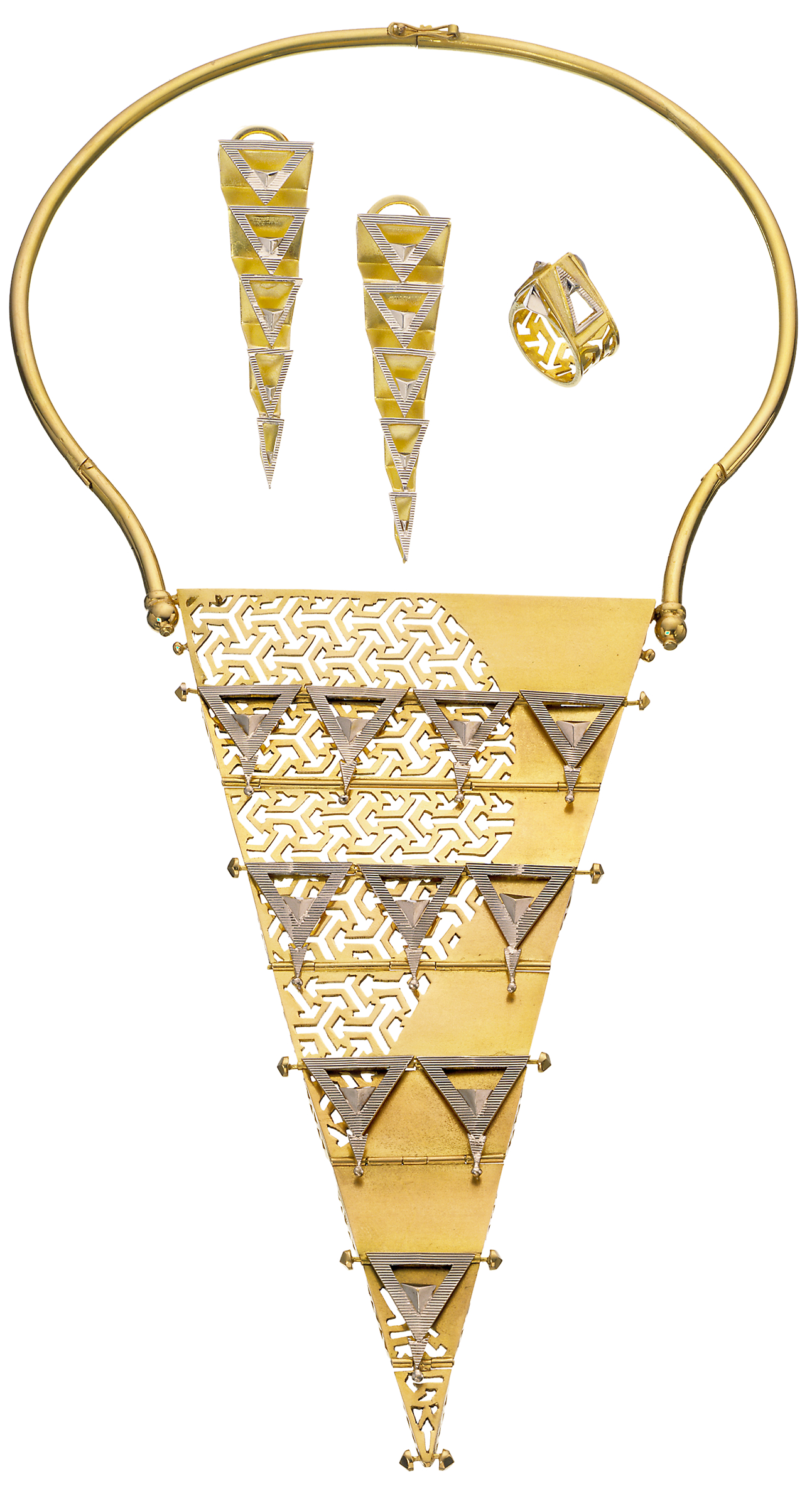
Image: ‘Gold Virtuosi’ ensemble by Reena Ahluwalia. 18K white and yellow gold. 12 inch necklace transitions from 2D to 3D. Composed of diagonal planer elements and triangles; each plate is hinged and folds like pleats to create a 3D form. Inspired by Pragati Maidan, a large convention center in New Delhi, India. The impression it left on me, resulted in a gold jewel. I found the interplay of open and closed spaces fascinating, as they almost assume human qualities. A meeting place, coming together of minds, blending and forming.

Exploration drawings by Reena Ahluwalia. Lower left drawing shows how necklace transitions from 2-dimensional to 3-dimensional form.
Canada, you inspire!

Image: LarryJW
Canada is my home.
A land of openness, pristine white winters, diversity and vibrant mosaic of thoughts and ideas. This work captures one of my first impressions of Canada and Canadian landscape - fluid, open, assured and monumental.

'Glacier' ring by Reena Ahluwalia for Mayur Davé (Gems) Inc. Canadian diamonds set in 18K white gold.

'Glacier' ring by Reena Ahluwalia for Mayur Davé (Gems) Inc. Canadian diamonds set in 18K white gold.
Of Connection And Personalization
A found pebble or a diamond. Both can hold high sentimental value for a person and define it's existence in a very personal way.
Just like this highly prized sickle-blade ring worn by a Turkana man that serve many purposes - a fighting weapon, decorative adornment, as well as a tool. In this case a miniature sickle, with curved blade, that maybe used for skinning, cutting meat, grass or fighting enemies.

This fascinating photograph was captured by French photographer Eric Lafforgue in Kenya.
The Turkanas inhabit the arid territories of northern Kenya, on the boundary with Sudan. Nilotic-speaking people, they have for a long time stayed outside of the influence of the main foreign trends. Nomad shepherds adapted to a almost totally desert area, some also fish in Lake Turkana. They are divided in 28 clans. Each one of them is associated with a particular brand for its livestock, so that any Turkana can identify a relative in this way.The majority of the Turkana still follow their traditional religion: they believe in a God called Kuj or Akuj, associated with the sky and creator of all things. He is thought to be omnipotent but rarely intervenes in the lives of people. The Turkana make finely carved wooden implements, used in the daily life. During the rainy season, moonlight nights' songs have a particular place in the Turkana's life. The songs often refer to their cattle or land, but they are sometimes improvised and related to immediate events. The Turkana have a deep knowledge of plants and products they use as medicine. -- Source
The Magnificent Maharajas of India
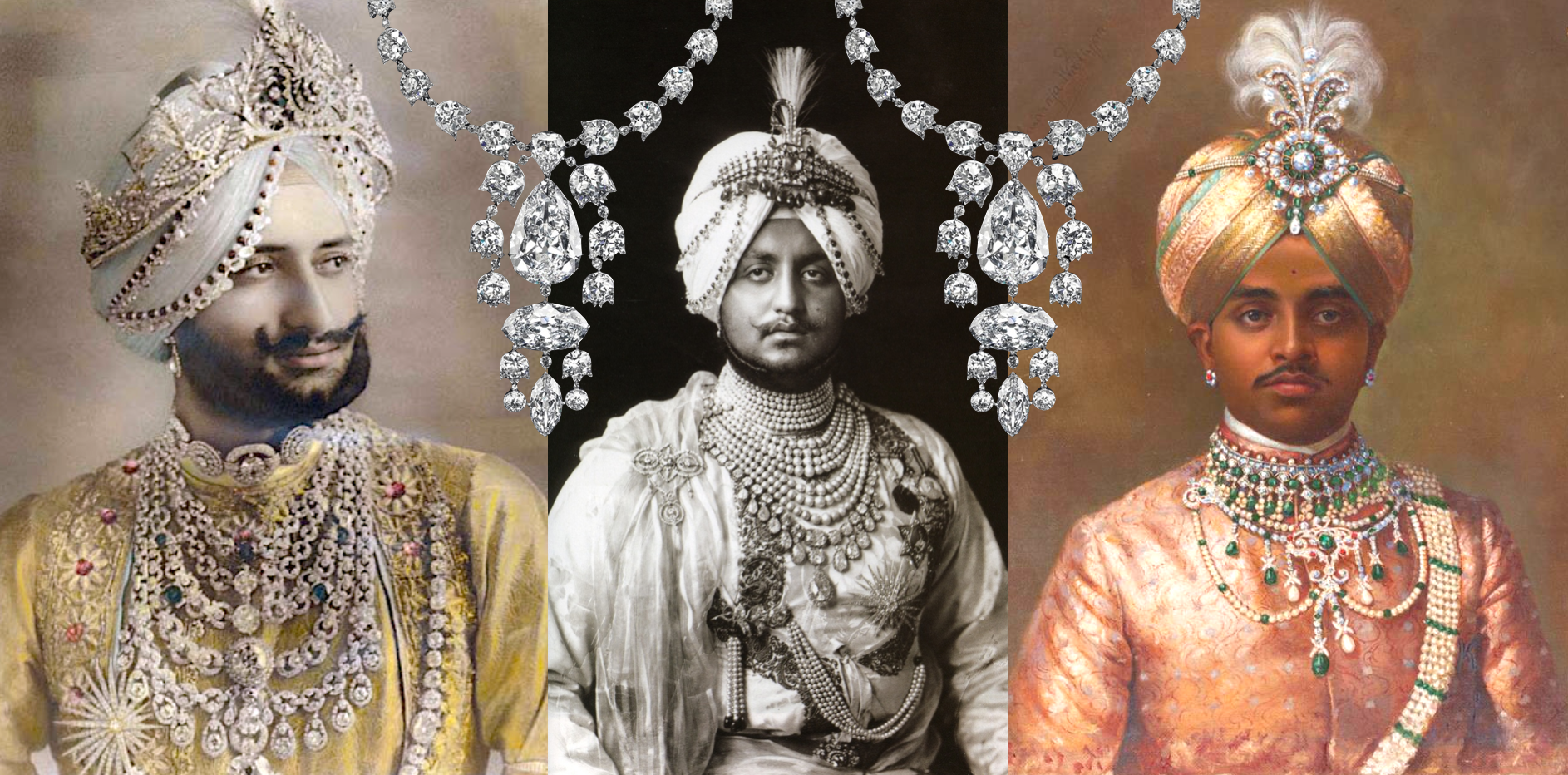
Maharajas! The word maharaja, literally ‘great king’, conjures up a vision of splendor and magnificence. These princely rulers of India played an important role within a social and historical context and were patrons of the arts, both in India and Europe. That resulted in magnificent objects symbolic of royal status, power and identity.
According to an account by Alain Boucheron on his family business in the book “The Master Jewelers” that was cited in the Times:
"The flamboyant Maharajah... arrived at Boucheron's in 1927 accompanied by a retinue of 40 servants all wearing pink turbans, his 20 favorite dancing girls and, most important of all, six caskets filled with 7571 diamonds, 1432 emeralds, sapphires, rubies and pearls of incomparable beauty.”
Here's a look at the opulent world of the maharajas and their extraordinarily rich culture thought their jewels.
I have tried my best to attribute images to their creators and original sources. Please contact me if you know the source of images that are not attributed.

Maharaja of Patiala, Yadavindra Singh. Patiala Necklace.

Maharaja of Patiala, Yadavindra Singh wearing the famous Patiala Necklace. 1930s.

The famous Patiala Necklace was made for the Maharaja of Patiala, Bhupinder Singh.
Patiala Necklace weighs almost a 1000 carats, Patiala necklace was made for the Maharaja in 1928 by Cartier. The bib-like Art Deco necklace featured five rows of diamond-encrusted platinum chains and Burmese Rubies. It included as its centerpiece the famous De Beers diamond, a cushion-cut pale yellow diamond weighing 234.69 carats.

Close up of the famous Patiala Necklace featuring the De Beers diamond, a cushion-cut pale yellow diamond weighing 234.69 carats.

Bhupinder Singh, Maharaja of Patiala (1891-1938), 1911. From the photo of Carl Vandyk © Costa / Bridgeman Images

The Patiala Ruby Necklace/ choker. Ruby beads, oval cabochon and circular-cut rubies, old and single-cut diamonds, natural pearls, platinum (French marks), 13 ins., 1931, restored and restrung by Cartier Tradition in 2012, signed Cartier.

Maharani of Patiala wearing The Patiala ruby choker and Cartier necklaces along with other Art Deco jewels in 1931. Photo © National Portrait Gallery, London
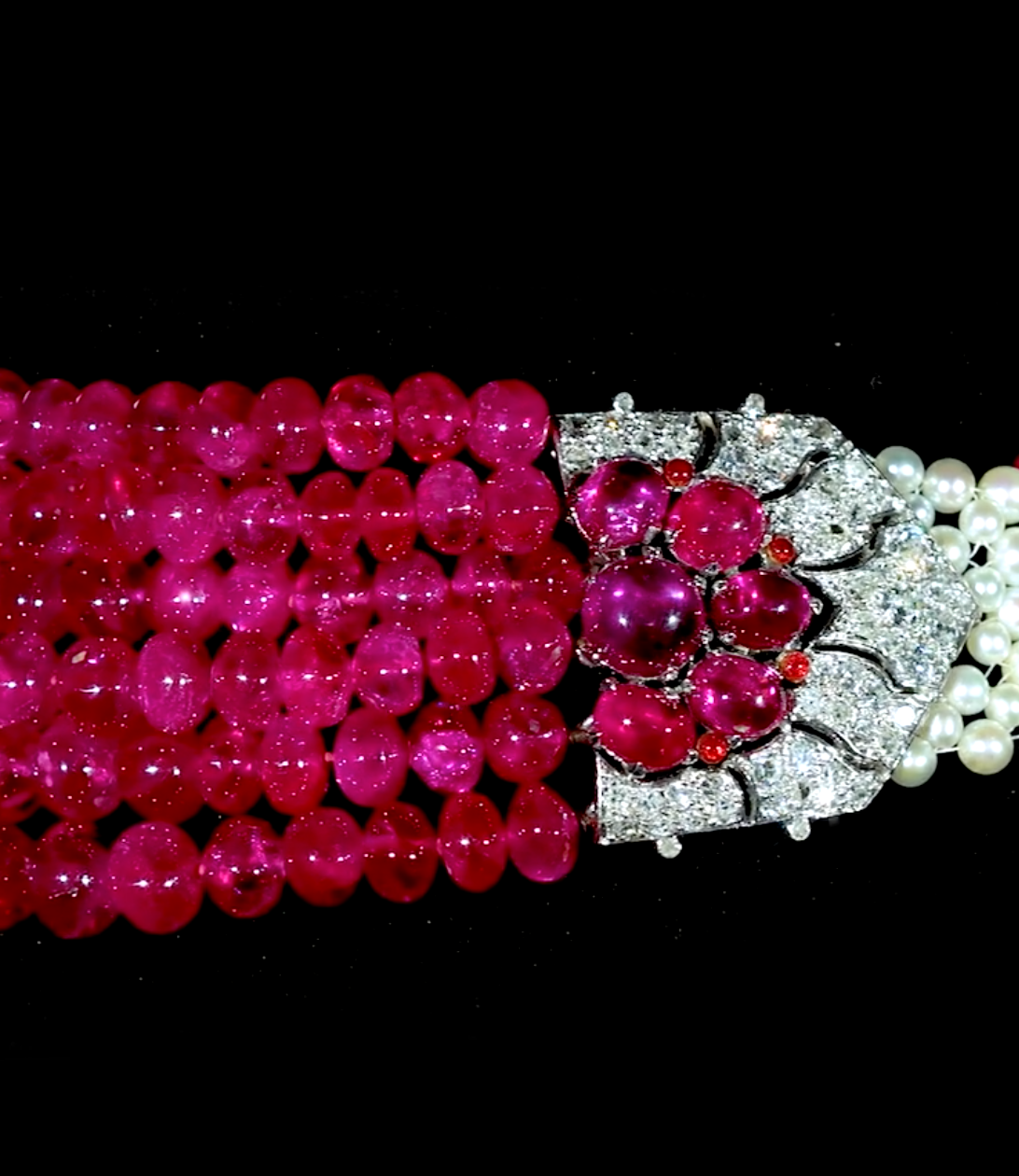
The Patiala ruby choker: an Art Deco ruby, diamond and natural pearl choker necklace, Cartier, 1931. Offered in Maharajas & Mughal Magnificence on 19 June 2019 at Christie’s, New York.
The Koh-i-Noor Diamond
It was only in the early 19th Century, when the Koh-i-Noor reached the Punjab, that the diamond began to achieve its preeminent fame and celebrity.
Enter, Maharaja Ranjit Singh, popularly known as Sher-e-Punjab or Lion of Punjab.
It was not just that Ranjit Singh liked diamonds, and respected the stone’s vast monetary value; the gem seems to have held a far greater symbolism for him. Since he had come to the throne he had won back from the Afghan Durrani dynasty almost all the Indian lands they had seized since the time of Ahmad Shah. Having conquered all the Durrani territories as far as the Khyber Pass, Ranjit Singh seems to have regarded his seizure of the Durrani’s dynastic diamond as his crowning achievement, the seal on his status as the successor to the fallen dynasty. It may have been this, as much as the beauty of the stone, that led him to wear it on his arm on all state occasions. [Source: William Dalrymple / OutlookIndia]

Painting of Sikh Maharaja Ranjit Singh. Indian school 19 century. Image credit: The Royal Collection Trust ( addition of Koh-i-Noor bajubandh by Reena Ahluwalia for this educational blog). Maharaja Ranjit Singh is seen wearing the Koh-i-Noor set in his armband as an armlet. “Of all the owners of the Koh-i-Noor,” Historians Anita Anand and William Dalrymple write, “none made more of the diamond than Ranjit Singh”, who turned it into a symbol of his rule.
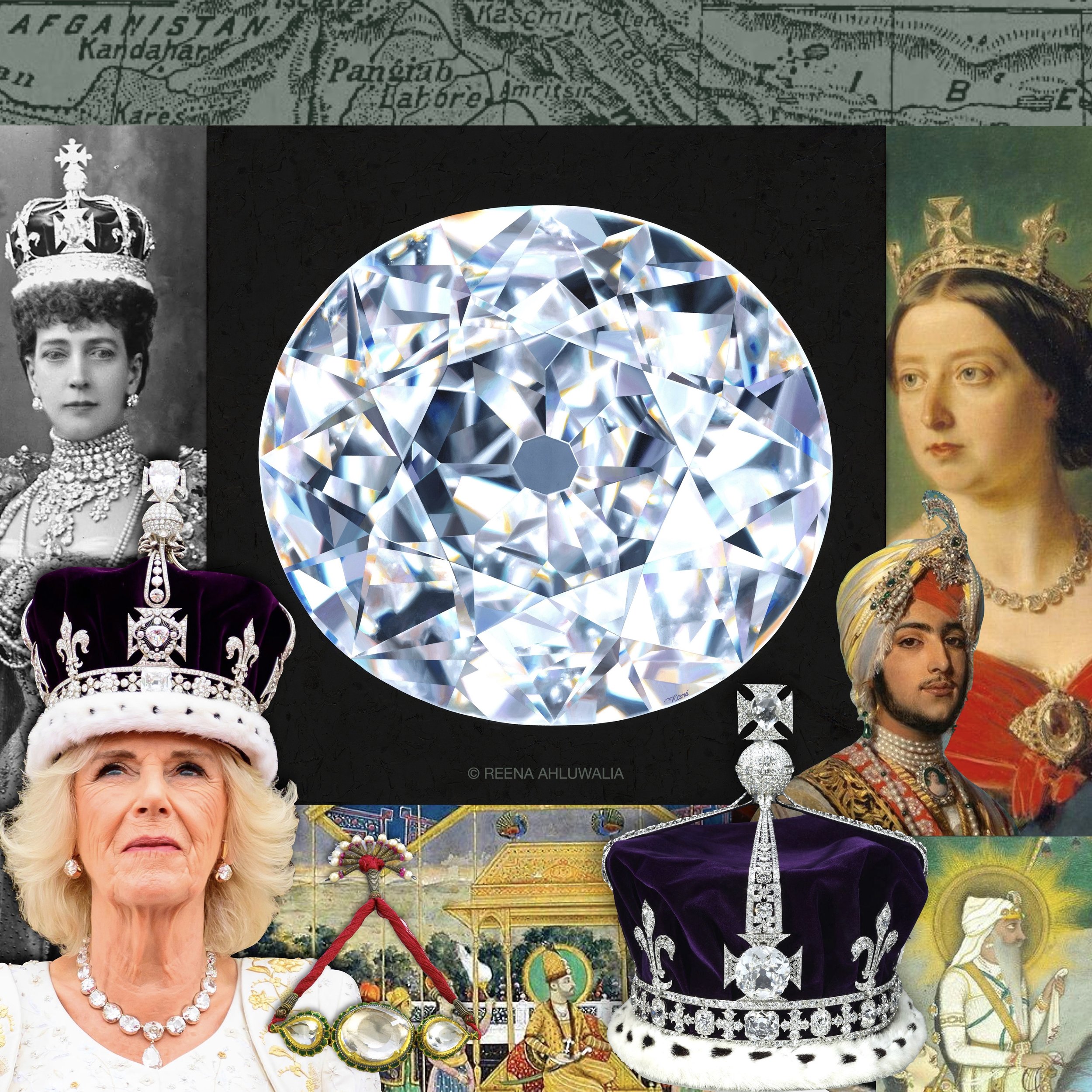
The world’s most famous, Koh-i-Noor is a diamond of monumental stature. Image: Compliled by Reena Ahluwalia, with Reena’s painting of the Koh-i-Noor diamond at it’s center. Shows Maharaja Ranjit Singh and Maharaja Duleep Singh of Punjab.

The magnificent and bejeweled Maharajas of the Royal Kingdom of Mysore. Image compiled by Reena Ahluwalia.

The diamond-clad, gem encrusted paintings of the Maharaja and Maharani of Royal Mysore. 60 x 40 inches, hand-painted on canvas by artist Reena Ahluwalia. C. Krishniah Chetty Crystal Museum. Bengaluru, India. Image: ©Reena Ahluwalia. The words Maharaja (great king) and Maharani (great queen) originates in Sanskrit (महाराज | महारानी). The paintings celebrate an unbroken jewelry heritage and the enduring significance these gems retain in the tapestry of Indian culture.

Jacques Cartier with Indian gemstone merchants, 1911, Cartier Archives. Since his first trip to India, in 1911, Jacques Cartier (1884-1942) had become familiar with the extravagant tastes of the maharajas. Fabulously rich and passionate about precious stones, the Indian princes stopped at nothing to satisfy their perpetual appetite for jewels. Image: Cartier Archives

Turban Ornament (jigha) of the Maharaja of Nawanagar. Belle Époque diamond jigha, 1907 and remodelled circa 1935. The turban ornament set with old baguette and pear-shaped diamonds, white gold, fitted with plume holder on the reverse, lower portion detachable and may be worn as a brooch. Image: Christie’s / The Al-Thani Collection

Drawing of the ceremonial necklace for the Maharajah of Nawanagar, 1931, London Cartier Archives. Jacques Cartier presented the Maharaja with a dazzling project. Sadly, the Maharaja of Nawanagar had little time to wear the “finest cascade of coloured diamonds in the World”. He died in 1933, two years after the necklace was delivered. Image: Cartier Archives
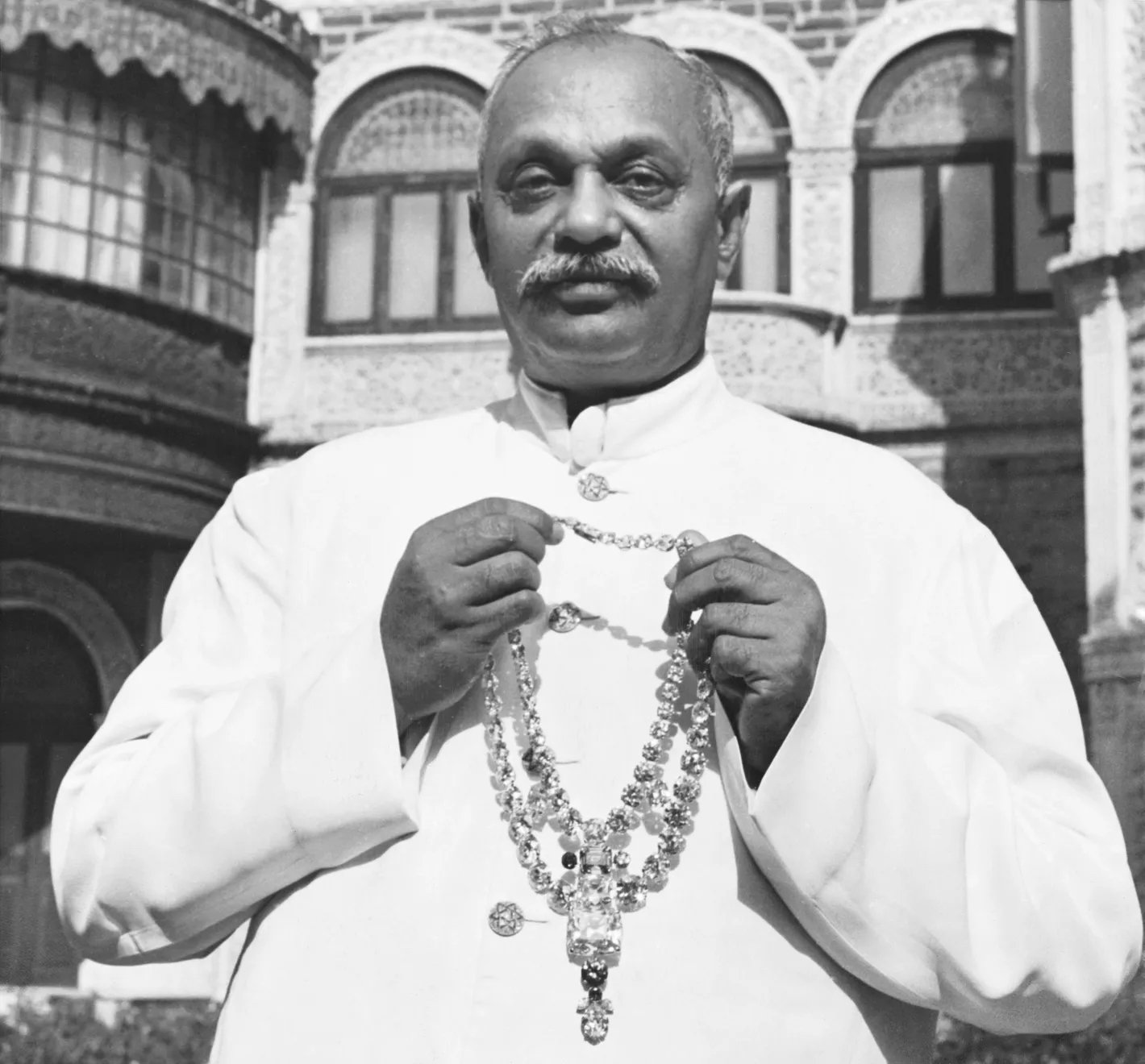
The Maharaja of Nawanagar. Image: Cartier.
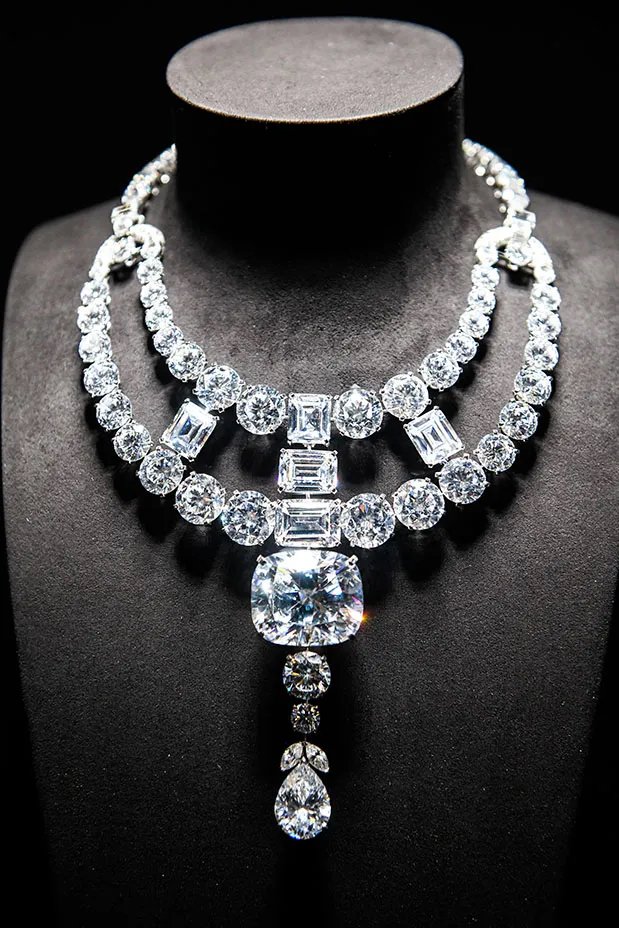
The replica of the famous Cartier necklace created for the Maharaja of Nawanagar. The design is inspired by a 1931 piece Jacques Cartier crafted for the Maharaja of Nawanagar; that necklace no longer exists, so Cartier artisans worked from sketches and photographs from its archives. Image: the Hollywood Reporter

Turban Ornament or Brooch of the Maharaja of Nawanagar. ca. 1920, modified ca. 1925–35. Platinum, set with sapphire and diamonds. Image: Metropolitan Museum of Art.

Maharajah of Nawanagar wearing the emerald and diamond necklace created by Cartier in 1926, Cartier Archives.
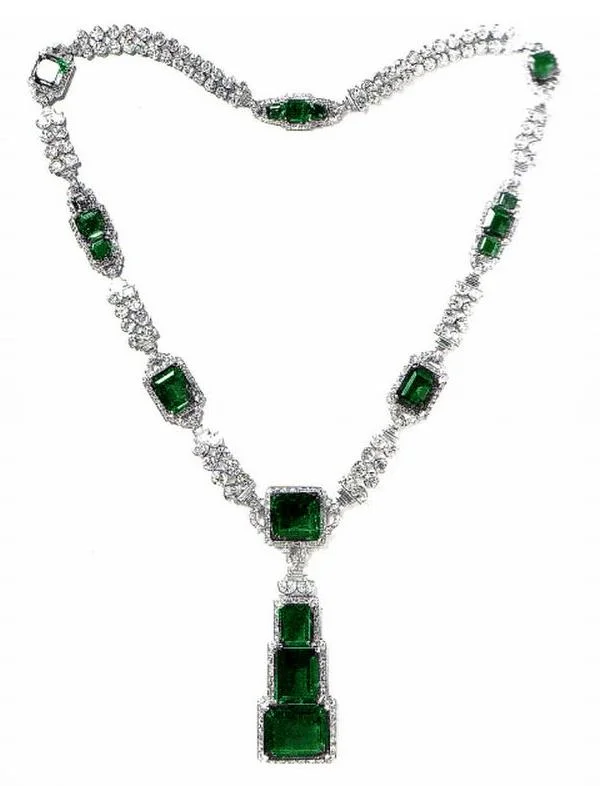
Emerald and diamond necklace, containing 17 rectangular emeralds, 277 carats. The emerald in the pendant weighed 70 carats and was reputed to have come from the collection of a former Sultan of Turkey. Jacques Cartier set it in a Art deco piece for the Maharaja of Nawanagar. Image: Cartier. Green coloration in image added by: https://royal-magazin.de/

The 61.05 carat Tiger Eye Diamond in the Tiger Eye Turban Ornament. Cartier London, 1937
Platinum, diamond . Although the Cartiers were never technically diamond merchants, the deals they made and the work they did with some of the finest stones in the world played a key role in developing the firm’s international stature. In 1937, Maharaja Digvijaysinhji of Nawanagar asked Cartier to set the ‘Tiger Eye’, an unusual cognac-coloured diamond discovered in 1913 and sold by the firm to his predecessor Maharaja Ranjisinhji. Cartier designed a turban ornament around the gem, using baguette-cut diamonds to create an Art Deco look for this traditional Indian jewellery form. Image courtesy: Al Thani Collection

This stunning Art Deco ruby and diamond necklace (1937) was created by Cartier, commissioned by Maharaja Digvijaysinhji of Nawanagar.
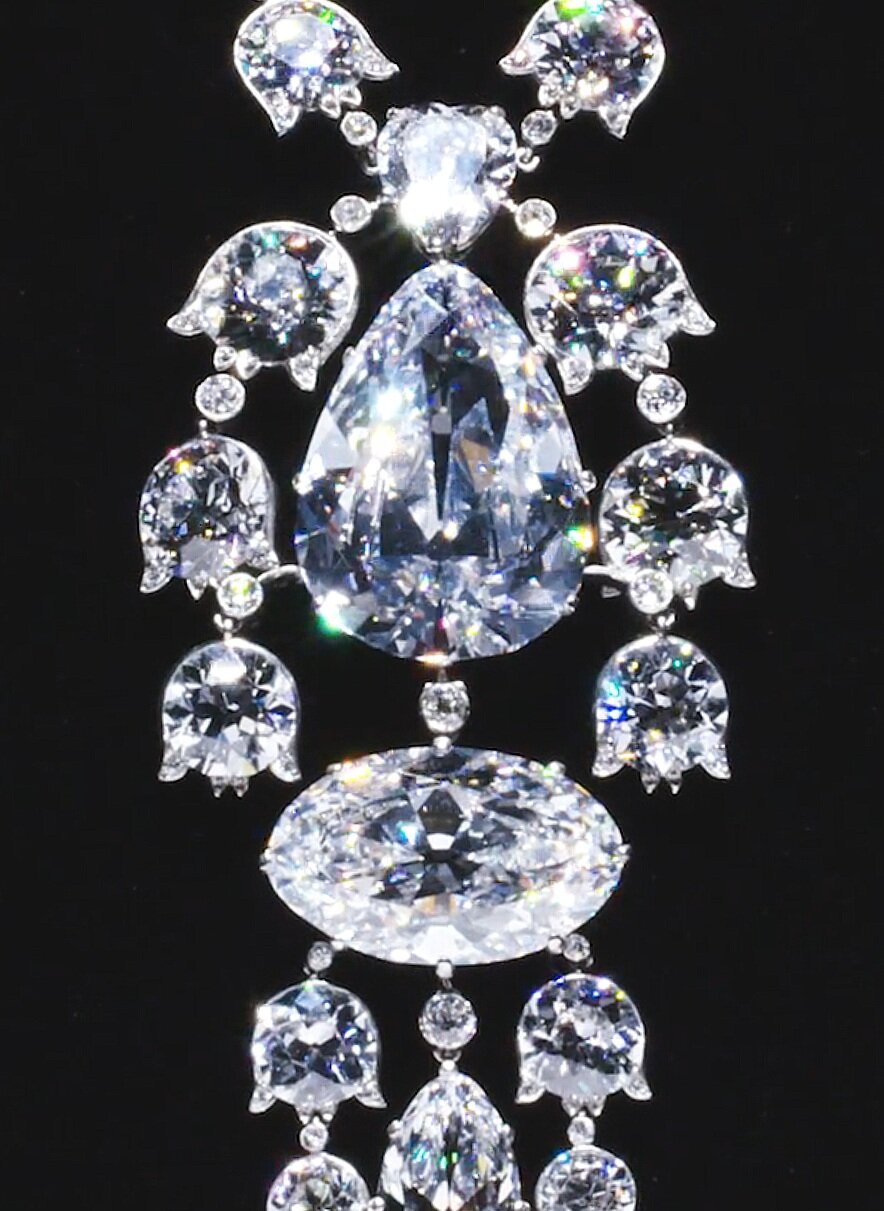
A Belle Époque diamond devant de corsage brooch, Cartier, 1912. Christie’s New York.

Devant-de-Corsage brooch, 1912, Cartier. Pear brilliant-cut diamond of 34.08 carats, oval brilliant-cut diamond of 23.55 carats, modified marquise brilliant-cut diamond of 6.51 carats, heart modified brilliant-cut diamond of 3.54 carats, lily-of-the-valley old-cut diamond links, platinum and 18k white gold. Image: Christie’s
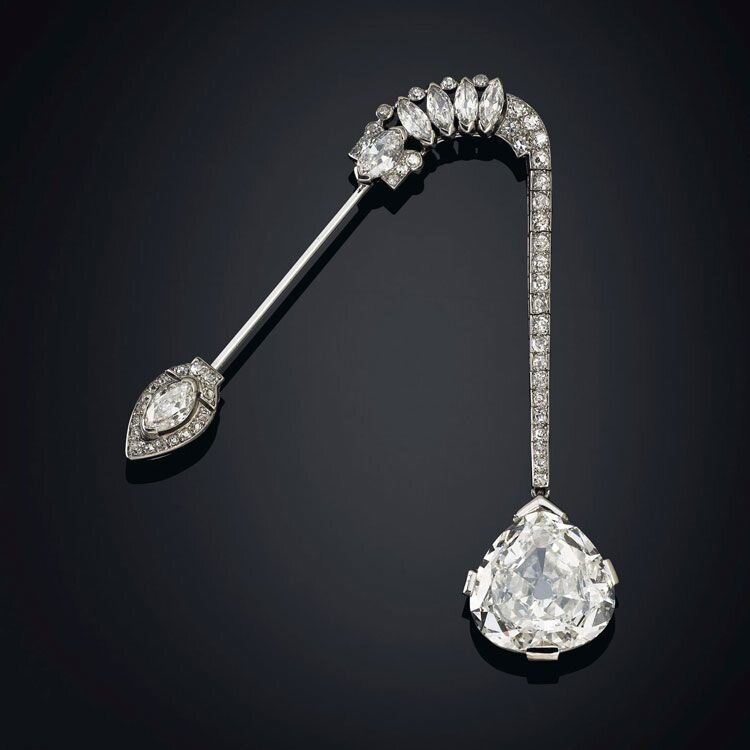
An Art Deco diamond Cliquet brooch, Cartier circa 1925. Offered in Maharajas & Mughal Magnificence on 19 June 2019 at Christie’s, New York. Credit: Christie’s
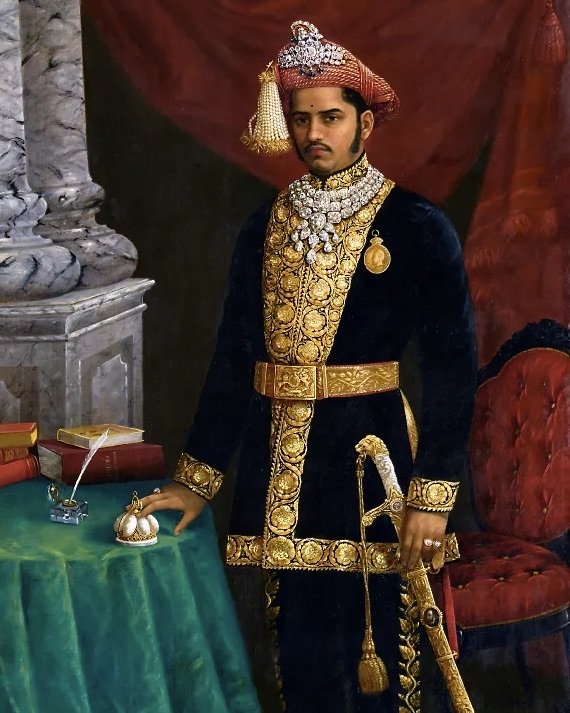
Maharaja of Baroda, Maharaja Sayajirao III painted by Raja Ravi Varma in 1881. Maharaja Fatesingh Museum. Image: The Royal Gaekwad Collection. The Maharaja is seen wearing the famous Baroda three-tier diamond necklace with Star of South and English Dresden diamonds.
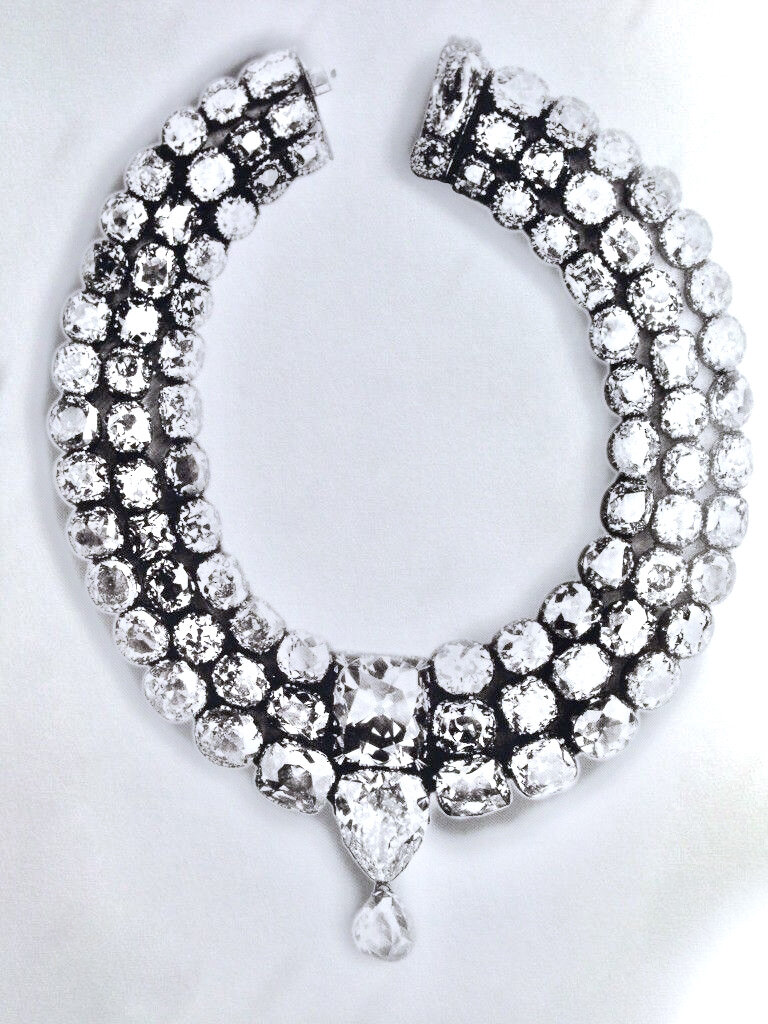
From The Treasury of Baroda - a magnificent three-tired diamond necklace, shown here worn by the Maharani of Baroda, Sita Devi in 1948. Khande Roe, Gaekwar of Baroda, had this necklace made to display two important diamonds - The 128.48-carat Star of the South (fancy light pinkish-brown) and the 78.5-carat English Dresden below it. Image taken in 1880.

Maharani Sita Devi of Baroda wearing a magnificent three-tired diamond necklace, image taken in 1948. Khande Roe, Gaekwar of Baroda, had this necklace made to display two important diamonds - The 128.48-carat Star of the South (fancy light pinkish-brown) and the 78.5-carat English Dresden below it.

The famous three-tiered diamond necklace featuring the 128.48-carat Star of the South (fancy light pinkish-brown) and the 78.5-carat English Dresden below it. Image: Alamy

The Gaekwar of Baroda. Diamond necklace made to display both the 128.48-carat "Star of the South" and the 78.5-carat "English Dresden" below it.

Maharaja of Baroda, Sayaji Rao III. 1889. Image: National Portrait Gallery. Wearing his famous seven row diamond necklace and other diamond ornaments. In the late 19th and early 20th centuries, virtually every Indian Maharaja commissioned state photographs of themselves wearing their most important jewelry as a symbol of their power and position.

The famous Baroda Diamond Necklace. This magnificent ceremonial necklace with diamonds and emeralds was worn by the Maharaja (King) of Baroda, India in the 1860s. It was said to have been broken up in the 1940s to provide stones for anklets for the new Maharani (Queen) of Baroda, Sita Devi. Image compilation by: https://royal-magazin.de/
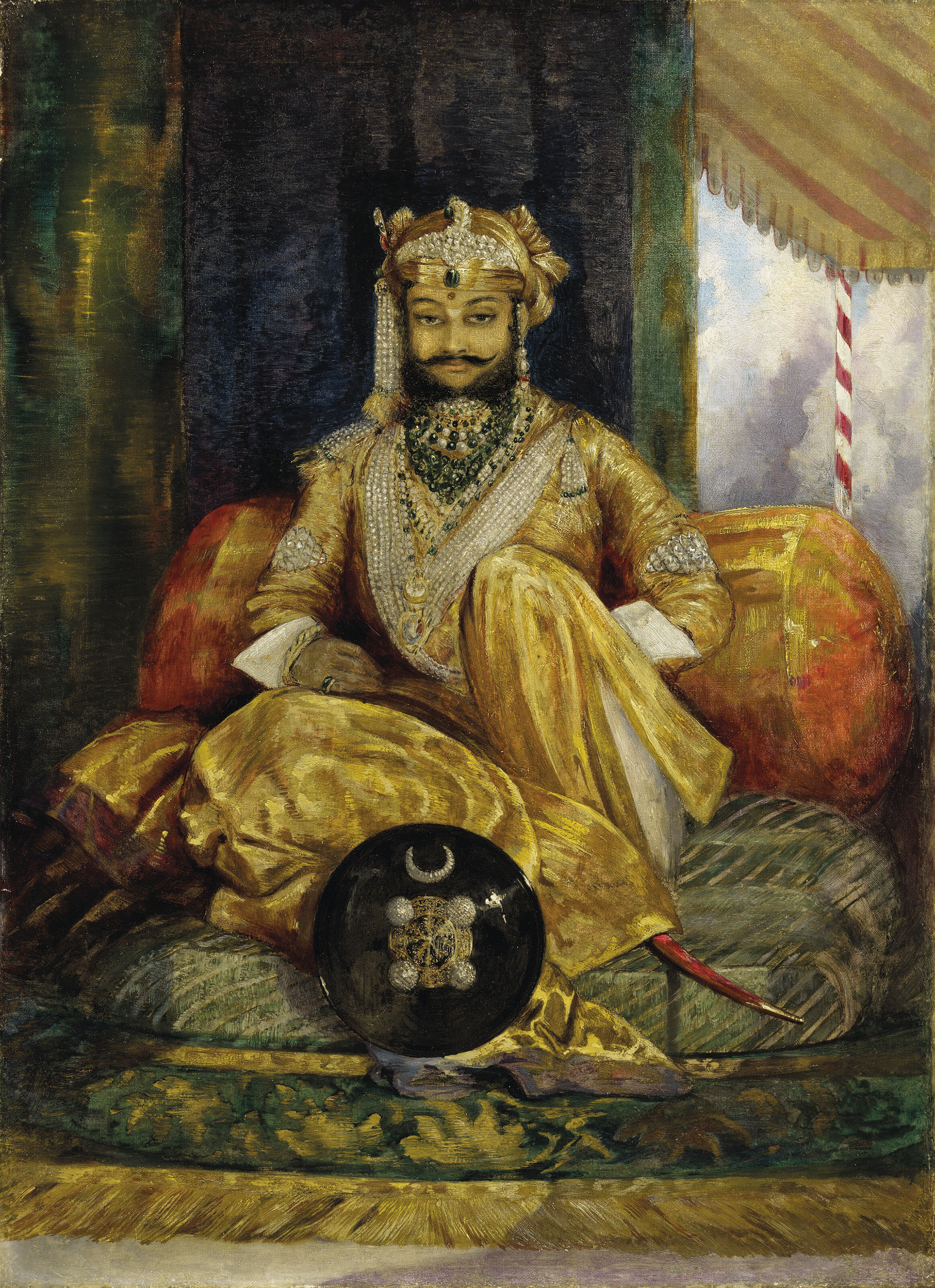
George Landseer (1834-1878). Portrait of H. H. the Maharaja Tukoji Rao II Holkar of Indore, seated small full-length on a cushion. Credit: Christie’s

The superb clarity and color of emerald ranks it among the world's finest Colombian emeralds. It was once the centerpiece of an emerald and diamond necklace belonging to the Maharani of the former state of Baroda , India. It originally weighed 38.4 carats, but was recut and set in a ring designed by Harry Winston, where it is surrounded by 60 pear-shaped diamonds totaling 15 carats. Photo: Smithsonian

Van Cleef & Arpels, Paris, 1949–50. The "Baroda Set" ordered by the Maharani of Baroda, “The Indian Wallis Simpson”, wife of the Maharaja of Baroda. This impressive suite of jewellery was designed by Jacques Arpels for Sita Devi, the second wife of Maharaja Pratapsinh Gaekwad of Baroda. It consists of 13 pear-shaped Colombian emeralds – 154 carats in total – suspended from diamonds set in the shape of a lotus flower. All the gems were all supplied by the Maharani and belonged to the Baroda Crown Jewels.

The Maharani of Baroda at a party given at Vagenende Restaurant in Paris in June 1966, wearing a grey pearl and diamond bracelet by Cartier. Photo © AGIP / Bridgeman Images Via Christie’s.

Portrait of Maharaja Madho Singh. Attributed to Sahib Ram. Maharaja Madho Singh (r.1750-1768) of the Kachwaha Dynasty of Jaipur. Multiple necklaces of white pearls and emeralds flow over his sheer semi-transparent mauve and gold jama. His finely trimmed upturned mustachio forming an abstract curving interplay with his stippled ax-blade sideburn and shadowlike hint of a beard. A mauve and gold pagri (turban) with highly ornamented aigrette contains strands of large emeralds and gold. Depicted bust length with his right arm flexed over a white and gold embroidered coverlet over a window ledge. Credit: Sotheby’s

Portrait of Maharaja Madho Singh of Jaipur (1750-1768) by Ram ji, Jaipur, north India, circa 1760-70. Credit: Christie’s

The meeting of Maharaja Mudhoji Bhosle sen sahib, Rajah of Nagpur and Maharaja Ishwari Sen Bahadur, Rajah of Mandi school of Ghulam 'Ali, Delhi, early 19th century. Credit: Christie’s

One of the highlights for me at 'Diamonds: A Jubilee Celebration' exhibition was this incredible 2000-carat, King Edward VII's diamond encrusted sword. Set with more than 700 white and yellow diamonds, the sword was presented to King Edward VII by the Maharajah of Jaipur, Sawai Sir Madho Singh Bahadur, to mark the king's coronation in 1902. Made from steel and gold, enamelled in blue, green and red, the diamonds are set in a design of lotus flowers and leaves. Photo:© PA
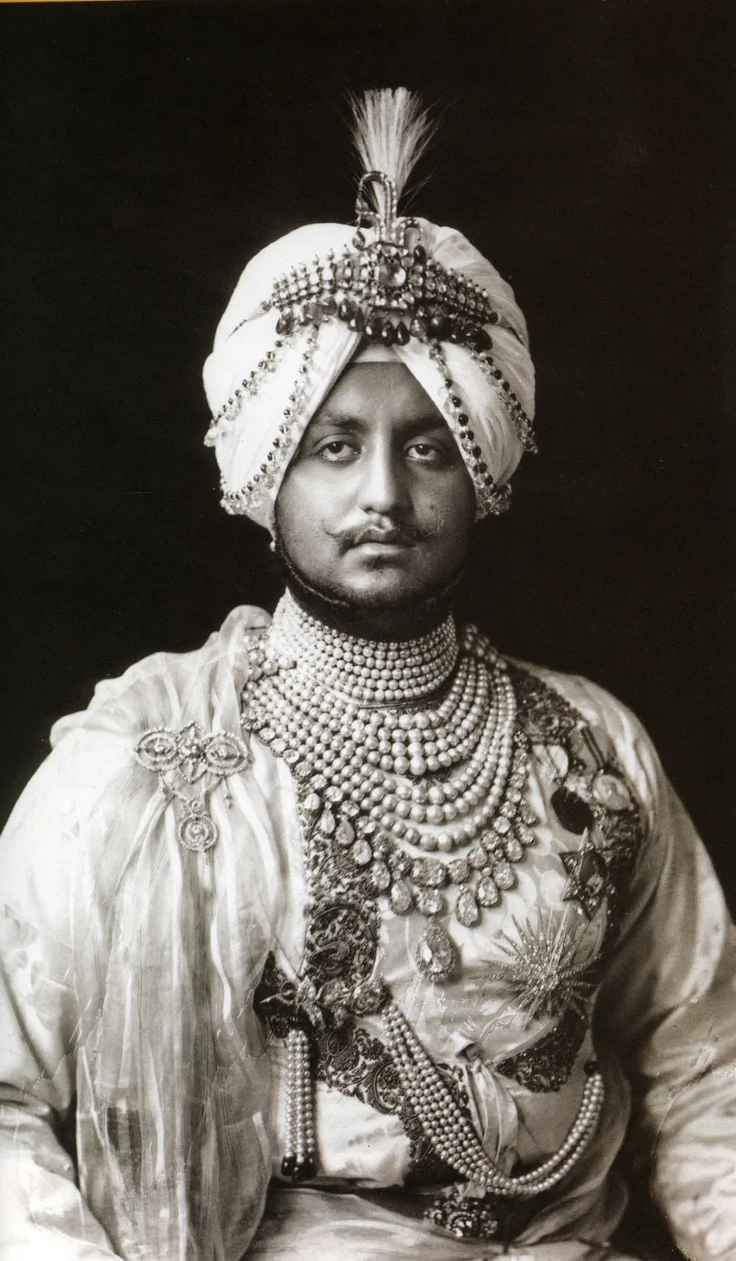
Maharaja Bhupendra Singh of Patiala. Image: © National Portrait Gallery, London

THE HILT OF THE STATE SWORD OF MAHARAJA JAGATJIT SINGH OF KAPURTHALA (1872-1949) NORTH INDIA, CIRCA 1900. Enamelled and set with diamonds, the lion-headed pommel set with ruby eyes, one side of the hilt set with a raised and molded crest of Kapurthala and the other side with the words ‘Kapurthala State’ set in diamonds. Credit: Christie’s

An enamel and gold hunting case pocket watch. Champlevé enamel portrait depicting Maharaja Bhupinder Singh of Patiala, enamel coat of arms on the reverse, white enamel dial, 18k gold, circa 1930. Image: Christie’s

Maharaja Bhupendra Singh of Patiala. 1911. Wears an aigrette or Sarpech by Cartier and various other turban ornaments. While the front of aigrette is set with diamonds, rubies and emeralds, the back shows the intricacy of craftsmanship with foliate motifs of red, green and blue enamel. He also wears a necklace of fourteen strands of natural pearls.

A single-strand natural pearl and diamond necklace, Cartier. Graduated strand of 37 natural pearls of 14.00 to 7.05 mm, old-cut marquise-shaped diamond, platinum (French marks). Image: Christie’s

An Art Deco emerald, sapphire and diamond belt buckle-brooch, Cartier. Octagonal step-cut emerald of 38.71 carats, buff-top calibré-cut sapphires and emeralds, old and single-cut diamonds, platinum and 18k white gold. Many of Cartier’s finest jewels from this period were inspired by Indian architecture, gems and jewels. The calibré-cut sapphire trim and diamond detail are reminiscent of ornate archways present in Mughal palaces and royal quarters. Image: Christie’s

Bejeweled Maharaja of Mysore, Krishnaraja Wadiyar IV. Portrait by K. Keshavayya (1906). © V&A Images/Victoria and Albert Museum, London.
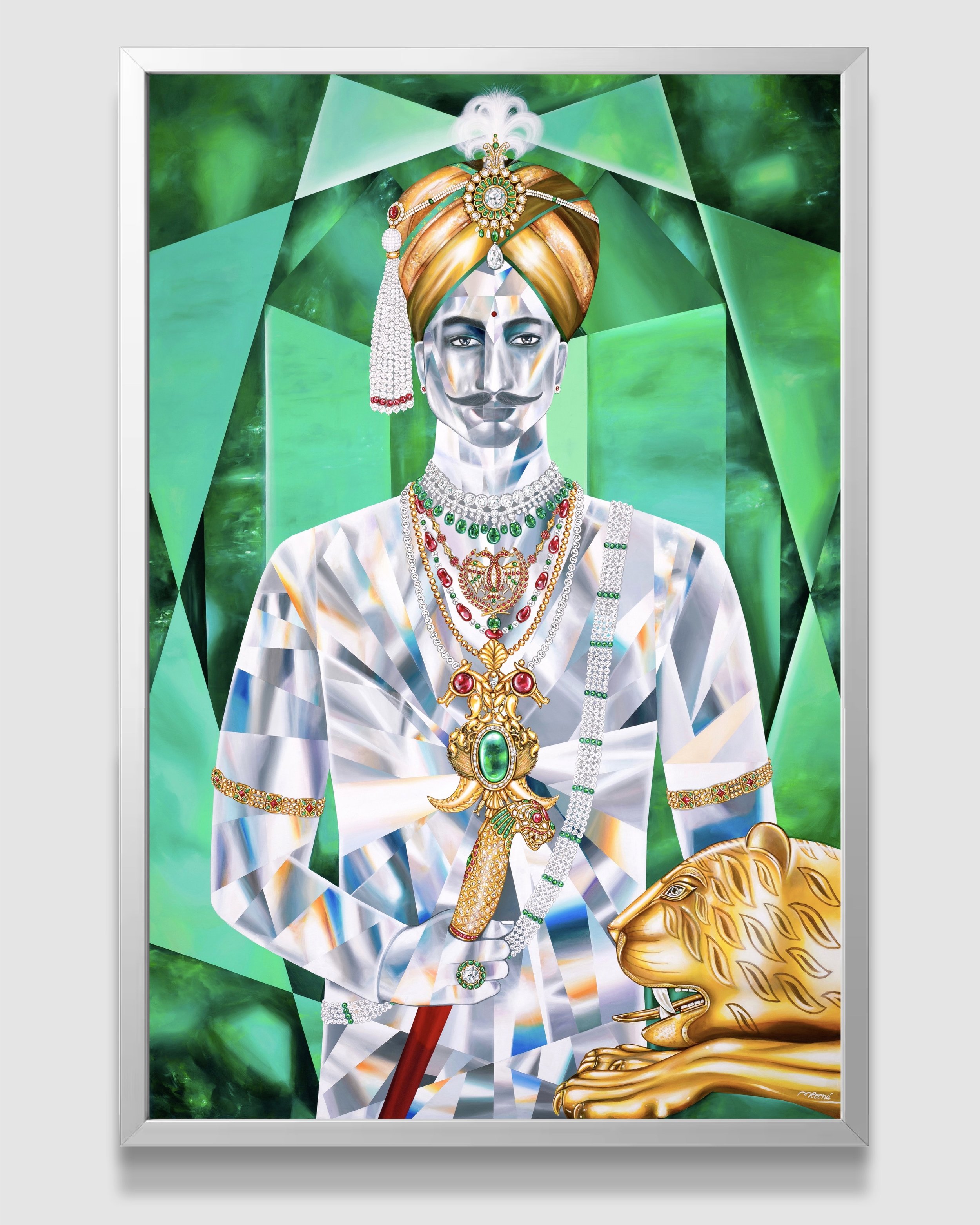
The Maharaja of Mysore. 60 x 40 inches, hand-painted on canvas by artist Reena Ahluwalia. C. Krishniah Chetty Crystal Museum. Bengaluru, India. Image: ©Reena Ahluwalia. The word Maharaja (Sanskrit: महाराज) means great king or ruler. The painting show a diamond-clad body of Maharaja, bejeweled with historically accurate gems and jewels. Meticulously crafted, every inch of the canvas narrates a tale embedded with diamonds, gemstones, and gold.

Krishnaraja Wadiyar III, Maharaja of Mysore. 1866. Credit:

Maharaja Chamarajendra Wadiyar X of Mysore. He was the twenty-third maharaja of the Kingdom of Mysore, between 1868 and 1894. Image: Wikipedia Commons.

Procession of Krishnaraja Wodeyar III through Mysore, 1825–1830. The bejewelled Maharaja is on an elephant leading a religious procession in honour of the god Shiva. He preceded by dancing-girls, musicians, chauri-bearers and men carrying illuminations and letting of fireworks. British military commanders are also shown. Credit: V&A.

An emerald, ruby and diamond set gold state pen case and inkwell. (Davat-i Dawlat). Deccan, Central India, Late 16th century. A sacred bird (hamsa) engraved under the inkwell. Image: Christie’s.
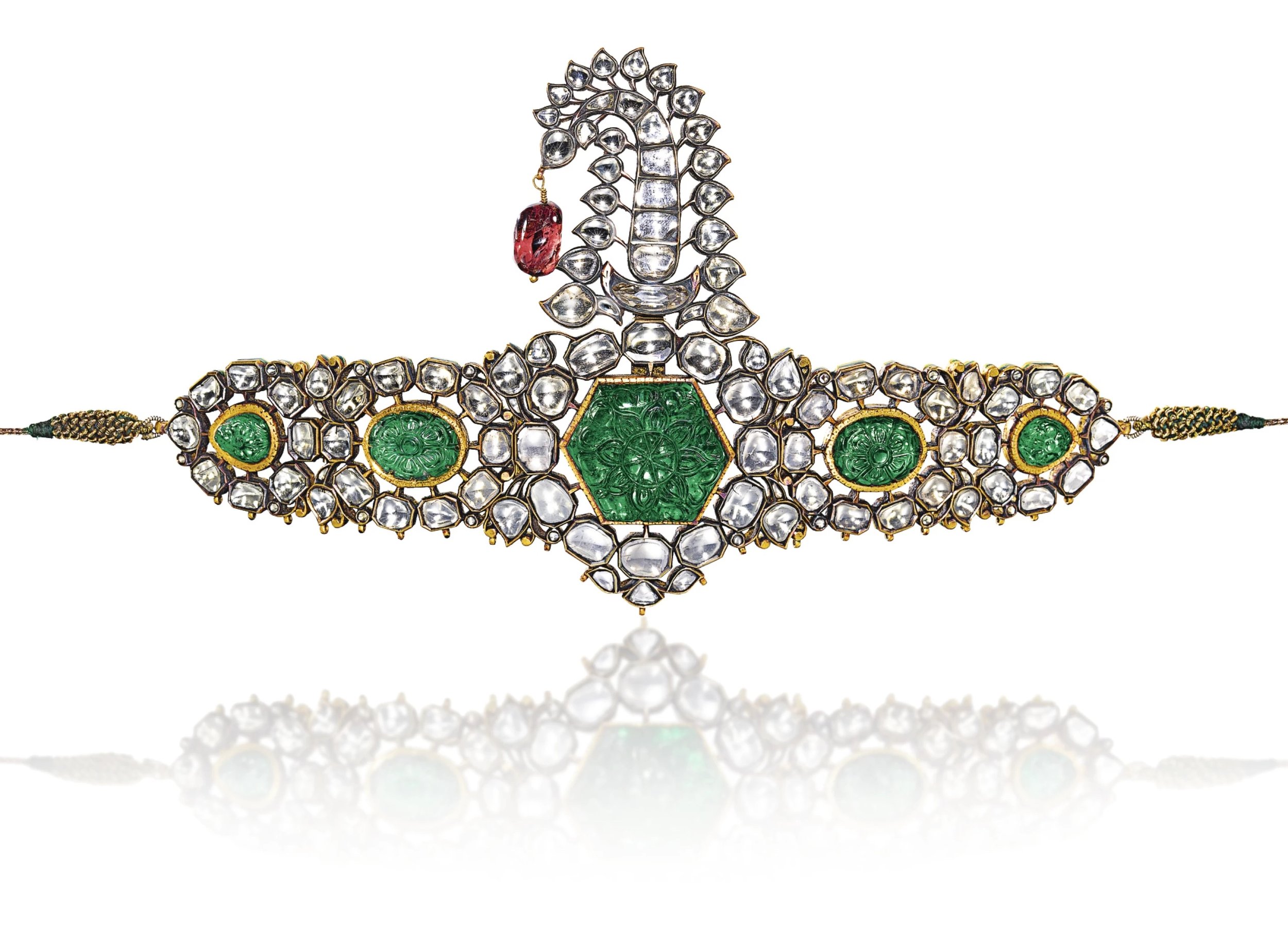
Deccan. 19th century. A gem-set Jigha. The openwork hinged body set with foiled diamonds and a large central octagonal carved emerald between four smaller carved emeralds, topped with a curling jigha and hanging spinel, the reverse with polychrome enamelled floral details and birds, compartment for jigha, suspension cords. Christie’s.

An Indian enamelled and gem-set pendant, Deccan, 17th-18th century, with later pearl chain. Image: Sotheby’s. Rendered in the form of a bird with outstretched wings and tail feathers, the breast mounted with a diamond medallion, gold body and neck set with cabochon rubies and emeralds, the ruby beak, wings and tail feathers with attached drop-pendant pearls, the reverse of the wings and tail decorated with dark blue, green, yellow, red and white enamelling, loops attaching later gold and pearl suspension chains.
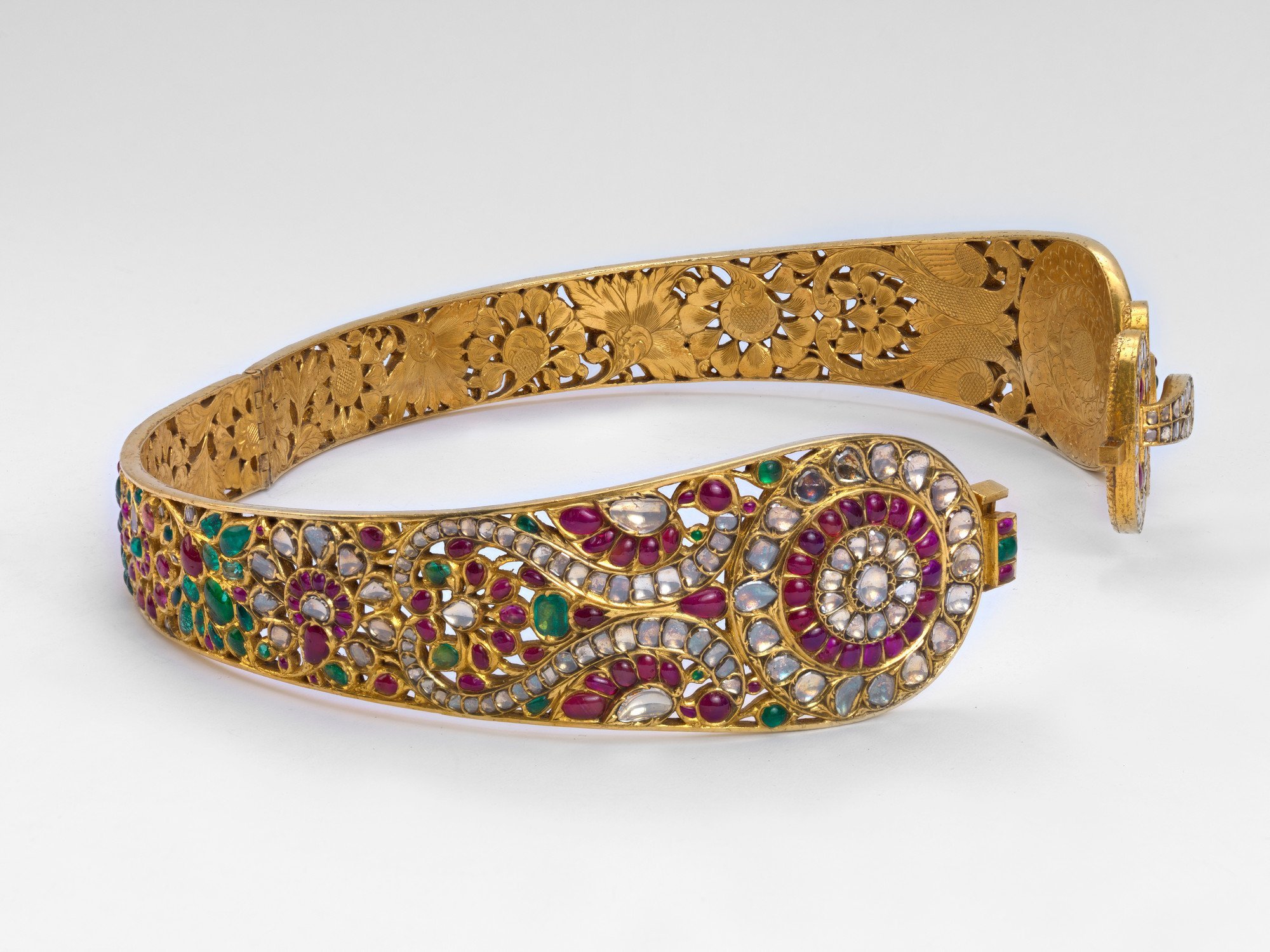
Waist belt mid-nineteenth century or earlier. Gold, diamonds, emeralds and rubies. Presented for Queen Alexandra, when Princess of Wales by Chamarajendra Wadiyar X, Maharaja of Mysore in 1875, during the Prince of Wales's tour of India in 1875-76. A hinged waist belt made of a gold framework inlaid with diamonds, rubies and emeralds. The inner rim of the belt is engraved with patterns of lotuses and peacocks. The front of the belt imitates a buckle, where a small hook that actually holds the two halves of the belt together is concealed. Belts of this type would be worn by women in India, in particular South India. Image: Royal Collection Trust.

The Maharani of Mysore. 60 x 40 inches, hand-painted on canvas by artist Reena Ahluwalia. C. Krishniah Chetty Crystal Museum. Bengaluru, India. Image: ©Reena Ahluwalia. The word Maharani (Sanskrit: महारानी) means great queen or ruler. The painting show a diamond-clad body of Maharani, bejeweled with historically accurate gems and jewels. Meticulously crafted, every inch of the canvas narrates a tale embedded with diamonds, gemstones, and gold.

Three bejewelled royal women from the Court of Mysore in Southern India was painted by Thomas Hickey in circa. 1805. Shown in white sari on right is Rami Lakshmi Ammani, queen of the Wadiyar ruler of Mysore and adoptive grandmother of Krishnaraja Wadiyar III. Credit: Sotheby’s

Detail of repousse gold hair braid ornament, Jadai Nagam. Tamil Nadu. 19th Century. Image: Bonhams.

Dancing Shiva Pendant. Tamil Nadu. 20th century. Image: GIA

Portrait of Rani Mudai, wife of the last Raja of Coorg, Vira Rajendra Wodeyar (1808-62, deposed 1834), with whom the Lingayar dynasty ended. She is dressed in a dark blue choli and a dark red and gold sari. She wears elaborate jewellery and has her hands folder across her waist. Credit: V&A

THE 'INDORE SAPPHIRE' TAVEEZ BEAD PENDANT NECKLACE, MOUNTED BY CARTIER. Oval-shaped sapphire taveez bead of 23.20 carats, 18th century, later added 18k white gold fine link chain. Owned by Maharaja Yeshwant Rao Holkar II of Indore. Image: Christie’s
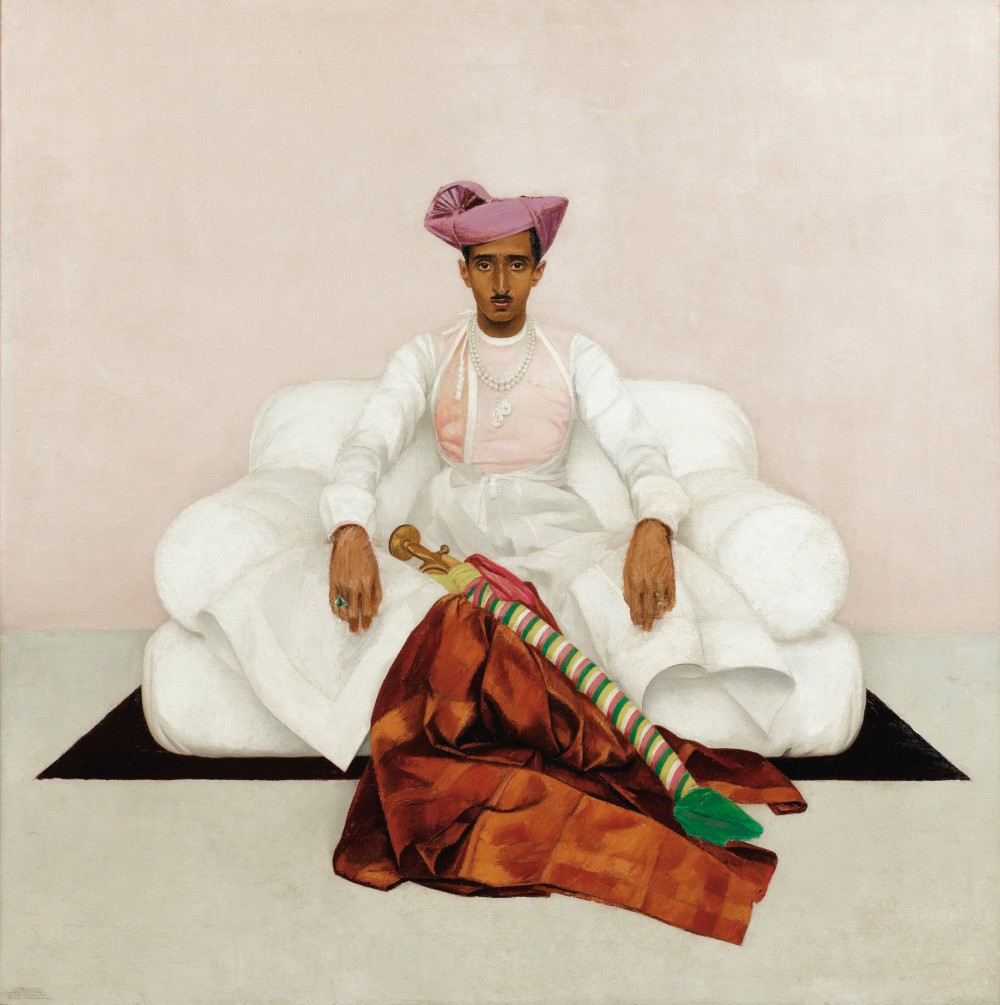
Bernard Boutet de Monvel, The Maharadjah (Maharaja) of Indore, Oil on canvas, 1933. 85 x 85 cm, Estimate : 300.000 – 500.000 € and sold in 2016 for €2,499,000. Image: Sotheby’s. Boutet de Monvel’s depiction of the Oxford-educated Maharajah of Indore, whose likeness was destined for the walls of Manik Bagh, his Indian palace. In this six-foot, stunningly ethereal composition from 1933, the young man, dressed in traditional costume, sits on a white throne against a pale background, the whole brought to vivid life by shots of shimmering colour: a garnet-hued turban on his head, two magnificent 47-carat diamonds (the Pears of Indore) around his neck, along with a luxurious fabric and a striped sabre scabbard at his feet.
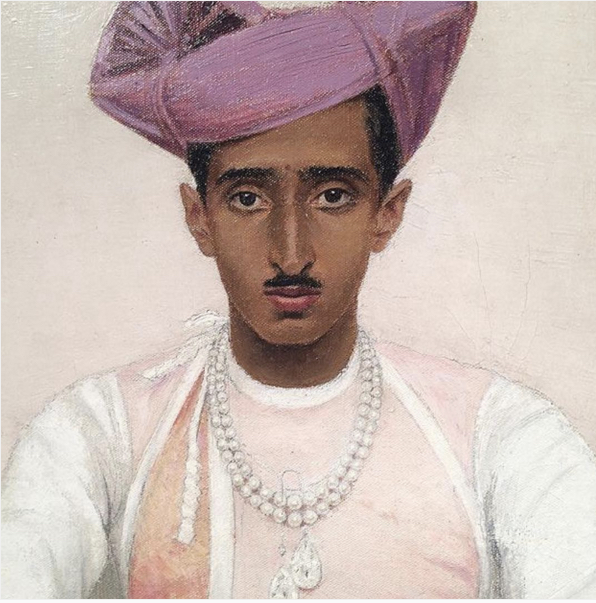
Bernard Boutet de Monvel, The Maharadjah (Maharaja) of Indore, Oil on canvas, 1933. 85 x 85 cm, Estimate : 300.000 – 500.000 € and sold in 2016 for €2,499,000. Image: Sotheby’s. Maharaja is wearing two magnificent 47-carat diamonds (the Pears of Indore) around his neck.

Maharaja Sawai Jai Singh Bahadur of Alwar, born 1882. Besides his traditional Indian ornaments, he wears the star insignia of the Indian orders granted to him by the British (Raj), then considered a part of the royal regalia.

Maharaja Sayaiji-Roa, Gaekwar, Baroda. 1889. Wearing his famous seven row diamond necklace and other diamond ornaments. In the late 19th and early 20th centuries, virtually every Indian Maharaja commissioned state photographs of themselves wearing their most important jewelry as a symbol of their power and position. Image: National Portrait Gallery.

A cross cultural exchange. Miniature painting. National Gallery of Modern Art, New Delhi, India. 1902. Interpreted by an Indian artist (unknown), King Edward VII and Queen Alexandra, depicted as the King-Emperor and Queen-Empress of India.
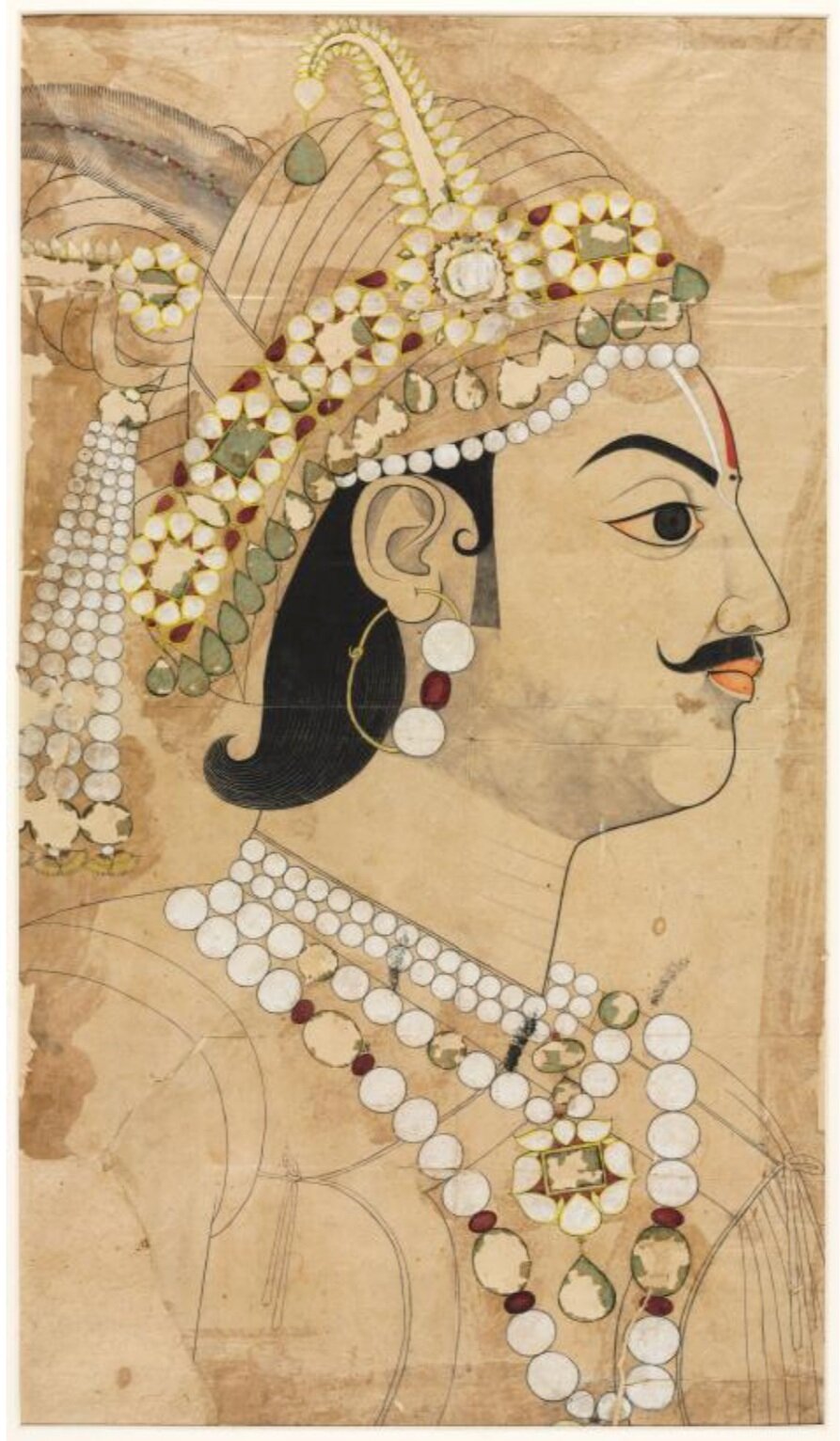
Bejeweled Portrait of Maharaja Pratap Singh (1764–1803). Maharaja Pratap Singh came to the throne in the princely state of Jaipur in 1778 at the age of 14, about 15 years before this portrait was painted. He was a poet and patron of the arts known for commissioning the famous “Palace of the Winds” in Jaipur. At his court he maintained an atelier of about 50 painters, among whom was a Muslim master, Sahib Ram, to whom this painting is attributed. Credit: Cleveland Art

Raja Sawant Singh and Bani Thani (as Krishna and Radha). 1780. Image: Philadelphia Museum of Art.
Kishengarh miniature painting, characterized by exaggerated profiles. Both with traditional Mughal-Rajput-style ornaments consisting of pearls, emeralds and rubies. They wear elaborate robes and precious jewels. Their intricate ornamentation—from the flower on Radha’s forehead to the anklet visible beneath Krishna’s robe—elevates them to royal status, hints at their amorous relationship, and emphasizes their divine identities.
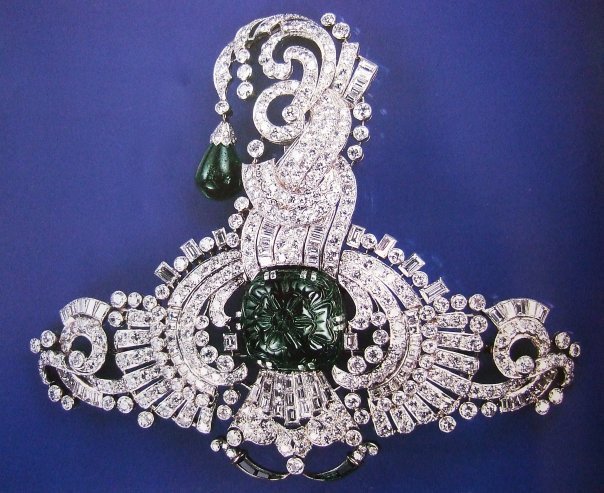
Diamonds and emeralds set in platinum. Aigrette (also known as Sarpech - Turban ornament). Private collection. 1930

The state durbar decorated elephant, with attendants of the Maharaja of Mysore. Royal India.

The Maharajah of Kolhapur.

End of 19th century rendering by Chaumet staff designer, of a proposed ensemble of ornaments for the uniform of a Maharaja. Rendering shows the use of diamonds, emeralds and pearls. Courtesy Chaumet.

1925. Rendering by Charles Jacqueau of Cartier for a headdress ornament for a turban, a project suggested by Maharaja of Kapurthala. Courtesy Cartier.

Jade case, 1700-1800. Jade, rubies, emeralds, diamonds, steel. © V&A Images/Victoria and Albert Museum, London.
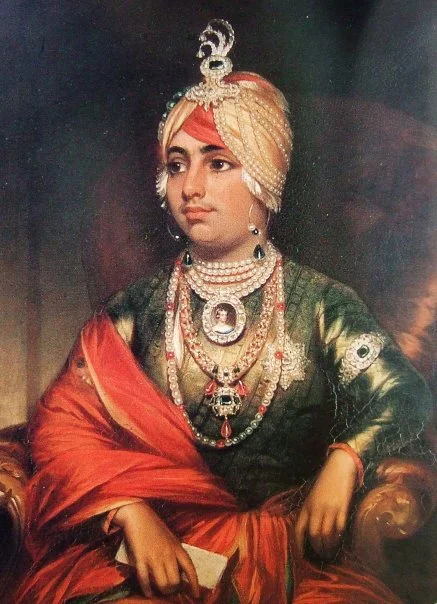
Maharaja Dilip Singh of Lahore. 1852. Portrait by George Beechy. Shown here at age fifteen. Amongst many other jewels, he is wearing a diamond Sarpech (Indian turban ornament) or aigrette with three plumes and a centrally placed emerald.
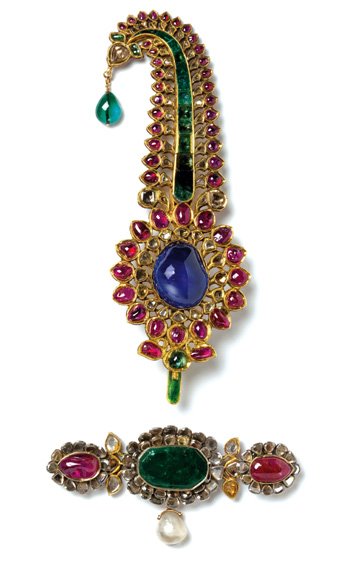
Turban ornament- gold, diamonds, rubies, emeralds, sapphire, pearl. Image: V&A

The Maharaja of Darbhanga. Royal India.

The Maharaja of Alwar. (1882-1937). Royal India.
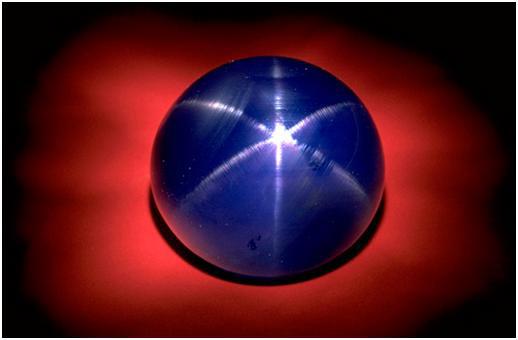
Renowned for its impressive size, intense color and sharp star, the Star of Asia, which weighs 330 carats, is one of the world’s finest star sapphires. It originated from Burma and is said to have belonged to India’s Maharajah of Jodhpur. Photo by Chip Clark

The Maharaja of Jammu & Kashmir. Royal India.

The Maharana of Udaipur. Royal India.

Emerald necklace & pendant that belonged to Maharani Prem Kumari, wife of the Maharaja of Kapurthala. 1910

Sprays of flowers turban jewel. Once belonged to the Maharaja of Jaipur. The aigrette is set with rubies, emeralds and pale beryls on one side, and the same stones with the addition of diamonds on the other. The stem and the sides of the jewel are enamelled in translucent green.

Prince, The Gaekwar of Baroda. Princely India.
Diamond necklace made to display both the 128.48-carat "Star of the South" and the 78.5-carat "English Dresden" below it. Royal India.

Portrait of Raja Jagat Singh of Nurpur (reigned 1618-46) probably 1619 attributed to Bichitr. Credit: Cleveland Art
In the past I have authored posts on, Bejeweled Maharaja & Maharani of Mysore, Koh-i-Noor Diamond, Diamonds on World Postage Stamps, Top Ten - Largest Diamonds Discovered In The World, Splendors of Mughal India, The Magnificent Maharajas Of India, Mystery & History Of Marquise Diamond Cut, Ór - Ireland's Gold, The Legendary Cullinan Diamond, Bejeweled Persia - Historic Jewelry From The Qajar Dynasty, Famous Heart-Shaped Diamonds, Type II Diamonds, Green Diamonds, Red Diamonds and more. Over years, I have spent countless hours in self-driven studies on diamond, jewelry history and research. I wrote these blogs for a simple reason - to share my collected knowledge with all who are interested, so that more can benefit from it. Take a look and enjoy! -- Reena
Quisque iaculis facilisis lacinia. Mauris euismod pellentesque tellus sit amet mollis.